
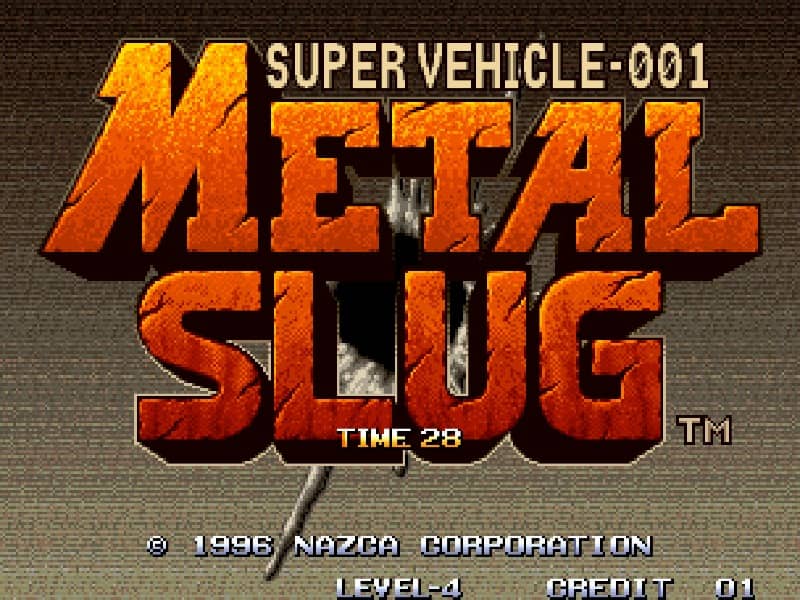
Gameplay and design
The core gameplay of Metal Slug is side-scrolling shooting, where players control a character moving forward and shooting enemies along the way. The controls are simple, with only movement, jumping, shooting, and grenade throwing, but the feel is smooth and the pace is tight. Players can pick up weapon upgrades dropped by enemies, including heavy machine guns, shotguns, flamethrowers, and more, each with different trajectories and power, and switching weapons strategically is key to clearing levels.
The game's most iconic feature is the SV-001 tank vehicle, which players can enter to gain stronger firepower and protection. The tank's main cannon and machine gun can fire simultaneously, and it can also crush enemies, but it will explode after taking a certain amount of damage, forcing players to bail out in time. The inclusion of the tank not only changes the combat style but also adds to the game's fun, becoming a signature element of the series.
Rescuing prisoners of war (POWs) is another important mechanic. POWs are scattered throughout the levels, and players can free them by getting close, after which they provide random items or weapons, and sometimes help attack enemies. At the end of a level, bonus points are awarded based on the number of POWs rescued. This mechanic encourages exploration and adds strategic depth and replay value.
The game consists of six missions, with settings including forests, cities, snowy mountains, canyons, and military bases, each with unique enemies and bosses. The enemy designs are full of humor, such as sunbathing or grilling meat, and they scream and run away or fight back when they spot the player. This lighthearted and comedic style contrasts sharply with the intense combat, adding to the game's charm.
The game features a one-hit death system, where players lose a life if hit by a bullet or fall into a pit, but touching enemies does not kill them. This design increases the challenge, requiring precise control and quick reflexes. The difficulty is high, but through repeated attempts and memorizing enemy positions, players can gradually master the rhythm and gain a sense of accomplishment.
Background and release
Metal Slug is set in 2028, where players take on the roles of Marco Rossi and Tarma Roving, soldiers of the Peregrine Falcon Strike Force, fighting against the rebel army led by General Donald Morden. The rebels stage a coup to overthrow the world government, and players must infiltrate enemy territory to thwart their plans. The story is simple, but through in-level cutscenes and enemy behavior, it creates a strong war atmosphere.
The game was first showcased at the Amusement Machine Show in Osaka, Japan, from September 13 to 15, 1995, featuring protagonists Phil Gene and Michiko Nakajima from the Regular Army, driving the SV-001 and SV-002 prototype tanks. The early version differed significantly from the final release, with different character and tank designs, but the core side-scrolling shooting gameplay was already established.
After extensive revisions, the game was officially released on the Neo Geo MVS arcade system on April 19, 1996, and on the Neo Geo AES home console on May 24. The arcade version was the initial platform, and the AES version preserved all content from the arcade version but was expensive, especially in North America, where it has become one of the most costly games for the platform.
On July 5, 1996, a Neo Geo CD version was released, adding a 'Combat School' mode that allowed players to replay cleared levels with new objectives. In 1997, the game was ported to the Sega Saturn and PlayStation in Japan on April 4 and August 7, respectively. The Saturn version, developed by SNK, used new compression technology and a 1MB RAM expansion cartridge to retain the arcade version's animation; the PlayStation version, developed by Ukiyotei, included an 'Another Story' mode and an art gallery.
The game was successful in the arcade market; on June 1, 1996, Japanese magazine Game Machine listed it as the seventh most popular arcade game of the past two weeks, and in the United States, it was one of the top ten highest-grossing arcade games of 1996. Despite mixed reviews, its commercial success laid the foundation for the subsequent series.
Development
The development team behind Metal Slug came from Irem, where they had worked on shooters like In the Hunt and GunForce II. After leaving Irem, they formed Nazca and began developing this game. The experience they gained at Irem, particularly in shooter design, had a lasting influence on Metal Slug's gameplay.
The initial design concept was for players to control tanks in combat, with a slower pace, shorter levels, and a darker atmosphere. The team aimed to create a simple yet thrilling side-scrolling shooter with simple controls, and the visual inspiration came from the works of Hayao Miyazaki. However, during a location test in Osaka, player feedback was poor, prompting the team to make major revisions to the project.
SNK, as the publisher, requested a longer game with more content. The team adjusted the design, shifting the focus from tank driving to soldier shooting and adding platforming elements. This change made the game faster-paced and more action-packed, better suiting arcade players' preferences. The final version was quite different from the original concept, but these adjustments were key to its success.
The hand-drawn animation was a highlight of development, with the team investing significant effort into creating smooth animations for characters and enemies. This hand-drawn style was striking at the time and gave the game a unique visual appeal. Humor was also deliberately incorporated, such as enemies sunbathing or grilling meat, to add levity to the intense combat, and this design became a hallmark of the series.
During development, the team faced technical challenges, such as achieving smooth animation and handling numerous enemies on Neo Geo hardware. They optimized code and used compression techniques to deliver impressive visuals within the hardware's limits. These technical achievements also laid the groundwork for future titles.
Reception and legacy
Metal Slug received mixed reviews upon release. Critics generally praised its humor and smooth hand-drawn animation, considering them rare highlights in arcade games at the time. However, many reviews criticized the game's short length, lack of replay value, and unfair difficulty, with the one-hit death system frustrating some players.
Despite the divided reviews, the game performed well in the arcade market. It was one of the top ten highest-grossing arcade games of 1996, gaining recognition from players in both Japan and the United States. The contrast between arcade player feedback and media reviews suggests the game appealed to core players, with its fast pace and humor being particularly popular in arcades.
The game's success spawned numerous sequels and spin-offs, including Metal Slug 2 in 1998 and subsequent series entries. These titles continued the original's gameplay and style while introducing new elements, making the series a classic representative of the run-and-gun genre. The original's design concepts, such as tank vehicles, POW rescues, and humorous enemies, became signature features of the series.
Metal Slug has also been included in several compilations, such as Metal Slug Anthology in 2006 and SNK Arcade Classics Vol. 1 in 2008, allowing new players to experience the classic. Additionally, the game has been re-released multiple times, including on the Wii Virtual Console in 2008, the PlayStation Network's NEOGEO Station service in 2010, and iOS and Android platforms in 2012.
From December 2016 to March 2017, Hamster Corporation re-released the game under the Arcade Archives series on PlayStation 4, Xbox One, and Nintendo Switch, allowing modern players to enjoy the authentic arcade version on current platforms. These ports and re-releases demonstrate the game's enduring appeal and solidify its place in gaming history.





