
Gameplay and design
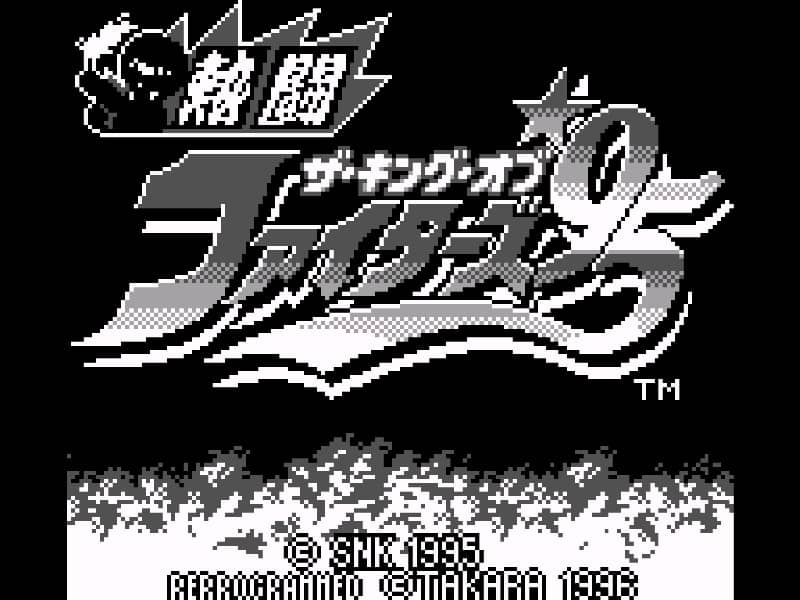
Nettou The King of Fighters '95 recreates the arcade version's 3-on-3 team battles on the Game Boy, but due to the handheld's hardware limitations, both the graphics and controls are simplified. Characters appear in a chibi cartoon style, and while the moves and techniques are not as extensive as in the arcade version, the core fighting experience remains intact. Players take turns sending out three fighters to battle, and victory is achieved by defeating all of the opponent's characters, preserving the tension of team combat on the handheld.
The game supports the Super Game Boy, allowing players to enjoy it in color on a television, which somewhat compensates for the limitations of the handheld screen. Additionally, the game introduces Nakoruru from the Samurai Shodown series as a hidden character, unlockable through specific conditions, providing extra challenge and fun. The inclusion of a hidden character is exclusive to the handheld version and serves as a highlight that encourages repeated play.
The team editing system, a core new feature of The King of Fighters '95, is also present in the handheld version. Players can freely choose three characters to form a team before each match and adjust their order, adding strategic depth. Although the limited character roster in the handheld version reduces the depth of team editing compared to the arcade, it still allows players to tailor their lineup based on preference and tactics, reflecting the original design philosophy.
In terms of controls, the Game Boy's limited buttons led to simplified command inputs, with some complex special moves being streamlined or adjusted to fit the handheld's operation. While the feel differs from the arcade version, the game still strives to capture the basic rhythm of attack and defense in fighting games. For handheld players, being able to experience the fun of The King of Fighters on a portable device is already a rare treat.
The AI difficulty in Nettou The King of Fighters '95 is moderate, and the game offers multiple modes, including single-player challenge and versus modes. Due to hardware constraints, the game lacks the arcade version's flashy cutscenes and voice, but through pixel animation and simple sound effects, it still creates a tense battle atmosphere. Overall, this handheld version makes reasonable trade-offs in gameplay, preserving the essence of the original while adapting to the handheld's characteristics.
Background and release
The King of Fighters '95 is the second entry in SNK's fighting game series, released on arcade platforms on July 25, 1995. As a sequel to The King of Fighters '94, this installment introduced the popular character Iori Yagami for the first time and added a team editing system that allowed players to freely form teams, an innovation that became a hallmark of the series. In the story, Rugal Bernstein once again hosts the KOF tournament and appears as the final boss, adding a sense of fated rivalry to the narrative.
The King of Fighters '95 was the first game in the series to be ported to home consoles beyond the Neo Geo AES and CD, including the PlayStation, Sega Saturn, and Game Boy. This move expanded the game's audience, allowing more players to access this classic fighter. Among these, the Game Boy version, Nettou The King of Fighters '95, was released in 1996, developed by TAKARA, published by TAKARA in Japan and by Nintendo in North America, reflecting a trend of cross-platform collaboration.
As a handheld adaptation, Nettou The King of Fighters '95 is not a direct port of the arcade original but was redesigned for the Game Boy's hardware. The graphics shifted from the original's realistic style to a chibi cartoon style, with characters and systems adjusted to fit the handheld's performance and screen. This adaptation approach was common at the time, aiming to provide handheld players with an experience close to the original while leveraging the portability of the handheld.
Among the multi-platform ports of The King of Fighters '95, the Game Boy version is particularly distinctive. Developed by TAKARA, it differs from other versions developed by SNK itself, resulting in variations in content and style. Despite the hardware limitations leading to simplified graphics and controls, the game retains the core gameplay of the original and adds exclusive content like hidden characters, making it a unique title among handheld fighting games.
The story of The King of Fighters '95 continues the series' worldview, with Kyo Kusanagi's father, Saisyu Kusanagi, appearing as a mid-boss who is brainwashed by Rugal, adding dramatic depth to the narrative. The final boss, Omega Rugal, is designed with a commanding presence, featuring a muscular build, white hair, a mechanical right arm and eye, and an Omega tattoo on his back, becoming a classic villain in the series. These elements, though simplified in the handheld version, are still conveyed through character selection and background settings.
Development
The King of Fighters '95 was directed by Masanori Kuwasaki, who also directed the previous installment, The King of Fighters '94. The development team faced time constraints during production, leading to the cutting of some elements, and initially planned to release it as a remake of The King of Fighters '94, but it ultimately became a sequel. This background explains the continuity and innovation in the game's systems; the team editing system was proposed by the director and consulted with producer Takashi Nishiyama, reflecting the team's emphasis on gameplay innovation.
The development team considered adding characters from Samurai Shodown but abandoned the idea due to balance and weapon issues. This decision reflects SNK's strict control over game balance and makes the character roster of The King of Fighters '95 more focused. However, in the Game Boy version, Nettou The King of Fighters '95, Nakoruru appears as a hidden character, possibly a unique adjustment made by TAKARA during adaptation, adding freshness to the handheld version.
Nettou The King of Fighters '95 was developed by TAKARA, a company known for producing handheld games and skilled at achieving smooth action on limited hardware. To suit the Game Boy's screen and performance, the game adopted a chibi art style with cute character designs and simplified movements, while still retaining the impact of fighting game hits. This adaptation strategy not only reduced technical difficulty but also appealed to handheld players' aesthetics.
During development, TAKARA likely referenced the arcade version's assets and designs but optimized them for the handheld. For example, character animation frames were reduced, and special move effects were simplified, but the core fighting logic was preserved. Additionally, the game supports the Super Game Boy, requiring extra compatibility design, demonstrating the development team's full utilization of hardware features.
The release strategy for Nettou The King of Fighters '95 is also noteworthy: it was published by TAKARA in Japan and by Nintendo in North America, a collaboration that helped promote the game in the North American market. Although specific sales figures are not mentioned, as part of the multi-platform ports of The King of Fighters '95, this title showcases the extension of SNK's works to portable platforms and also provides a reference for subsequent handheld fighting games.
Reception and legacy
The King of Fighters '95 achieved success on arcade platforms, being ranked as the second most successful arcade game of the month by Game Machine magazine in September 1995. Its Neo Geo AES version won the Electronic Gaming Monthly 1995 Best Neo Geo Game award, proving the high quality of the original. These achievements laid the foundation for subsequent ports, and home console versions, including the Game Boy version, benefited from the original's reputation.
Omega Rugal from The King of Fighters '95 became a classic boss in the series, making multiple returns in titles like The King of Fighters '98, demonstrating the success of his character design. This villain left a deep impression, and although the handheld version's story presentation is limited, the boss's presence still adds to the game's challenge.
Game designer Masahiro Sakurai has cited The King of Fighters '95 as one of his favorite competitive experiences, which influenced his thinking on the accessibility of fighting games. This comment reflects the game's standing in fighting game history, and while Nettou The King of Fighters '95 had limited influence as a handheld adaptation, it allowed more players to encounter this classic series.
As a handheld adaptation, Nettou The King of Fighters '95 demonstrates the extension of SNK's works to portable platforms. Despite hardware limitations leading to simplified graphics and controls, the game retains the core gameplay of the original and adds exclusive content like hidden characters, providing a unique experience for handheld players. This adaptation approach was common at the time and also served as a reference for later handheld fighting games.
Overall, Nettou The King of Fighters '95 is a special version among the multi-platform ports of The King of Fighters '95. Through its chibi art style and simplified systems, it allows handheld players to enjoy the fun of The King of Fighters. Although specific review data is limited, as a handheld fighting game, it holds a place in the series' history and is a microcosm of SNK's cross-platform dissemination.





