
Gameplay and design
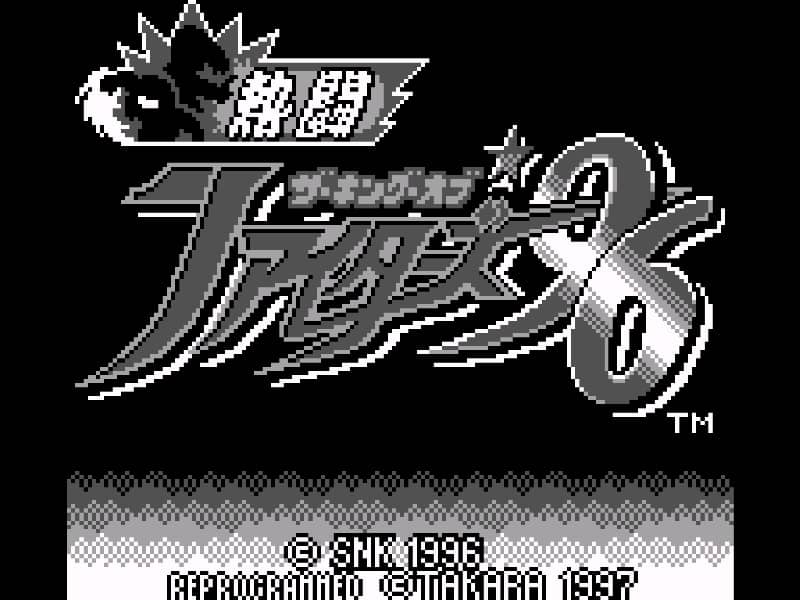
As a fighting game on the Game Boy, Nettou The King of Fighters '96 naturally couldn't replicate the grand spectacle of the arcade original. TAKARA's approach was to render all characters in a chibi style, giving them a round, cute look that fits the handheld's lighthearted vibe. The battles remain 3-on-3 team fights, but the pace and scale are simplified, since the small screen and limited buttons can't support the high-speed offense and defense of the arcade version.
The most distinctive feature is the Carnage mode. This mode is unlocked via a secret code, and once activated, both the player's and the computer's power gauges are automatically filled and don't require charging. This means you can unleash super special moves at any time, including the powerful versions that normally require low health. The battles quickly become a chaotic barrage of super moves, delivering a satisfying rush, though balance takes a backseat.
Beyond Carnage mode, the Game Boy version includes several exclusive characters, which was a big surprise at the time. Orochi Iori and Orochi Leona from The King of Fighters '97, a powered-up Chizuru Kagura, the final boss Goenitz, and an alternate identity of Takuma Sakazaki, the 'Invincible Dragon', are all playable. These characters give the handheld version its own unique selling points and satisfy players eager to try out new characters early.
In terms of controls, the Game Boy only has two buttons, so command inputs were adjusted accordingly. While you can't pull off complex combos like in the arcade, basic punches, kicks, special moves, and super special moves are all preserved. For handheld players, being able to enjoy a fighting game on the go was already a luxurious experience. The game also supports versus mode, allowing you to battle friends.
Overall, the core of Nettou The King of Fighters '96 is to recreate the fun of KOF on a handheld. It doesn't aim for the completeness of the arcade version; instead, through chibi graphics, simplified systems, and exclusive content, it finds a path suited to the handheld. Carnage mode amplifies the thrill of fighting games to the extreme, letting players easily experience the joy of unleashing super moves.
Background and release
To talk about Nettou The King of Fighters '96, we must first mention its source material, the arcade version of The King of Fighters '96. This game was the third entry in the series, released by SNK on July 30, 1996, two years after the original The King of Fighters '94. Story-wise, it continues the Orochi saga, with Chizuru Kagura hosting a new KOF tournament to counter the impending revival of the Orochi clan.
The final boss of the arcade version is Goenitz, a servant of Orochi and a key character in the Orochi saga. The story of this installment serves as a bridge in the series, resolving some plot threads from the previous game while setting the stage for the final showdown with Orochi in The King of Fighters '97. For players who appreciate the narrative, this entry holds significant importance.
In terms of systems, the arcade version introduced several innovations. It was the first to feature an emergency evasion move, as well as short hops and mid jumps, which sped up the combat. Players could now dash to close in on opponents, whereas in the previous game, they could only approach by jumping. These changes made battles more flexible and visually engaging, laying the groundwork for future installments.
The character roster also saw adjustments. Leona replaced Heidern in the Ikari team, Kasumi Todoh joined the Women Fighters team, and Mature and Vice teamed up with Iori Yagami to form the Yagami team. The Boss team consisted of Geese, Krauser, and Big, drawn from Fatal Fury and Art of Fighting. Chizuru Kagura and Goenitz were also available as hidden characters.
The arcade version performed well commercially, with the AES version selling over 30,000 copies in its first week, and the Sega Saturn version also selling decently. It was even named Neo Geo Game of the Year by Electronic Gaming Monthly. It's fair to say this installment earned recognition from both players and the press, providing a solid foundation for the subsequent handheld adaptation.
Development
The arcade version of The King of Fighters '96 took a year to develop, while the original The King of Fighters '94 took two. Although the time was shorter, the development process was not easy. SNK staff were still making adjustments right up to the scheduled release date, indicating that the system changes required considerable effort. Director Masanori Kuwasaki was in charge of the Orochi saga's story, drawing inspiration from the Japanese myth of Yamata no Orochi to give the narrative a mythological flavor.
Technically, the arcade version was the first in the series to break the MVS system's limits, using 362 megabits of memory. This was a significant breakthrough at the time, allowing the game to include more characters and animations. However, this was also the last game directed by Kuwasaki, as the director role was later taken over by Yutaka Tanabe.
On the handheld side, TAKARA took on the adaptation. They had prior experience with the Nettou series, having developed fighting games for the Game Boy. The biggest challenge in adapting The King of Fighters '96 was recreating the KOF experience on limited hardware. The chibi style was a smart choice, saving resources while adding cuteness.
TAKARA included exclusive characters during development, such as Orochi Iori and Orochi Leona, who originally appeared in The King of Fighters '97. This was likely to give handheld players something fresh and to differentiate the game from the arcade version. The addition of Carnage mode was more of an experimental gameplay feature, allowing players to experience a different battle tempo.
The game was released in Japan on August 8, 1997, and later in Europe in 1998 under the name The King of Fighters: Heat of Battle. Although there isn't much public information about the development details, the final product shows that TAKARA made considerable efforts under limited conditions, giving this handheld fighting game its own identity.
Reception and legacy
As a handheld adaptation, Nettou The King of Fighters '96 received a fairly positive reception among players. It didn't feel cheap despite hardware limitations; instead, the chibi characters and exclusive content conveyed the development team's dedication. For players who didn't have access to arcades at the time, this game was an important gateway to the KOF series.
From a series perspective, the arcade version of The King of Fighters '96 laid many foundations for subsequent titles. The emergency evasion and short hops it introduced became signature KOF mechanics. Characters like Leona and Chizuru Kagura became series regulars, remaining active in later installments. It's safe to say this entry holds an important place in the series' history.
While the Game Boy version's influence was less than the arcade's, it helped popularize the KOF series on portable platforms. In an era before mobile gaming, being able to play a fighting game on a handheld was itself a cool thing. TAKARA's Nettou series thus accumulated a fanbase and provided a reference for future handheld fighting games.
Carnage mode, despite being unbalanced, added a lot of fun to the game. Players could easily unleash various super moves and experience that thrill. Similar modes have appeared in other games since, making it an interesting experiment.
In summary, Nettou The King of Fighters '96 is a sincere handheld adaptation. It may not be perfect, but it carved out its own identity within constraints, leaving a lasting impression. For veteran KOF fans, this game carries many memories and serves as a snapshot of handheld gaming from that era.





