
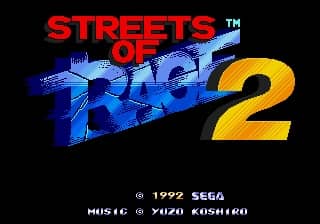
Gameplay and design
The core gameplay of Streets of Rage 2 remains side-scrolling beat 'em up, where players fight through street scenes, taking on hordes of minions and powerful bosses. The game supports one or two players in cooperative play, allowing them to pick up weapons like pipes and knives, and use environmental props like barrels. Compared to the original, this installment adds several enhancements to the action system, most notably the introduction of Blitz Attacks and Special Attacks that consume health, offering more strategic choices in combat.
The two new characters add more variety to the roster. Max Thunder is a big guy with high attack power but slow speed, specializing in throws; Eddie "Skate" Hunter is Adam's younger brother, young but agile, skilled in slides and rapid combos. The returning characters Axel and Blaze remain effective but have their own strengths. Each character has different normal moves, special moves, and movement speeds, allowing players to choose based on preference and adding freshness to replayability.
Special Attacks are a highlight of this generation. Pressing the attack and jump buttons together triggers them, dealing heavy damage but costing a bit of health. This design gives players a chance to turn the tide in critical moments, but requires weighing risks, as health is precious. Blitz Attacks are attacks performed during a dash, allowing quick approach or escape; they are simple but practical. These mechanics make the combat faster-paced and more timing-oriented than the original.
The game also introduces a Duel mode for the first time, allowing two players to battle each other on the same machine. Though simple, this mode adds competitive fun beyond cooperation and increases longevity. Additionally, the game supports Sega's Sega Activator peripheral, a wearable sensor device that controls characters through body movements. While the actual experience was mediocre, it reflects Sega's experimentation with motion controls at the time.
Overall, the level design in Streets of Rage 2 is also well-crafted, with varied environments from night streets to docks, factories, and skyscrapers, and a diverse array of enemies and bosses. The difficulty curve is reasonable, but later stages demand significantly higher precision and resource management. The game lacks complex progression systems, relying purely on player skill and character choice to differentiate experiences, which is the charm of straightforward beat 'em up gameplay.
Background and release
Streets of Rage 2 is the sequel to Streets of Rage, with the story picking up right after the original. At the end of the first game, Axel, Blaze, and Adam defeated the crime lord Mr. X, and the city briefly returned to peace. But a year later, Mr. X returns and kidnaps Adam. Axel, Blaze, Skate, and Max form a rescue team and embark on a new battle journey. This simple plot provides clear motivation for the game and enhances player immersion.
This installment holds a special place in the series, with many players considering it the best. Compared to the original, it shows significant improvements in graphics, music, and systems, while compared to the later third installment, it retains a purer beat 'em up experience. The game has a single ending: defeating Mr. X and rescuing Adam, after which the heroes leave by helicopter. This linear narrative is uncommon in the series, giving the ending more weight.
Released in 1992, the game came during the golden age of 16-bit beat 'em ups. Sega had already built a solid reputation for action games on the Mega Drive, and Streets of Rage 2 quickly spread among players thanks to its solid feel and outstanding audiovisual presentation. It was not only a highly anticipated title for series fans but also attracted many newcomers.
The Japanese and Western versions differ in title: the Japanese version is called Bare Knuckle II, while the Western versions are called Streets of Rage 2. The Japanese version has the subtitle "Requiem for the Deadly Battle," which the Western versions lack. Such naming differences were common in Japanese games of the time, but this title also has several content differences, such as character names and some visual details.
The game has been ported and remade on multiple platforms. The 8-bit Master System and Game Gear versions differ significantly from the Mega Drive original, even lacking the character Max. Later, the game was included in several compilations, such as Sega Smash Pack for Dreamcast, Sonic Gems Collection for PS2, and later Sonic's Ultimate Genesis Collection and Sega Genesis Classics. In 2007, it also appeared on Virtual Console and Xbox Live Arcade, allowing new players to experience it.
Development
The development team for Streets of Rage 2 was unusual, not a fixed internal Sega group, but a temporary collaboration among several companies including Sega, Ancient, Shout! Design Works, MNM Software, and H.I.C. This kind of collaboration was not uncommon at the time, but the team composition was quite complex, bringing diverse creative perspectives. Among them, Ayano Koshiro from Ancient served as lead graphic designer and one of the game design planners, while her brother Yuzo Koshiro composed the music.
Yuzo Koshiro's soundtrack is a major highlight of the game. He used an NEC PC-8801 computer and a self-created programming language to compose the music, which was quite avant-garde at the time. The soundtrack blends electronic dance genres like house, techno, hardcore techno, and breakbeat, with strong rhythms and catchy melodies that perfectly match the street-fighting atmosphere. Three tracks were contributed by Motohiro Kawashima, but the overall style remains cohesive.
The game's development was also influenced by Capcom's Street Fighter II. That arcade fighting game was a huge hit in 1991, and its depth in combat systems and character differentiation inspired the development team. As a result, this installment focuses more on character individuality and move variety rather than simply increasing enemy numbers. This borrowing integrated fighting game concepts into the beat 'em up genre, enhancing the spectacle and strategic depth of combat.
On the technical side, the game was programmed by the same team as the original, but they improved the Mega Drive cartridge specifications, adding memory and features, enabling richer graphics and sound. For example, character sprites are larger, animations are smoother, and background details are more abundant. These improvements elevate the visual quality a notch above the original, showcasing the team's ability to exploit the hardware's potential.
Version differences were also a topic during production. In the North American version, Blaze's flying kick sprite was slightly modified to reduce exposure; in the Japanese version, a scene of Mr. X smoking a cigar was removed in Western versions. Character names also differ: in Japan, Skate is called Sammy, while in Western versions he is Eddie; in Europe, Max's surname is Hatchett, while in North America and Japan it is Thunder. These adjustments reflect different market censorship and localization practices.
Reception and legacy
Streets of Rage 2 received widespread acclaim upon release. GamePro gave it a perfect score, and GameFan's four reviewers gave scores of 97, 95, 97, and 97. The game also won the Mega Game award from Mean Machines Sega and the Smash award from Sega Force, and GameFan's Golden Megawards honored it with Best Game, Best Action Fighting Game, and Best Game Music. These awards and scores were significant at the time and established the game's reputation.
Commercially, the game performed strongly. In North America, it was among the top five Genesis sellers in December 1992; in Japan, it was the top-selling Mega Drive game in January 1993; in Europe, it was the third best-seller from 1992 to early 1993, and in the UK it topped both the all-formats and Mega Drive charts at launch. While exact figures were not disclosed, it clearly enjoyed popularity in major markets.
The soundtrack, in particular, has been praised by later generations and is regarded as one of the greatest game soundtracks of all time. Yuzo Koshiro's electronic dance style not only influenced later game music but also led to him being invited to DJ at nightclubs, which was rare at the time. Many players can still hum those melodies years later, a testament to the soundtrack's enduring appeal.
The game's standing among players and media has remained high. Retro Gamer readers voted it the 64th best retro game in 2004, and outlets like Stuff, NowGamer, and BuzzFeed have listed it among the best games ever. While such rankings are subjective, they reflect the game's long-term reputation among players. It is often compared to contemporaries like Final Fight and Double Dragon, and Streets of Rage 2 often stands out.
The game's ports and remakes on multiple platforms have also extended its influence. In 2015, M2 developed a 3D version, 3D Streets of Rage 2, released in Japan and globally, adding modes like Rage Relay and Casual Mode, allowing veterans to revisit and newcomers to ease in. Additionally, the game has been included in several Sega classic compilations, ensuring it won't disappear with hardware generations. In short, Streets of Rage 2 is not only the peak of the series but also a milestone in the history of beat 'em up games.





