
Gameplay and design
Streets of Rage 3 builds on the series' foundation by adding dash and side-roll moves, making character movement more agile. Players can quickly close in on enemies or dodge attacks, noticeably speeding up combat. All characters can run, and with the new dash attacks, combos and positioning gain more variety. These new moves aren't just for show; they genuinely change the approach to brawler combat, giving players more proactive options in the heat of battle.
The timer above the health bar has been replaced by a charge gauge, one of the game's most distinctive features. The gauge fills automatically over time, and when full, using a special attack consumes the entire gauge instead of health. This mechanic encourages players to save up for a powerful special move at critical moments, while also limiting the frequency of regular specials, requiring careful timing.
The weapon system now includes durability; each weapon has a set number of uses before it breaks. This changes the previous habit of unlimited weapon use, making players value their weapons more. Additionally, some hidden characters, like the kangaroo Vicky, cannot use weapons, forcing players to rely entirely on hand-to-hand combat, which adds to the challenge.
Level design introduces branching paths, where player performance in certain stages affects the route and the final ending. The game has four endings, depending on the chosen difficulty and the time taken to complete certain stages. This design gives players an incentive to replay the game to see different routes and endings, increasing replay value. The branching paths aren't just cosmetic; they offer different scenarios and enemy configurations, keeping each playthrough fresh.
Hidden characters are a major highlight. In the Japanese version, players can use Shiva, Vicky the kangaroo, and Ash via a cheat code, while the overseas version only allows the first two. These hidden characters have unique moves, such as Shiva's rapid combos and Vicky's jumping attacks, offering a different experience from the regular cast. The unlock method is quite obscure, requiring specific input on the title screen, a common practice in the cheat code culture of the time.
Background and release
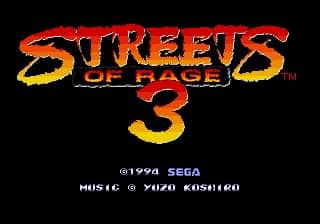
Streets of Rage 3 was first released in North America on March 17, 1994, followed by Japan the next day, and Europe in June. As the third game in the series, it continues the side-scrolling beat 'em up gameplay of its predecessors but introduces bold innovations in story and systems. Published by Sega for the Mega Drive/Genesis, it is a representative title of 16-bit action games.
The Japanese and overseas versions have fundamental differences in story. The Japanese version, Bare Knuckle III, revolves around a new explosive called "Raxine," which villains plan to use to overthrow the city. The overseas version, however, changes the plot to a conspiracy involving robots replacing government officials, shifting the focus to artificial intelligence and mechanical rebellion. This alteration affects the overall tone, with the Japanese version closer to realistic crime and the overseas version leaning toward sci-fi thriller.
The overseas version also made several content cuts and adjustments. Most notably, the gay character Ash was removed, and female enemies' outfits were made more conservative. Additionally, Axel and Skate's clothing colors were changed, and Blaze's outfit became white. These changes reflect the censorship standards of different regions at the time and sparked discussions about localization policies.
The difficulty adjustment is one of the most controversial changes in the overseas version. The normal difficulty in the overseas version is higher than the Japanese version's hard difficulty, and the easy difficulty cannot be completed, causing many players to face frustration early on. This increase may have been to extend playtime, but it also felt unfair to some. In contrast, the Japanese version's difficulty curve is more balanced, catering to players of different skill levels.
Within the series, Streets of Rage 3 holds a transitional position. It inherits characters and the world from previous games but attempts to break the traditional brawler mold with new mechanics and branching paths. Despite the controversies, it remains the most content-rich entry in the series and provided much design inspiration for the later Streets of Rage 4.
Development
The game was co-developed by Sega CS3 and Ancient, with producers OSSIY and NORIYUKI, and directed by YUI. Ancient is a company founded by Yuzo Koshiro and his family, which had been involved in previous series entries. This collaboration continued the series' production tradition while introducing new technical experiments. The development team aimed to achieve smoother action and richer level design within the limited hardware capabilities.
Music is a major highlight of Streets of Rage 3, composed by Yuzo Koshiro and Motohiro Kawashima. Koshiro used his self-created "Automated Composing System," which generates random music sequences, giving the soundtrack a unique feel. This approach was quite avant-garde at the time, giving the music an experimental quality that also influenced later electronic music.
The music style is heavily influenced by Detroit hardcore techno, a genre popular in Tokyo nightclubs at the time. Koshiro incorporated this underground music element into the game's soundtrack, creating tracks full of industrial and rhythmic energy. While not all players appreciated this style, it undeniably added a unique atmosphere and reflected the team's sensitivity to emerging music culture.
During development, the game initially included a motorcycle-riding level, but it was removed from the final version. However, Japanese players could access this unfinished version using a Game Genie code, allowing them to experience the cut content. The design concept of this level may have been borrowed by other games, but it was not fully realized in this title, becoming a minor anecdote in development history.
The changes made during localization were not arbitrary but based on the censorship standards and commercial considerations of the Western markets at the time. Removing the Ash character and adjusting female outfits were likely to avoid controversy, while the difficulty increase may have been to cater to Western players' preference for challenge. Although these changes drew criticism from some players, they reflect common practices in game localization during the 1990s.
Reception and legacy
Streets of Rage 3 received mixed reviews from the media upon release. Four reviewers from Electronic Gaming Monthly praised the new moves and larger levels, but two criticized the music as below Koshiro's usual standard. Mean Machines Sega thought the graphics surpassed the previous two games, but the gameplay hadn't significantly improved, finding it fun but too easy. These reviews reflect the game's balance between innovation and conservatism.
Diehard GameFan, on the other hand, criticized the overseas localization, calling it "castrated" and recommending players buy the Japanese version. Such voices were not uncommon at the time, with many players importing the Japanese version to experience the full content. In contrast, Famitsu gave it 27/40, while GamePro gave it 4.5/5, showing a wide disparity in scores and indicating different levels of acceptance across regions.
Colin Williamson of Allgame gave it 3/5, finding the new characters "bland" but praising the new moves. Mega magazine called the game "uninspired and easy to complete," but later listed it as the 25th best Mega Drive game of all time. This contradictory reception reflects the complexity of the game's reputation among players, suggesting its value took time to be appreciated.
Over the years, the game has been re-released multiple times in compilations and reissues. It appeared in Sonic Gems Collection (Japanese version), Sonic's Ultimate Genesis Collection, and Sega Genesis Classics. On May 2, 2012, the game was released on Steam as part of the Sega Genesis Classics Pack 5. On October 27, 2022, it was included in the North American and European versions of the Genesis Mini 2, but the Japanese Bare Knuckle III was not included. These re-releases have allowed new players to experience this classic.
Streets of Rage 3 has had a lasting impact on the series' future. Streets of Rage 4, released on April 30, 2020, continues from this game's true ending, advancing the story into a new chapter. Many design concepts, such as branching paths and the charge gauge, were inherited and developed in the sequel. Despite the controversies at the time, the game is an important part of the series, and its status and influence have been increasingly recognized in retrospect.





