
Gameplay and design
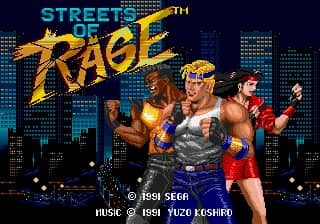
At its core, Streets of Rage is a classic side-scrolling beat 'em up. Players advance through side-scrolling stages, using punches, kicks, and weapons to take down enemies in their path. The game offers three playable characters: Axel, Blaze, and Adam, all former police officers who, disillusioned with the police's inability to act, decide to take on the crime syndicate themselves. Each character has distinct attributes: Axel is well-balanced, Blaze is agile, and Adam is powerful, allowing players to choose the one that best suits their playstyle.
The game consists of eight stages, ranging from the streets to the harbor and the enemy's hideout, offering a variety of environments. Each stage ends with a boss battle, except for stage seven, which instead features a tense escape sequence, providing a change of pace. Enemy types are diverse, from common punk thugs and ninjas to armed henchmen and dominatrices, with up to twelve enemies on screen at once, creating chaotic and intense battles.
In addition to basic attacks, the game introduces a special attack system. Each character has a special move that consumes health but can clear out nearby enemies in a pinch. More notably, players can call for police support, where a police car arrives at the edge of the screen and fires a machine gun across the entire screen, dealing massive damage. This mechanic provides a safety net and adds a layer of strategy, as the number of times you can call the police is limited.
Two-player co-op is a major highlight of Streets of Rage. Two players can fight side by side, coordinating attacks, such as one player grabbing an enemy while the other lands heavy blows. The game also features cooperative team moves, where both players can trigger a combined attack when near an enemy, dealing extra damage. This cooperative gameplay greatly enhances the fun and made Streets of Rage one of the most popular party games among friends at the time.
Overall, the gameplay design of Streets of Rage builds upon predecessors like Double Dragon and Final Fight, adding its own unique touches. It doesn't have complex combo systems, but the combat feels solid, and the enemy AI is reasonably smart, not just standing around. The game is challenging, but with the right character choice and cooperation, players can find a way to clear it. This simple, direct, yet challenging design is what makes beat 'em ups so appealing.
Background and release
Streets of Rage was first released in Japan on August 2, 1991, under the title Bare Knuckle: Ikari no Tekken, which translates to 'Bare Fists: Fists of Fury'. The North American version followed on September 18 of the same year, with the European version arriving in October. The Western versions were renamed Streets of Rage, a title that more directly conveys the game's theme.
At the time of release, the Mega Drive (known as Genesis in North America) was in the thick of the 16-bit console war. Sega needed a strong title to compete with Nintendo's Super Nintendo, and Streets of Rage, with its impressive graphics and music, quickly gained a positive reputation among players. In the UK, it topped the Mega Drive sales charts, becoming one of Sega's best-selling games and contributing significantly to Sega's success in the European market.
The success of Streets of Rage extended beyond the original release. It was later ported to the Game Gear, Master System, and Sega CD, allowing more players to experience the game. Additionally, it was included in several official Sega compilations, such as Mega Games II and Sonic Gems Collection, making it easily accessible to new players.
In the digital distribution era, Streets of Rage embraced new platforms. On January 26, 2011, the game was released on Windows as a standalone purchase and as part of the SEGA Mega Drive Classics Pack 4. On August 21, 2013, the 3DS version, 3D Streets of Rage, was released on the Nintendo eShop, using autostereoscopic 3D to give the classic game a new experience. On April 11, 2025, the game was added to the Nintendo Classics service on Nintendo Switch Online, allowing subscribers to revisit the classic on the Switch.
As the first entry in the series, Streets of Rage paved the way for its sequels. Streets of Rage 2 (1992) and Streets of Rage 3 (1994) continued the core gameplay, adding more characters and a wider array of moves. After a long hiatus, the series received a proper sequel in 2020 with Streets of Rage 4, developed by a new team but retaining the spirit of the original, much to the excitement of longtime fans.
Development
The development of Streets of Rage began with a small team within Sega, with the working title 'DSWAT', set in the same universe as Sega's previous game ESWAT. This setting was originally intended to have a direct connection to ESWAT, but this was not reflected in the final product. However, the development codename hints at the team's initial concepts.
The game's design was clearly influenced by the popular beat 'em up games of the time, especially Double Dragon and Final Fight. Director Noriyuki Ohba mentioned in interviews that they wanted to create a game that surpassed these predecessors. To that end, the team borrowed some systems from Golden Axe, such as enemies appearing from both sides of the screen and the ability to pick up weapons to change attack patterns, which made combat more varied.
Noriyuki Ohba served as the game's director, overseeing the overall direction. The music was handled by the then-young composer Yuzo Koshiro, who would later become a legend in game music. At the time, he was a young man passionate about electronic dance music. He boldly incorporated house and techno styles into the game's soundtrack, which was rare in mainstream game music at the time.
For the soundtrack, Koshiro used Roland drum machine sounds to emulate the feel of club music. This rhythmic electronic music perfectly matched the fast-paced combat, making players feel like they were on a dance floor. The success of the soundtrack not only enhanced the game's immersion but also made the Streets of Rage soundtrack a classic, with multiple soundtrack CDs released and beloved by fans.
During development, the team faced technical challenges. The Mega Drive's hardware had limitations, but the game still achieved smooth two-player co-op and displayed multiple enemies on screen. To achieve this, programmers optimized sprite drawing and collision detection algorithms. These efforts ultimately made Streets of Rage reach a top-tier level of graphics and feel for its time, showcasing the technical prowess of the Mega Drive.
Reception and legacy
Streets of Rage received critical acclaim and positive player feedback upon release. Electronic Gaming Monthly called it 'a winner for the genre on the 16-bit Sega', particularly praising the graphics and music. MegaTech magazine gave it a high score of 92% and called it a 'must-buy'. These reviews helped the game stand out in a competitive market and become one of the Mega Drive's flagship titles.
The game's most profound impact lies in its music. Yuzo Koshiro's introduction of electronic dance music to game soundtracks broke the convention of rock or orchestral music in games at the time. This style later influenced countless game music composers, especially those seeking rhythm and atmosphere. The Streets of Rage soundtrack is still revered by many electronic music fans, with some even creating remixes and covers.
As a landmark title of the Mega Drive era, Streets of Rage has maintained its longevity through ports and compilations. From Game Gear to Sega CD, and to modern PC and Switch, the game has appeared in various forms. Its inclusion in the Nintendo Switch Online service in 2025 allows a new generation of players to easily experience this classic, proving its value stands the test of time.
Streets of Rage also laid the foundation for the entire series. The sequels, Streets of Rage 2 and 3, continued the framework of the original, adding more characters and more complex combo systems. The 2020 sequel, Streets of Rage 4, though developed by a new team, retained the core feel of the original and even brought back Yuzo Koshiro for the music, showing how much the original influenced the series.
Looking back at the historical significance of Streets of Rage, it is not only one of the representative works of the golden age of beat 'em ups but also an important asset for Sega in the 16-bit era. It proved that even without a strong IP, excellent game design and a unique artistic style can leave a lasting mark on gaming history. For action game fans, it remains an unavoidable milestone.





