
Gameplay and design
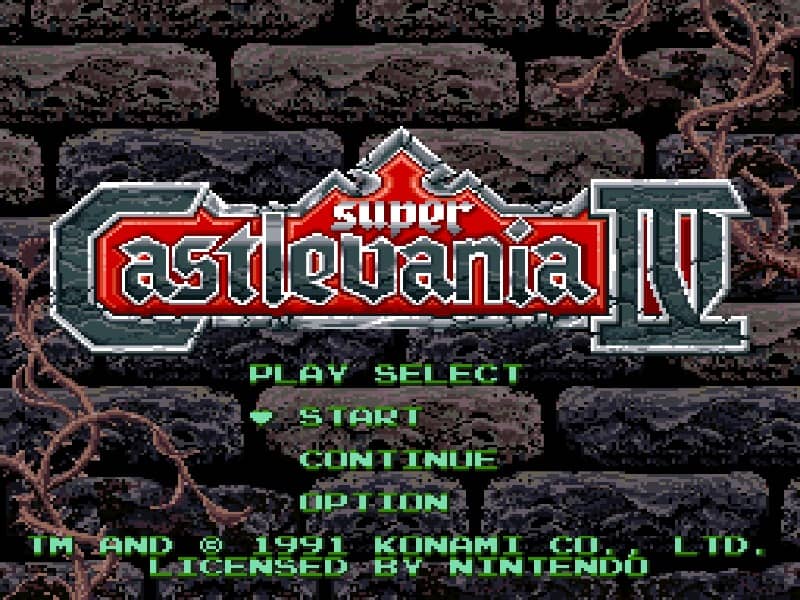
The core gameplay of Super Castlevania IV revolves around Simon Belmont's signature weapon, the whip. Unlike earlier games where the whip could only attack horizontally, in this installment the whip can be swung in eight directions, allowing players to easily hit enemies above or diagonally below. Holding the attack button makes the whip spin, creating a barrier that can deflect enemy projectiles and flying items, though the spinning whip deals less damage and is more for defense. This design makes combat more flexible and fulfills ideas the development team couldn't realize in the original game.
The whip can be upgraded twice by collecting items, each upgrade increasing its length and power, giving Simon a wider attack range. Additionally, the whip can hook onto rings in the environment, allowing Simon to swing like a pendulum to cross dangerous chasms or obstacles. This swinging mechanic was quite novel for platformers at the time, adding fluidity to the action and enabling more vertical and spatial variety in level design. Players must master timing and rhythm to progress.
In addition to the main weapon, the game retains the series' traditional sub-weapon system. Players can pick up items like axes, stopwatches, and daggers, which consume hearts to use. Hearts are obtained by breaking candles or defeating enemies, so managing resources is key to success. The game also features double and triple shot items that allow sub-weapons to be thrown consecutively, greatly increasing their power. These elements combine to create a rich combat strategy, letting players choose the most suitable attack method for different enemies and situations.
The game consists of 11 stages, each divided into multiple scenes. Sometimes the perspective changes between scenes, such as shifting from horizontal to vertical scrolling or featuring rotating 3D effects. These perspective changes showcase the SNES's hardware capabilities and add variety to the level design. Players have five lives; running out of lives or time results in a game over, but the game offers a password continue feature, allowing players to record progress and resume from the corresponding stage, which somewhat reduces the difficulty.
The level design emphasizes exploration and challenge, with hidden rooms, secret passages, and special items scattered throughout. The enemy variety is rich, from skeletons and bats to various monsters, each with unique attack patterns. Boss battles test players' reflexes and strategy; early bosses are relatively simple, allowing players to quickly discover weaknesses, while later ones are more challenging. Overall, the game maintains the series' hardcore action style while introducing innovative whip mechanics and clever level design, offering a familiar yet fresh experience.
Background and release
Super Castlevania IV was released in Japan on October 31, 1991, for the Super Famicom (SFC), and in North America on December 3, 1991, for the SNES. The story is set in 1691 in Transylvania, where protagonist Simon Belmont once again faces the resurrected Count Dracula, a plot identical to the original Castlevania from 1986. As such, the game is often considered a remake of the original, but director Masahiro Ueno later emphasized that it is only a partial remake, with much of the design being independent.
As a Castlevania title on a 16-bit console, the game fully utilizes the SNES's hardware, featuring 16-bit graphics and Mode 7 effects that enable rotation and scaling, which were key selling points at the time. The music includes newly composed tracks and arrangements of old tunes, composed by Masanori Adachi and Taro Kudo. These tracks were later included in the Akumajō Dracula Best 2 compilation, and a vinyl record version was released in 2017.
The game sold approximately 800,000 copies worldwide, a respectable figure at the time. It received widespread critical acclaim and is considered one of the best action games of the 16-bit era. Since then, the game has been re-released multiple times, including on the Virtual Console for Wii, Wii U, and New 3DS, as well as on the SNES Classic Edition mini console, allowing new generations of players to experience this classic.
On May 17, 2019, the game was included in the Castlevania Anniversary Collection, released on multiple modern platforms including PC, PlayStation 4, Xbox One, and Nintendo Switch. This inclusion made the game more accessible to a wider audience and reflects Konami's appreciation of the series' history. The collection also includes other classic Castlevania games, providing a comprehensive retrospective of the series.
The game holds a special place in the series: it pays homage to the original while laying the groundwork for future installments through its innovative whip system. Although the series later took a different direction, the smooth controls and action design established here had a lasting impact on subsequent Castlevania games. Many players and critics consider it one of the pinnacles of 2D Castlevania, and it is still frequently mentioned and recommended.
Development
Super Castlevania IV was directed and primarily programmed by Masahiro Ueno, who used the pseudonym Jun Furano because Konami did not allow employees to use their real names in games. Ueno was a big fan of the original Castlevania and wanted to create a pure action game similar to it, so the game returns to the hardcore gameplay of the original. He considered the game only a partial remake, as the team added many new elements and designs during development.
The development team was small, and all members contributed to the design. Early design documents depicted Simon in modern clothing because the setting wasn't finalized; later, the classic Belmont look was adopted. The maps were drawn on paper, and changes were frequent during development, with many ideas tested and adjusted. The team considered adding branching stages but ultimately did not, possibly to maintain a tight linear flow.
The whip system is the core innovation, programmed by Mitsuru Yaida (under the pseudonym Yaipon). This idea was originally planned for the original Castlevania but wasn't realized until this game. The eight-directional whip attacks and swinging mechanic allow players to handle enemies and terrain more flexibly, becoming the game's biggest highlight. Ueno handled enemy and boss programming, with early bosses designed to be relatively simple so players could quickly find their weaknesses.
The English version underwent some censorship changes upon release. Ueno was asked to modify the color palette of Stage 8 to remove bloodstains, reflecting different standards for violent content in different regions. The North American box art was created by Tom duBois and differed from the Japanese version. These changes highlight differences in cross-cultural publishing and affected players' visual impressions of the game.
Additionally, Factor 5 created a demo for the Mega Drive, but Konami ultimately did not adopt it, so the game never appeared on Sega's 16-bit console. This decision may have been due to commercial or technical reasons, but it made the game an SNES exclusive. Nevertheless, the game performed excellently on the SNES, becoming one of the platform's representative titles.
Reception and legacy
Super Castlevania IV received unanimous critical acclaim upon release. Famicom Tsūshin praised the graphics, controls, and gameplay, particularly the multi-directional whip attacks. Nintendo Power gave it high scores of 4.0, 4.0, 4.5, and 4.5 out of 5, praising the visuals, music, and action. These reviews established the game's excellent reputation at the time.
Other media also gave high praise. Dragon magazine reviewed the game in 1994 in Sandy Petersen's 'Eye of the Monitor' column, and Entertainment Weekly in 1992 called it 'vampire film noir,' appreciating the game's atmosphere and design from different angles. The game has also been listed multiple times among the 'greatest games of all time,' such as Nintendo Power ranking it 66th on its list of best games for Nintendo systems in 2006 and 27th in its final issue.
The game influenced subsequent Castlevania titles. Although the series later shifted toward a more exploration-focused 'Metroidvania' style, the improvements in control fluidity and action design provided a reference for later works. The multi-directional whip attacks and swinging mechanic were carried forward and evolved in later games, becoming iconic elements of the series.
The game enjoys a high reputation among players, many of whom consider it a pinnacle of 2D action games. Its difficulty and control feel are still frequently discussed, and some players regard it as a classic challenge. The continuous releases of remakes and re-releases attest to its enduring appeal.
In summary, Super Castlevania IV is not only an excellent action game but also an important milestone in the history of the Castlevania series. It successfully combines the classic gameplay of the original with modern technology, creating an experience that is both nostalgic and fresh. For fans of action games and the Castlevania series, this is a must-play classic.





