
Gameplay and design
The core gameplay of Contra Force is run-and-gun shooting, but compared to other series entries, it places a stronger emphasis on strategic character selection. The game offers four playable characters: leader Burns, heavy-weapons expert Iron, sharpshooter Smith, and demolition expert Beans, each with distinct strengths in firepower, speed, and jumping ability. For instance, Iron packs a punch but moves slowly, while Smith is accurate but less powerful. Players must choose the right character based on level requirements and their own play style. This variety ensures a different experience with each playthrough and encourages experimentation with different combinations.
The level design is also distinctive, with five stages that alternate perspectives: odd-numbered levels are traditional side-scrolling, while even-numbered ones switch to a top-down view. This shift forces players to adapt to different spatial awareness and enemy patterns. In top-down stages, players can move in all directions, and the density of enemy encirclements and bullet patterns changes accordingly, adding a fresh feel to the game. Such a design was rare in the Contra series at the time and stands out as a notable feature.
The weapon system is the most unique aspect of Contra Force. Instead of the series' typical letter-based power-ups, it borrows the weapon selection table from Gradius. When a player picks up a briefcase item, a horizontal menu appears at the bottom of the screen, listing various enhancements such as increased firepower, speed boosts, and shields. Players must move a cursor to select the desired enhancement and confirm it to take effect. This mechanic allows players to adapt flexibly to the battle situation rather than passively accepting fixed upgrades, adding strategic depth.
Another unique feature is the partner summon system. At any time, players can pause and enter a submenu to switch characters or summon a computer-controlled partner to assist in battle. The partner appears for only five seconds but actively attacks enemies, easing the pressure on the player. Additionally, players can set one of six offensive or defensive strategies for the partner, such as full attack, defensive standby, or follow movement. This system makes solo play less lonely and adds unpredictability to combat.
The difficulty and life mechanics are also noteworthy. Each character has three lives. In single-player mode, if the current character runs out of lives, the game does not end immediately; instead, the player can switch to another character with remaining lives. In two-player mode, if one player loses all lives, they can be assigned a character from the other player, but the lost character becomes unavailable. This design forces players to manage resources wisely and increases the need for cooperation. Fortunately, the game offers unlimited continues, giving players ample room to try again.
Background and release
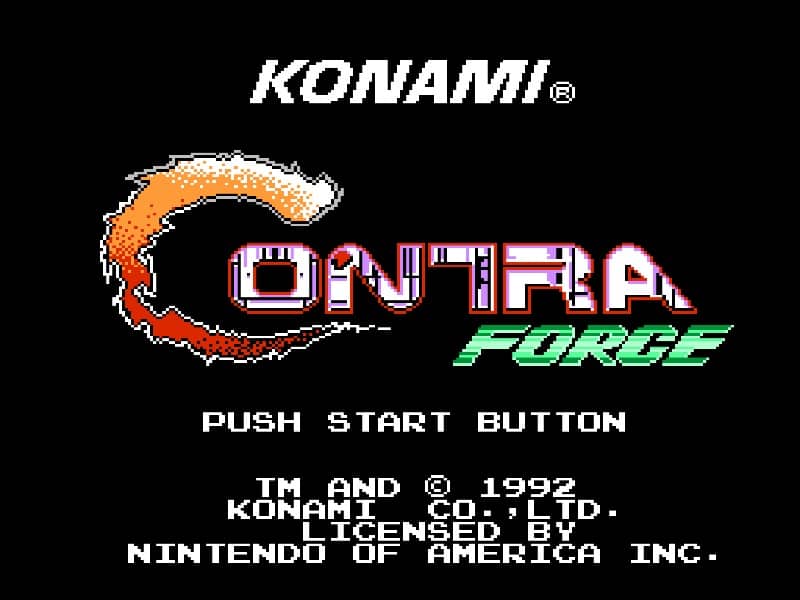
Contra Force is a run-and-gun game released by Konami for the NES in North America in 1992. From its numbering, it is the third Contra game on the NES, but unlike other series entries, its story is completely independent and unrelated to the games before or after it. The game is set in 1992, where a terrorist organization called D.N.M.E. threatens Neocity City. The player controls the C-Force squad to protect the city. The enemies are human terrorists, not the aliens or extraterrestrial creatures typical of the series, making this entry particularly unusual in theme.
The opening story is also quite suspenseful. Leader Burns receives a call from an informant named Fox, who says the intelligence chief is threatened. Burns rushes to meet him but finds Fox dead. This opening sets a tense and mysterious tone for the entire game, piquing the player's curiosity. However, the story is not heavily developed as the levels progress; it serves more as a backdrop, but at least it makes clear that the enemies are real humans, not supernatural monsters.
The standalone identity of Contra Force largely stems from its development origins. The game was initially planned for release in Japan as Arc Hound, a title unrelated to the Contra series. In other words, it was not originally part of the Contra franchise but an independent project within Konami. After the Japanese version was canceled, the game was localized and repackaged, then incorporated into the Contra series as a spin-off for the North American market.
This shift in identity makes Contra Force very special within the series. It is neither a sequel to Super Contra nor does it continue the series' usual alien enemy setting. Instead, it pits players against human terrorists and tells a brand-new story. For players familiar with the Contra series at the time, this game might have been confusing, but it also brought a sense of novelty. It demonstrated that the Contra series could explore directions beyond its typical gameplay.
The game's release also went through some delays. It was initially scheduled for a winter 1991 release as the third console game in the series, but it was ultimately pushed back to October 1992. This delay not only affected the game's own release but also triggered an interesting chain reaction: Contra III: The Alien Wars, originally numbered Contra IV, was renumbered before release because Contra Force took the third slot. This detail reflects Konami's adjustments to the series' release planning at the time.
Development
The development story of Contra Force begins with its predecessor, Arc Hound. This game was originally slated for release in Japan in 1991, with announcements in magazines like Famicom Tsūshin and a planned October release. From the public information, Arc Hound was an independent game unrelated to the Contra series, with its own world and characters. However, for unknown reasons, the Japanese version was canceled, and the game never appeared in its original form.
Although the Japanese version was scrapped, Konami did not completely abandon the project. They decided to localize the game for the North American market and package it as a spin-off of the Contra series. This decision changed the game's fate and gave it a new identity. During localization, the characters, story, and title were adjusted to fit the Contra style and appeal to North American players. Thus, Arc Hound transformed into Contra Force.
This localization was not a simple reskin but a reimagining of the game's content. The originally independent characters were given new names and backgrounds, such as leader Burns and heavy-weapons expert Iron, forming the C-Force squad to fight the terrorist organization D.N.M.E. The story was also rewritten, adding elements like the informant and the intelligence chief to make it more in line with the tense atmosphere of the Contra series. In essence, the localization team preserved the core gameplay while infusing it with the spirit of Contra.
The game's delay and renumbering are an interesting episode in its development. Originally scheduled for a winter 1991 release as the third console game in the series, it was pushed back to October 1992 due to development progress or market strategy. Meanwhile, another Contra game, Contra III: The Alien Wars, was also in preparation and originally numbered Contra IV. Because of the delay, Konami renumbered Contra III before release, making it the fourth entry in the series. This adjustment, though seemingly simple, reflects Konami's flexible planning of the series' release order.
From development materials, many designs in Contra Force reflect Konami's exploratory spirit in gameplay. For example, the weapon selection table borrows the classic mechanic from Gradius, and the partner summon system is an innovative cooperative feature. These designs were uncommon in shooting games at the time, showing the development team's intention to create a differentiated product. Although the game eventually faced criticism for technical issues, its gameplay experiments provided reference for later games.
Reception and legacy
After its release, Contra Force received reviews from some professional media, but they were mixed. Allgame editor Brett Alan Weiss criticized the game's technical issues, such as slowdown and flickering, which were not uncommon on the NES but did affect the game's smoothness. However, he also praised the character selection system, noting that it provided strategic depth. This review largely represented the overall media opinion of the game at the time.
For players, the reception of Contra Force was more complex. On one hand, as a Contra series title, it lacked the series' signature alien enemies and intense story, disappointing some series fans. On the other hand, its unique character system and top-down levels attracted players who enjoyed fresh gameplay. In the contemporary market, it did not become a hit, but it was not entirely forgotten either; it remained in players' memories as a distinctive work.
From the perspective of the series' evolution, Contra Force holds an awkward position. It is neither a mainline sequel nor a spin-off in the traditional sense, but a derivative work adapted from an independent game. This identity makes it stand out within the series, but it is also this uniqueness that keeps it mentioned by players years later. When people look back at the Contra series, they always bring up this game without aliens but with rich character choices, making it an oddity in the franchise.
In gaming culture, Contra Force has left behind some intriguing legacies. Its weapon selection table and partner summon system, while not original, were distinctive in their application within shooting games. Many later games show similar influences in character switching and companion systems. Additionally, as the North American localization of Arc Hound, the game serves as a case study in game localization, demonstrating how an independent title can be adapted into a series.
Now, years after its release, Contra Force is still of interest to nostalgic players and game researchers. It remains playable through emulators and in retro gaming communities, with players sharing their strategies and character tips. Although it has not achieved the classic status of the original Contra, as a unique entry in the series, it has left its mark on gaming history through its standalone story and gameplay. For players interested in exploring gaming history, it is a title worth trying.





