
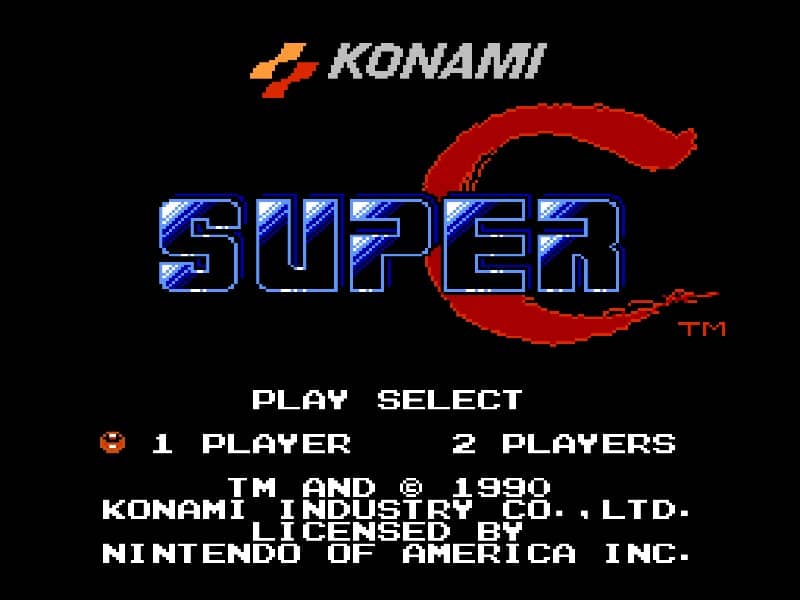
Gameplay and design
The home console version of Super Contra continues the series' signature run-and-gun style, with players controlling Bill or Lance as they battle through side-scrolling and vertical-scrolling stages against enemies and bosses. Compared to the arcade original, the NES version's biggest change is the addition of three vertical-scrolling stages, set in a high-tech base, mountains, and an alien nest. These stages not only lengthen the game but also alternate the pacing between horizontal and vertical levels, offering a stronger sense of visual and mechanical variety.
The weapon system is a core part of the game's appeal. The NES version retains the machine gun, spread gun, bomb gun, and laser gun from the arcade, but the fireball gun has been altered: it no longer travels in a straight line as in the first game, but instead fires a large projectile that explodes on impact, sending sparks in multiple directions. This makes it highly effective against dense groups of enemies. Additionally, players can pick up rapid-fire, shield, and other special items, allowing for varied strategies in each stage.
Two-player co-op is a key feature of Super Contra. Two players can play simultaneously, with one controlling Bill (green) and the other Lance (purple), covering each other and sharing weapons and items. This design not only enhances the social aspect but also opens up more possibilities for coordination in enemy encounters and boss battles, making it one of the most popular forms of entertainment in arcades and living rooms of the era.
The NES version's difficulty is also noteworthy. It does away with the arcade's looping system, instead ending with a final stage, but the overall challenge remains high, especially in the new vertical stages and the final boss, which demand quick reflexes and precise control. To accommodate home players, the game includes a new 30-life cheat code (30 lives in the Japanese version, 10 in the American version), giving more players a chance to see the ending.
Beyond regular combat, the game contains hidden elements. The Japanese NES version has a stage-select cheat, while the American and European versions remove it, but all three versions retain a sound test mode where players can enjoy the game's music and sound effects. These details, though simple, reflect the ingenuity of game design at the time and encourage players to discover new delights through repeated play.
Background and release
Super Contra first hit arcades in 1988 as the direct sequel to Contra. In Japan, it was titled Super Contra: The Alien Strikes Back, while North America and Europe received it as Super Contra. The story picks up after the previous game, with Bill and Lance once again dispatched to stop the alien forces of Red Falcon, providing a familiar motivation for players.
The NES version was released in Japan on February 2, 1990, with the North American version renamed Super C and the European version called Probotector II: Return of the Evil Forces. The North American name change was not arbitrary; it was to avoid association with the politically sensitive Iran-Contra affair, reflecting the market considerations of the time.
The European Probotector II underwent more drastic changes, with the protagonists and some enemies replaced by robots to comply with censorship requirements in certain European regions. Although the character designs changed, the core gameplay remained intact. This localization strategy was not uncommon at the time and highlights the differences in gaming markets across regions.
The NES version was a commercial success, selling over 500,000 copies. This was a notable achievement in the home console market and underscored the popularity of the Contra series. In comparison, the arcade version was listed as the fourth best-selling arcade game in Japan by Game Machine magazine in March 1988, also performing well.
It's worth noting that the NES version was not a simple port of the arcade game; it included substantial original content, such as new stages and bosses. This practice of enhancing home versions was not widespread at the time, but it provided players with an experience that surpassed the arcade and set a benchmark for future home console ports.
Development
The development of the NES version was a complex process, with the team making numerous adjustments during the port. For the music, Hidenori Maezawa re-arranged the arcade's dynamic melodies into 8-bit style, adapting them to the Famicom's audio chip while preserving the original tension. The European version's sound driver was modified by Yuichi Sakakura to prevent pitch distortion, ensuring stable audio across different TV standards.
The new stages and bosses were a major focus of the NES development. The team designed three vertical-scrolling stages exclusively for the home console, along with a new final boss, none of which existed in the arcade version. This decision not only extended the game's length but also gave arcade veterans a fresh experience on the Famicom, demonstrating the team's commitment to home players.
The adjustment of cheat codes also reflected development considerations. The Konami code from the original Contra (Up Up Down Down Left Right Left Right B A) was not included, but a new 30-life cheat was added, with 30 lives in the Japanese version and 10 in the American version. This change may have been to balance difficulty and player needs, while avoiding a simple repeat of the previous game's setup.
The Japanese NES version also included a stage-select cheat, but it was removed from the American and European versions, possibly for difficulty control or localization reasons. All three versions retained the sound test mode, allowing players to enjoy the music and reflecting the team's confidence in the audio. These regional differences created subtle variations in player experience.
In addition to the NES version, Distinctive Software developed Amiga and IBM PC versions of Super C in 1990, but these were based on the arcade version rather than the NES version, so their content differed. This multi-platform strategy expanded the game's audience but also led to differences between versions, sparking discussion among players.
Reception and legacy
Super Contra received widespread acclaim upon release. Japan's Famitsu magazine gave the Famicom version a score of 25 out of 40, which, while not top-tier, was above average for the time. In 1997, Electronic Gaming Monthly ranked the arcade version as the ninth best arcade game of all time, a testament to its standing in the golden age of arcades.
The NES version, Super C, sold over 500,000 copies, proving its commercial value. In the eyes of players, it is not only a classic sequel in the Contra series but also a benchmark for shooting games on the Famicom. Many players fondly remember the new vertical stages and boss battles, which became an integral part of their childhood memories.
Over time, the game has been re-released and remastered multiple times. The arcade version appeared on Xbox Live Arcade in 2007 with HD graphics and online co-op, and was included in the Contra Anniversary Collection in 2019, developed by M2. The NES version was released on the Wii Virtual Console in 2007 and later appeared on 3DS, Wii U, and the NES Classic Edition, allowing new generations to experience the classic.
The game's influence also extended to unofficial realms. In 1996, Fuzhou Alien Technology (under the alias ESC Co. Ltd.) produced a pirated hack called Super Contra 7, which used stages and bosses from other games. Although unauthorized, its existence reflects the immense popularity of Super Contra among players and serves as a reminder of the importance of copyright protection.
Looking back, Super Contra is not only another masterpiece by Konami in the shooting genre but also a prime example of combining home console ports with original arcade content. Its success laid the foundation for the future of the Contra series, and its level design, weapon system, and two-player co-op mode are still referenced by many similar games today, leaving a lasting mark on gaming history.





