
Gameplay and design
The biggest innovation in Super Mario Bros 3 is the introduction of a world map system. Instead of progressing linearly through levels as in previous games, players can freely choose levels on an overhead map, which features icons for action panels, fortresses, castles, and multiple paths. This design gives players more autonomy and plants the seeds for hidden elements, such as special ways to enter secret areas for extra rewards. The map itself becomes part of the game experience, enhancing the sense of adventure.
The game adds a variety of new power-ups, the most iconic being the Super Leaf, which gives Mario a tail and the ability to fly. The Tanooki Suit further enhances flight and attack, and allows Mario to transform into a statue to avoid enemies. The Frog Suit is suited for underwater levels, while the Hammer Suit lets Mario throw hammers. These items not only enrich gameplay but also offer players more strategic choices in different scenarios. The flight ability, in particular, completely changes vertical exploration in platformers and becomes a key element in later series entries.
The action system is greatly expanded. In addition to traditional jumping and stomping, Mario can now slide, pick up and throw items, climb vines, and perform a ground pound. The ground pound is introduced for the first time and can break certain floors or enemies, later becoming one of Mario's signature moves. These new actions make controls more flexible and allow level design to revolve around them, such as sliding through low passages or using the ground pound to trigger switches.
Two-player mode is retained but changed to alternating play, with each player controlling Mario or Luigi, and switching after one fails. Additionally, the game includes mini-games, including a remade version of the arcade game Mario Bros, which players can challenge between adventures to earn extra lives or items. This blend of cooperation and competition adds social fun and motivates players to replay levels.
The game consists of eight kingdoms, each with a unique visual theme, ranging from grasslands and deserts to oceans and skies, then to frozen, pipe, and dark worlds. Level design makes full use of new abilities, such as flight levels requiring players to master aerial control, and underwater levels emphasizing the Frog Suit's advantages. This thematic diversity not only enriches the visuals but also ensures gameplay freshness, with each world offering different challenges and experiences.
Background and release
Super Mario Bros 3 was first released in Japan on October 23, 1988, for the Famicom/NES. It is the third mainline entry in the Super Mario Bros series, but it does not directly continue the story of the previous game, Super Mario Bros 2; instead, it features a new setting. The story follows Bowser and his seven children, who steal the magic wands of seven kingdoms and transform their kings into animals. Mario and Luigi must retrieve the wands and defeat Bowser to save Princess Peach.
Before its North American release, Nintendo promoted the game heavily through the 1989 film The Wizard. The movie itself received poor reviews, but it featured extensive gameplay footage, leading many to consider it a '90-minute advertisement' for Super Mario Bros 3. This marketing strategy generated high anticipation, and the game sold 250,000 copies within two days of its North American launch, with sales exceeding 8 million by 1990, making it one of the best-selling games at the time.
The game was released in Japan on October 23, 1988, in North America on February 12, 1990, and in Europe on August 29, 1991. The release dates varied significantly across regions, but all were commercially successful. As of 2011, the game had sold over 17 million copies worldwide, making it one of the best-selling games on the NES. This achievement not only solidified Nintendo's position in the gaming industry but also demonstrated the immense commercial potential of platform games.
The game received widespread acclaim, with Computer and Video Games magazine giving it a 98% score and calling it the 'Mona Lisa of video games.' In Famitsu's 1988 Best Game Awards, it won Best Action Game. These honors reflect the game's industry influence at the time and laid the foundation for its enduring classic status.
The game has also been ranked among the greatest games of all time by multiple media outlets, including Nintendo Power, which listed it as the second-best NES game, and IGN, which included it in its best games lists. These evaluations are based not only on the game's quality but also on its profound influence on subsequent game design. The game's success also spurred the development of related merchandise, including an animated series and remakes, further expanding its cultural impact.
Development
Development of Super Mario Bros 3 began in the spring of 1986 and took over two years to complete, with a team of more than ten people, directed by Shigeru Miyamoto. As the core figure of the series, Miyamoto experimented with many new ideas in this game, aiming to break the mold of previous entries. The development budget was approximately $800,000 to $1.3 million, a high investment at the time, reflecting Nintendo's commitment to the project.
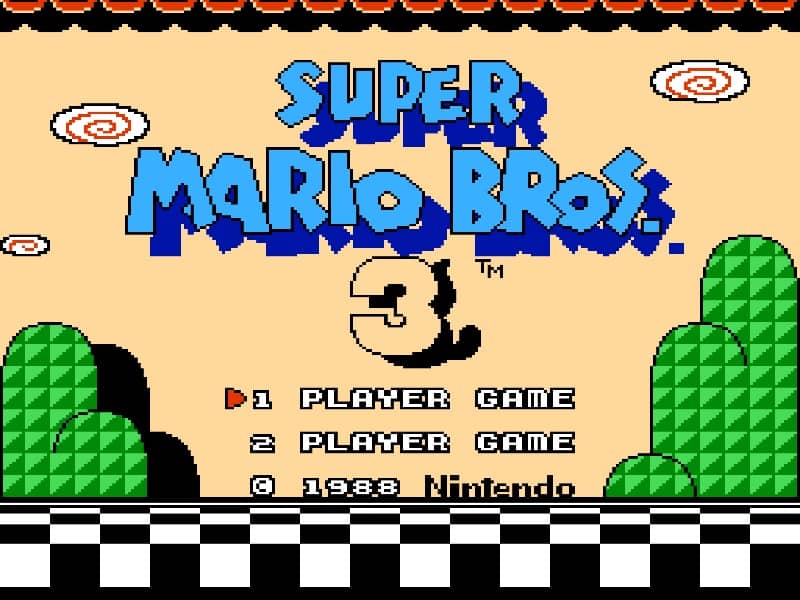
The game was initially planned to use an isometric perspective, but the developers found it difficult to judge jumps in that view, leading to player misjudgment, so they ultimately reverted to a 2D side-scrolling view. However, the checkerboard floor on the title screen retains isometric elements, becoming a visual hallmark of the game. This decision underscores the team's dedication to gameplay, prioritizing player control experience even when technology was appealing.
Technical implementation also posed challenges. To achieve richer effects on the NES's limited hardware, the cartridge used Nintendo's MMC3 ASIC chip, which supported animated tiles, extra RAM, and a scanline timer. These features enabled split-screen display of the status bar and smoother animations. Pixel art was drawn using a Fujitsu FM R-50 HD commercial computer, and code was written and tested on an HP 64000 host with a 6502 processor card, with development tools that were quite advanced for the time.
The music was composed by Koji Kondo, who later recalled it as the hardest game he ever composed for. To find the right style, he experimented with various genres, ultimately settling on a blend of jazz, classical, and pop elements. These tracks not only perfectly match the game's scenes but also become part of the game's legacy, with many melodies still frequently discussed by players today.
Enemy designs also carry personal touches. For example, the Chain Chomp was inspired by Miyamoto's childhood experience of being bitten by a dog, and the Koopalings were designed based on seven programmers, with the North American versions named after musicians, such as Ludwig von Koopa and Roy Koopa. These details give characters more personality and reflect the team's style of incorporating personal experiences into their creations.
Reception and legacy
Super Mario Bros 3 has had a profound impact on the gaming industry, introducing elements such as the world map, flight, and Bowser's red hair, which later became iconic features of the Mario series. The world map system was not only adopted by subsequent Mario games but also inspired other platformers, becoming a standard mode for level selection. Flight expanded the vertical dimension of platforming, giving players more possibilities in exploration.
The game's success also drove transmedia development. In 1990, DIC Entertainment produced an animated television series, The Adventures of Super Mario Bros. 3, which, although loosely connected to the game's plot, further expanded the IP's influence. The game itself has been remade and ported multiple times, including Super Mario All-Stars on the SNES in 1993 and Super Mario Advance 4 on the Game Boy Advance in 2003, as well as subsequent Virtual Console and Nintendo Classics services, allowing new and old players alike to experience this classic.
The game also influenced other game developers. John Carmack and Tom Hall drew inspiration from it when developing a PC clone, and they later founded id Software and created games like Commander Keen. This shows that Super Mario Bros 3 not only influenced Nintendo's own games but also drove technological and design innovation across the entire industry.
Culturally, the game is widely recognized as a classic. In 2020, a sealed copy of Super Mario Bros 3 sold for $156,000, setting a record for video game auctions at the time, reflecting its collectible value and cultural status. The game was also selected for the 'Games of the Century' and submitted to the Library of Congress, preserved as part of video game history.
In summary, Super Mario Bros 3 is not just an excellent platformer but a milestone in game design history. Through innovative gameplay, polished production, and successful marketing, it set a benchmark for future games. Whether in terms of commercial achievement, industry influence, or cultural significance, it truly deserves the title of 'one of the greatest games of all time.'





