
Gameplay and design
The core experience of Super Mario Bros. is built on the interplay of running, jumping, and observation. Mario's horizontal speed doesn't reach full velocity instantly; it requires a distance to accelerate, and the height and distance of a jump can still be adjusted with the directional pad after takeoff. This physics means players must always anticipate momentum while moving, and the level's bricks, pipes, and enemies constantly demand that players translate this anticipation into precise actions. For example, when facing a row of bricks, players need to judge the timing and force of their jump to land exactly on top or hit hidden items from below; when encountering moving enemies, they must calculate the margin for acceleration to avoid overshooting and colliding. This continuous awareness of speed and space forms the foundation of the game's control feel.
The basic flow of the game is to traverse eight worlds, each containing four levels, and ultimately defeat Bowser in a castle to rescue Princess Peach. In standard levels, enemies, pits, pipes, and bricks form the main obstacles, while hidden coins, power-ups, and secret routes reward players who are willing to explore. This design makes every forward move carry both risk and reward; once players learn the rules, they actively try hitting suspicious bricks or jumping over seemingly dangerous pipes. For instance, some bricks look ordinary but may yield coins or a hidden mushroom when struck from below, while certain pipes not only block the path but may lead to underground bonus rooms or shortcuts. This blend of exploration and goal-oriented progression means players, while seeking speed, also take time to probe the environment's details.
The power-up system is a key regulator of the game's pacing. When small Mario eats a mushroom, he becomes Super Mario, growing in size and able to take one hit; obtaining a Fire Flower allows him to shoot fireballs. Taking damage usually reverts him to a smaller form rather than costing a life immediately. This gradual penalty system lets players feel growth during the adventure without being completely discouraged by a single mistake, encouraging continued attempts. More importantly, the powered-up state not only changes appearance and resilience but also alters the player's strategy: Super Mario can smash bricks, opening new paths or revealing hidden items, while Fire Mario can attack enemies from a distance, reducing the risk of close contact. This difference in abilities means that after losing a power-up, players must readjust their approach to the level, adding depth and replay value.
World 1-1 is a model of instructional design. The level opens with a Goomba, a question block, and the first mushroom, while the placement of the first pipe is carefully adjusted so that the mushroom bounces back toward the player rather than rolling off-screen. This arrangement allows new players, without any text, to naturally learn how to collect items, stomp enemies, and discover hidden content through observation and trial. Specifically, players first encounter a Goomba that slowly walks toward them; instinctively, they try to jump over it, thereby learning to stomp enemies. Next, a question block appears overhead; hitting it yields a coin, teaching interaction with blocks. Then, the first mushroom pops out of a brick and moves right, but a pipe ahead blocks its path, causing it to bounce back; driven by curiosity, the player touches it and discovers the growth effect. This sequence of events is tightly linked, integrating basic controls and core mechanics into the natural flow of the game without any written instructions.
The game adds variations to the basic side-scrolling structure, such as underground, underwater, arena, and castle levels, as well as shortcuts like warp pipes, but the controls remain consistent throughout. This uniformity allows players, once familiar with the core rules, to quickly adapt to different challenges. For example, underground levels are dimly lit with denser enemy placement, but players still use the same jumping and brick-hitting techniques; underwater levels alter gravity and movement, yet the basic logic of acceleration and jumping still applies; arena levels feature platform and pit arrangements that test control over momentum; and castle levels include more traps and mechanisms, but observation and reaction remain key. At the same time, the strict one-way progression and limited lives discourage meaningless trial and error, but the short level loops and recurring visual patterns make failure understandable rather than random punishment. Through repeated attempts, players gradually master each level's rhythm, and this learning process is itself part of the game's enjoyment.
Background and release
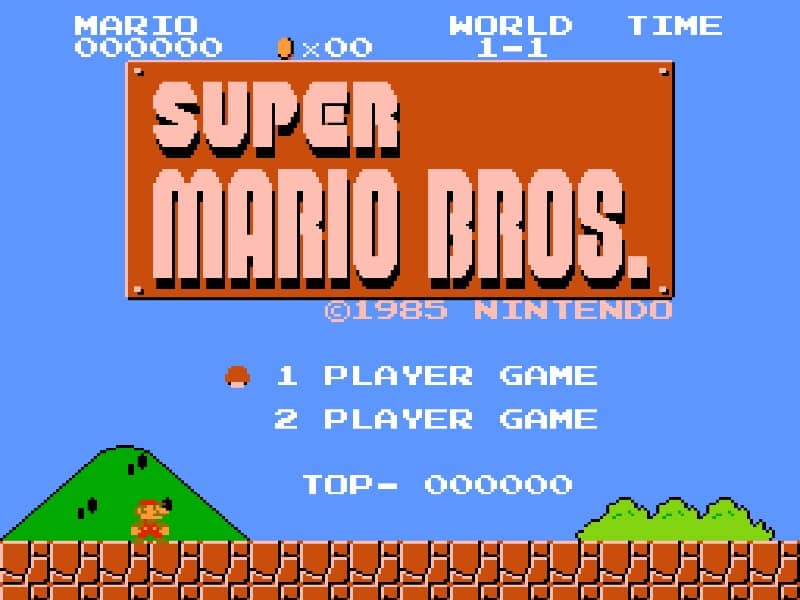
Super Mario Bros. was released for the Famicom in Japan on September 13, 1985. Prior to this, Mario had already appeared in Donkey Kong and Mario Bros., and Luigi made his debut in Mario Bros. Thus, this new game did not introduce the characters for the first time but placed them in a new side-scrolling adventure, establishing the basic framework for the series. Nintendo had experimented with platform jumping in Donkey Kong and introduced enemies and environmental interaction in Mario Bros., and Super Mario Bros. combined these elements with longer horizontal scrolling levels to create a new form of gameplay. Shigeru Miyamoto served as director, Takashi Tezuka as lead designer, and Koji Kondo composed the music and sound effects. The development team began experiments around December 1984, initially envisioning a large character traversing land, sea, and sky, but later adjusted to start with a small form that grows through items. This design decision ultimately shaped the core experience.
The game's story is simple: Mario (or Luigi in the two-player alternating mode) travels through the Mushroom Kingdom, defeats Bowser, and rescues Princess Peach. This narrative, though basic, provides a clear goal for the player's adventure. The game consists of eight worlds, each with four levels; players must progress through standard levels and castle levels, ultimately facing Bowser. The first three levels of each world typically feature different themes such as ground, underground, underwater, or arena, while the fourth is a castle where players defeat a boss or a Bowser impostor. This structure maintains consistent controls while offering diverse challenges through scene changes and enemy configurations. Along the way, players encounter enemies like Goombas and Koopa Troopas, as well as interactive elements like bricks, pipes, and question blocks, which together form the basis of the level design.
The two-player mode is not simultaneous but alternating: when one player finishes a turn or clears a level, the other takes control. In single-player, the player always controls Mario, while in two-player mode, they alternate between Mario and Luigi. This alternating mode means that two players cannot act simultaneously in the same level but must take turns, which adds a competitive and social element to the game.
Its level design, character imagery, and music quickly became a topic of discussion among players, prompting Nintendo to continue and expand these elements in subsequent works. The game's music was composed by Koji Kondo, who initially wrote a slower melody for the ground levels but found it mismatched with the speed of running and jumping, so he replaced it with the version that became widely known. The underwater music was actually completed before the familiar ground theme, and sound effects were integrated early in development so the team could understand how audio processing coexisted with the rest of the game. The development team faced strict sound and memory limitations, and Kondo reused related sound effects for different actions, such as shrinking and entering pipes, and stomping and swimming, rather than sampling each event separately. This economical approach allowed the limited hardware to support rich auditory feedback, and the game's short, clear cues for jumping, collecting, taking damage, time running out, and clearing a level not only set the mood but also became essential tools for players to assess their state.
From a historical perspective, this game did not appear out of nowhere; it was the culmination of Nintendo's early explorations in action games. This integration made it the true starting point of the series and an entry point for many players into the genre. The game's design was not achieved in one stroke but through repeated trial and adjustment. World 1-1 was not designed first; it was completed late in development and tweaked until near the end because it had to teach new players the basics without relying on the manual. Level design was first planned on paper, then adjusted through repeated playtesting to arrange bricks, enemies, and safe spaces. This player-centric design approach became an important tradition in Nintendo's subsequent works.
Development
The development of Super Mario Bros. was directed by Shigeru Miyamoto, with Takashi Tezuka as lead designer and Koji Kondo handling music and sound effects. The project began with early experiments in late 1984, when the team tried a large character, about twice the size of the one in Mario Bros., jumping in a simple test space. This prototype did not include a small Mario form but used the large character directly. This stage's design approach differed significantly from the final product, reflecting the uncertainty of early development. During exploration, the team gradually realized that character size changes could become a game mechanic, not just a visual difference. This experiment with a large character laid the groundwork for the growth system, though it was not yet clear how to implement it.
During development, the team initially envisioned a large character traversing land, sea, and sky, a concept that incorporated various ideas Nintendo had explored in early action games. However, after repeated trials, the designers concluded that starting with a small form and growing through items would provide a more satisfying experience. This decision ultimately led to the transformation structure of Small Mario, Super Mario, and Fire Mario. This design not only changed the character's appearance but also affected the game's overall pacing and player strategy. Small Mario's fragility required cautious play, while Super Mario's size and strength offered new possibilities, such as smashing bricks. Fire Mario further expanded attack options, allowing players to defeat enemies from a distance. This gradual growth system let players constantly feel their abilities improving during the adventure, while also adding depth and replay value.
The layout of World 1-1 was carefully arranged, from the appearance of the first Goomba to the placement of the question block and mushroom, and the clever positioning of the first pipe; each step was designed to guide players to naturally learn the game's rules. For example, after the mushroom pops out of a brick, it moves right, but a pipe ahead causes it to bounce back, ensuring the player sees and touches it. This design was not accidental but the result of multiple adjustments, reflecting the team's deep understanding of player behavior.
Koji Kondo began composing when the prototype was playable. He initially wrote a slower melody for the ground levels but found it mismatched with the speed of running and jumping, so he replaced it with the version that became widely known. This early integration of sound effects allowed music and sound to be tightly coupled with gameplay rather than awkwardly layered on later. In his composition, Kondo not only considered the melody's catchiness but also the synchronization of music with the game's rhythm. For instance, the ground theme's tempo matched Mario's running speed, enhancing immersion. The underwater music, with its soothing melody and special timbre, created an atmosphere fitting the underwater environment.
The development team faced strict sound and memory limitations. Kondo reused related sound effects for different actions, such as shrinking and entering pipes, and stomping and swimming, rather than sampling each event separately. For example, the crisp sound of a jump confirmed a successful action, the chime of collecting a coin brought a sense of achievement, and the low sound of taking damage warned of danger. These sound effects, though simple, achieved a diverse auditory experience through reuse and pitch variation. This careful use of resources did not diminish the game experience; instead, through concise and effective sound design, it enhanced the feedback mechanism, allowing players to quickly understand the game state and focus on controls and strategy.
Reception and legacy
The enduring influence of Super Mario Bros. lies in its establishment of a clear and accessible visual language for platform action games. From the feel of acceleration and jumping to elements like bricks, pipes, and flagpoles, and the power-up system of growing from small to large and shooting fireballs, these designs have been continually used and evolved in subsequent Mario games. It did not invent all platformer conventions but integrated these elements into a highly readable experience that spread to a wide audience. The core controls—running, jumping, hitting bricks—have remained essentially consistent across decades of series entries, and the power-up states (from Small Mario to Super Mario to Fire Mario) have become a signature growth mechanic. This stability of design vocabulary allows players to quickly pick up any later title while also making the original feel familiar to veterans.
In the decades since its 1985 release, the game has been re-released by Nintendo multiple times and frequently appears in anniversary materials. This indicates that it remains an active part of the company's catalog, not merely a remembered classic. For example, the layout of World 1-1, the melody of the ground theme, and Mario's iconic image have all become symbols in gaming culture.
From a design perspective, World 1-1's teaching method is widely regarded as exemplary, but its success stems not from a simple difficulty curve but from spatial layout guiding player behavior. The layout of World 1-1 is carefully arranged: players first encounter a Goomba that slowly walks toward them; instinctively, they try to jump over it, learning to stomp enemies. Next, a question block appears overhead; hitting it yields a coin, teaching interaction with blocks. Then, the first mushroom pops out of a brick and moves right, but a pipe ahead blocks its path, causing it to bounce back; driven by curiosity, the player touches it and discovers the growth effect. This design was not accidental but the result of late-stage adjustments by the development team, who ensured the teaching effectiveness through playtesting and layout tweaks.
However, its legacy must be described with caution. It was not the first game to include hidden areas or power-ups, nor did it invent side-scrolling. Its contribution lies in distilling existing concepts into a coherent, fluid, and engaging whole, and through the Famicom's popularity, exposing a large audience to the genre. Thus, its influence is more about providing a reusable design vocabulary for platformers than pioneering each specific mechanic. This integrative ability makes it an important reference for platformer design, rather than a purely technical innovation.
When evaluating this game, one should not overlook its era's limitations: one-way progression, alternating two-player mode, and losing power-ups upon taking a hit may seem harsh by today's standards. But it is precisely these limitations, combined with the game's excellent pacing, that make failure understandable and success more valuable. It is both a historical document and a work that still brings enjoyment, with design wisdom worth studying decades later. These limitations are not flaws but important factors shaping the game experience; together with level design and control feel, they form a complete whole, making every failure a learning opportunity and every success hard-earned.





