Gameplay and design
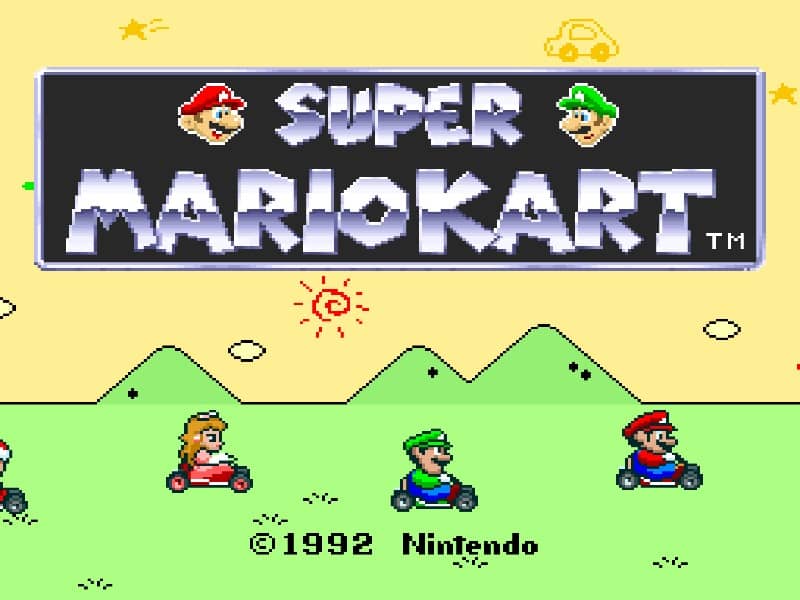
The core gameplay of Super Mario Kart has players controlling characters from the Mario series as they race on fantastical tracks. Eight characters are available: Mario, Luigi, Princess Peach, Yoshi, Bowser, Donkey Kong Jr., Koopa Troopa, and Toad. Each character has different speed, acceleration, and handling stats; for example, Bowser is the fastest but has poor handling, while Toad is the opposite. This differentiation lets players choose a character that suits their driving style and laid the groundwork for character abilities in later series entries.
The game features several modes, with Grand Prix being the main one. In Grand Prix, players race against computer opponents across four cups—Mushroom Cup, Flower Cup, Star Cup, and Special Cup—each containing five tracks, for a total of twenty. Time Trial lets players race alone for the fastest lap. Versus mode supports two-player same-screen racing, while Battle mode takes place in dedicated arenas where players use items to attack opponents, with victory determined by balloon count. Battle mode was introduced because the development team wanted a one-on-one mode not solely decided by ranking, and this design later became a classic series staple.
The item system is a major feature. Players can pick up item boxes on the track to obtain items like banana peels, shells, and stars. Banana peels can be placed on the track to make opponents spin out, shells can be thrown forward or backward to hit opponents, and stars grant temporary invincibility and a speed boost. These items add unpredictability and fun, embodying Nintendo's design philosophy of being easy to pick up but hard to master. Knowing when and how to use items is what separates skilled players from novices.
The coin collection mechanic is another innovation. Coins are scattered on the track, and collecting them increases a character's top speed, up to a maximum of ten. When hit by an item, players lose coins rather than spinning out, which reduces frustration for those falling behind and encourages active coin collection. This mechanic was carried forward in later series entries and became a hallmark of the Mario Kart series.
The game also introduces advanced techniques like drifting and hopping. Drifting allows players to maintain speed through corners, but drifting too long causes the kart to spin out, requiring precise timing. Hopping lets players jump over obstacles or cut corners. These simple moves offer skilled players room to improve their times, making the game appealing to both casual and hardcore players. Track designs are based on locations from Super Mario World, such as Donut Plains, and include obstacles and shortcuts, adding depth and strategic fun.
Background and release
Super Mario Kart was first released in Japan on August 27, 1992, followed by North America on September 1, 1992, and Europe on January 21, 1993. As the first game in the Mario Kart series, it marked Nintendo's expansion of its flagship Mario character from platformers into the racing genre. The game received a strong market response upon release and quickly became a popular title on the Super Nintendo.
The game sold 8.76 million copies worldwide, making it the fourth best-selling game on the Super Nintendo. In Japan, it sold 3.82 million copies, becoming the best-selling game in September 1992 and reaching one million sales that year. This success not only proved the game's appeal but also reflected the strong drawing power of the Mario brand at the time.
The game also performed well in Europe. In the first quarter of 1993, it was the best-selling game in Europe, outselling Sonic the Hedgehog 2 and Streets of Rage 2 on the Sega Genesis. In the UK, it became the best-selling Super Nintendo game in February 1993 and was the seventh best-selling game of 1993 with over 250,000 copies sold. These figures show that the game succeeded not only in Japan and the US but also won over players in Europe.
Over time, the game was re-released multiple times via Virtual Console and classic consoles. In 2009, it appeared on the Wii Virtual Console, with releases in Japan on June 9 and North America on November 23. In 2013, it was re-released on the Wii U Virtual Console, with Japan in June and Europe on March 27, 2014. In 2016, it came to the New Nintendo 3DS Virtual Console. In 2017, it was included as a built-in game on the Super NES Classic Edition, allowing a new generation of players to experience this classic.
In 1995, the game received a Player's Choice release, a special designation Nintendo gives to games that sell over one million copies, further confirming its commercial success. From its initial release to multiple re-releases, Super Mario Kart has remained relevant across generations, becoming an indispensable classic in Nintendo's library.
Development
The development of Super Mario Kart began with an unexpected inspiration. The game originally started as a multiplayer mode prototype for the 1990 Super Nintendo game F-Zero, with Masato Kimura, who had worked on F-Zero, serving as lead programmer. The goal was to create a racing game that could display two players on the same screen simultaneously, in contrast to the single-player F-Zero. Consequently, the track designs were simpler than F-Zero's to accommodate the split-screen display.
In the early stages, the prototype used a generic kart racer character. The team decided to use characters with a three-head-tall proportion to fit the karts. However, it wasn't until several months into development that they decided to include Mario characters. This decision came from an inspiration: when observing one kart overtaking another, they imagined Mario sitting in the kart. This idea transformed the game from a simple racing game into a Mario-themed racing experience, establishing the core appeal of the series.
The game used Mode 7 graphics technology, which first appeared in F-Zero, allowing for free rotation and scaling of planes to create pseudo-3D effects. This technology enabled tracks to be presented from a top-down or tilted perspective, giving players a novel visual experience. Additionally, the game used the DSP-1 chip, the most common DSP chip in Super Nintendo games, to assist with 3D mathematical calculations, making the Mode 7 effects smoother.
The development team was strong, with Shigeru Miyamoto as producer and Naoto Sugiyama and Hideki Konno as directors. Miyamoto, as the creator of the Mario series, brought unique creativity and quality control to the game. The music was composed by Soyo Oka, who had previously composed for Nintendo games like Pilotwings and Ice Hockey, creating lighthearted and cheerful melodies that complemented the game's fun atmosphere.
During development, the team also focused on character and track diversity. Characters were rendered as sprites and displayed from 16 different angles, making them look more natural when rotating. Track designs were based on locations from Super Mario World, such as Donut Plains, giving Mario fans a sense of familiarity. The introduction of Battle mode stemmed from the team's desire to create a one-on-one mode not solely determined by ranking, and this innovative thinking permeated the entire development process.
Reception and legacy
Super Mario Kart is widely regarded as the pioneer of the kart racing subgenre. Before it, racing games mostly aimed for realistic simulation, but this game, with its lighthearted style, item-based combat, and multiplayer fun, opened up a new genre. Its success spawned many imitators, such as Crash Team Racing, but the Mario Kart series has always remained the benchmark of the genre.
The game played a crucial role in the evolution of the Mario series. It was the first Mario game outside of platformers to feature multiple playable characters, bringing Mario, Luigi, Princess Peach, and others into a broader arena. This expansion not only enriched the Mario universe but also helped make the Mario series one of the best-selling game franchises.
Many of the game's design elements became series classics, reimagined in later entries. For example, Rainbow Road, with its unique visual style and difficulty, became a signature track, appearing in nearly every Mario Kart game. Core mechanics like the item system, coin collection, and drifting were retained and evolved in later titles, demonstrating the forward-thinking design of the original.
The game received high praise from media and players, frequently appearing on lists of the greatest games of all time. Its innovative gameplay, impressive graphics technology, and multiplayer fun made it one of the most representative games of the Super Nintendo era. In 2015, it was inducted into the World Video Game Hall of Fame, an official recognition of its historical significance and cultural impact.
Super Mario Kart is not just a successful game but a cultural icon. It proved that gameplay innovation and character charm can transcend genre boundaries, setting an example for Nintendo and the entire gaming industry. To this day, the Mario Kart series remains active in the gaming market, and it all started with this classic from 1992.