
Gameplay and design
Super Mario World's core gameplay continues the series' classic side-scrolling platforming, but adds a host of new mechanics that make the game feel both familiar and fresh. Players control Mario or Luigi as they run, jump, and stomp enemies across the levels of Dinosaur Land, ultimately reaching the goal pole at the end of each stage. The controls are finely tuned, with jump arcs and inertia balanced just right, allowing newcomers to pick up and play while veterans can pull off stylish moves at high speed.
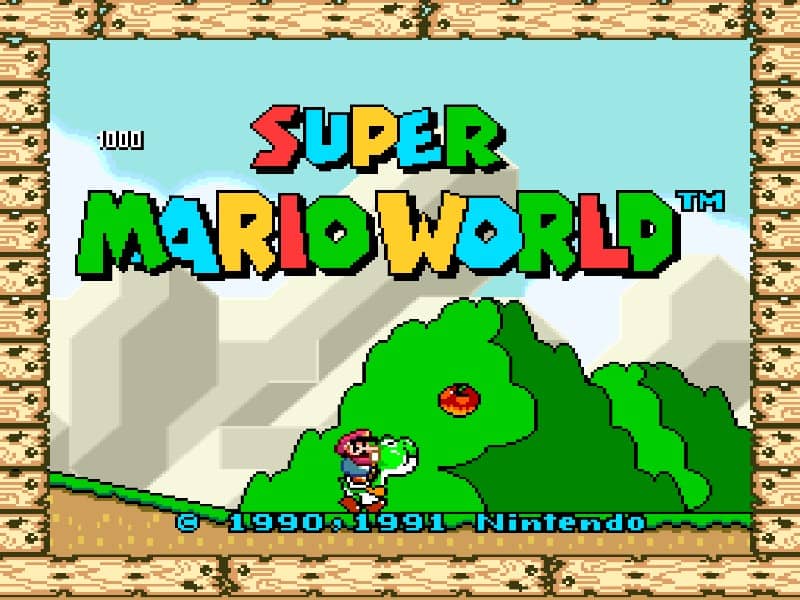
The most notable innovation is the introduction of Yoshi. Mario can ride this green dinosaur companion, who can swallow enemies with his long tongue, stomp them, and gain special abilities like fire breath or flight by using different colored shells. Yoshi not only diversifies combat but also changes the rhythm of platforming, as players must learn to work with him to clear levels that require long jumps or special attacks.
Another iconic item is the feather cape. When Mario grabs a feather, he can don a cape and, with a running start and cape swings, glide or even sustain flight. This greatly expands vertical exploration, as many hidden high platforms and secret areas are only reachable by air. The cape's flight mechanics have a learning curve, but mastering it brings a great sense of freedom and accomplishment, adding depth to level design.
The game's map system is also distinctive. Players move on a world map connecting levels, free to choose their path. Many levels have hidden exits that unlock new routes, sometimes bypassing entire sections of the game. Special locations like ghost houses, switch palaces, and the Star Road further enrich exploration, making the game world feel vast and mysterious, encouraging players to try different paths.
Level design in Super Mario World emphasizes exploration and discovery. Beyond the standard goal pole, each level hides secrets like hidden blocks, passages, and coins. These often require careful observation or daring jumps to find. The game doesn't force players to uncover every secret, but those who do are rewarded with extra bonuses and routes, making the game highly flexible and extending its longevity.
Background and release
Super Mario World was released in Japan on November 21, 1990, as a launch title for the Super Nintendo Entertainment System, one of the first games for the 16-bit console. At the time, Nintendo was transitioning from the Famicom to new hardware and needed a flagship title to showcase the system's power and entice players to upgrade. Mario, as Nintendo's mascot, naturally took on this role.
The game is set in Dinosaur Land. Mario and Luigi are on vacation when they discover that Bowser has kidnapped Princess Peach and trapped Yoshi's friends in eggs. To rescue the princess and the Yoshis, the brothers embark on an adventure across Dinosaur Land. The story is simple but provides motivation and naturally introduces Yoshi, with players uncovering the land's secrets along the way.
In the series' evolution, Super Mario World is a continuation and refinement of Super Mario Bros. 3 from the Famicom era. It inherits the previous game's extensive item system and level design philosophy, while leveraging the new hardware to deliver larger levels, smoother animations, and richer colors. The game's graphics and sound far surpass the 8-bit era, offering a new audiovisual experience.
This installment also marks the first time the series used a world map combined with level selection. While Super Mario Bros. 3 had a similar map, this one is more three-dimensional, with branching paths and hidden routes, allowing players to see level locations and choose their direction. This design greatly increases non-linearity and set the tone for future Mario games' map design.
Super Mario World was a commercial success, selling over 20 million copies worldwide, making it one of the best-selling games on the Super Nintendo. It was a killer app at launch and continued to sell well throughout the console's life, playing a key role in the SNES's popularity. For many players, this game is synonymous with 16-bit action gaming.
Development
Super Mario World was developed by Nintendo Entertainment Analysis & Development (EAD), directed by Takashi Tezuka, produced by Shigeru Miyamoto, with music by Koji Kondo. The team had previously created classics like Super Mario Bros. 3, accumulating extensive experience in 2D platformer development. For this project, they faced the challenge of realizing even greater creativity on the new 16-bit hardware.
The character Yoshi originated from an idea Miyamoto had harbored for years. Early in Mario's development, he wanted Mario to ride a dinosaur-like companion, but the Famicom's hardware couldn't support it. The Super Nintendo's capabilities finally made riding and character animation possible. Yoshi's design blends dinosaur and turtle features, with green skin and a red shell, making him cute and unique.
The development team invested heavily in level design. They aimed to break away from the linear progression of traditional platformers, giving players more freedom to explore and choose. To this end, they designed hidden exits, switch palaces, and the Star Road, creating complex connections between levels. This forward-thinking approach reflected Miyamoto's philosophy of letting players discover fun on their own.
For music, Koji Kondo composed several classic tracks. The main theme is light and lively, matching the game's upbeat style, while level themes vary by setting, from the pastoral to the mysterious, enhancing the atmosphere. Kondo skillfully utilized the SNES's audio chip to produce fuller, more melodic sound.
The development process also involved technical challenges, such as making Yoshi's tongue, swallowing, and riding animations smooth, implementing complex path connections on the map, and balancing flight mechanics with level design. These issues were resolved through repeated testing and adjustment, and the final results proved the efforts worthwhile.
Reception and legacy
Since its release, Super Mario World has received high praise from players and critics alike. Many media outlets and gamers consider it one of the greatest platformers ever made, with some calling it the pinnacle of 2D platforming. Its level design, controls, and exploration elements are frequently lauded and have become a template for countless subsequent games.
Yoshi quickly became a beloved character after the game's release, becoming another iconic figure for Nintendo. He not only plays a key role here but also spawned his own series, such as Yoshi's Island and Yoshi's Crafted World. Yoshi's cute appearance and unique abilities endeared him to fans, enriching the Mario universe.
The game has had a lasting influence on later Mario titles. Design concepts like the world map, hidden exits, and rideable companions were carried forward and evolved in games like New Super Mario Bros. U. Elements such as switch palaces and the Star Road have become classic references, often homaged or reimagined.
In retrospective evaluations, Super Mario World frequently appears near the top of 'greatest games of all time' lists. It achieved both commercial and critical success at launch and remains a classic decades later. Many older players cherish it as a fond childhood memory, while new players can experience its charm through re-releases or emulation.
In summary, Super Mario World is not just an excellent game but a milestone in game design history. It demonstrated that platformers could have deep exploration and rich gameplay, showcasing Nintendo's unique design philosophy. Its influence endures, and it remains a benchmark for game designers and players alike.





