
Gameplay and design
The most noticeable system change in The King of Fighters 2002 is the removal of the Striker system from the previous game, which had troubled many players, bringing combat back to the classic 3-on-3 format. This decision made the pace of matches noticeably cleaner; players no longer had to think about when to call for assistance, instead focusing entirely on direct confrontation. For veterans who had been playing since The King of Fighters '98, this return felt like meeting an old friend.
The power gauge changes are also intriguing. The power gauge design in this game is closer to that of The King of Fighters '97, but with a key difference: as your team's character count decreases, the number of power stocks you can store increases. In other words, when you're down to your last character, you can build up more meter to stage a comeback. This mechanic makes endgame scenarios especially thrilling and tests players' resource management rather than encouraging relentless aggression.
The MAX activation state is another core system. Players can consume power to enter MAX mode, gaining enhanced attack power and new combo possibilities for a short time. More impressively, each character can unleash a unique MAX2 super move while in MAX state; these moves often feature flashy animations and massive damage, making them powerful tools for turning the tide in battle. However, the conditions for triggering MAX2 are not lenient, requiring players to make strategic trade-offs at the right moments.
This installment also introduces two new actions: quick emergency evasion and quick MAX activation. The former allows players to dodge quickly in various situations, increasing flexibility in spacing; the latter permits players to enter MAX state directly during specific actions, offering new approaches to combos and pressure. These systems are easy to pick up but have depth for advanced play, allowing both experts and casual players to find their own enjoyment.
Overall, the gameplay design philosophy of The King of Fighters 2002 is clear: it builds on the classic framework while adding depth through the new power gauge system and action options. It doesn't pile on complex assist mechanics like the previous game, instead letting players focus on character-versus-character combat. This subtraction is quite clever, catering to the nostalgia of old players while leaving ample room for newcomers to explore.
Background and release
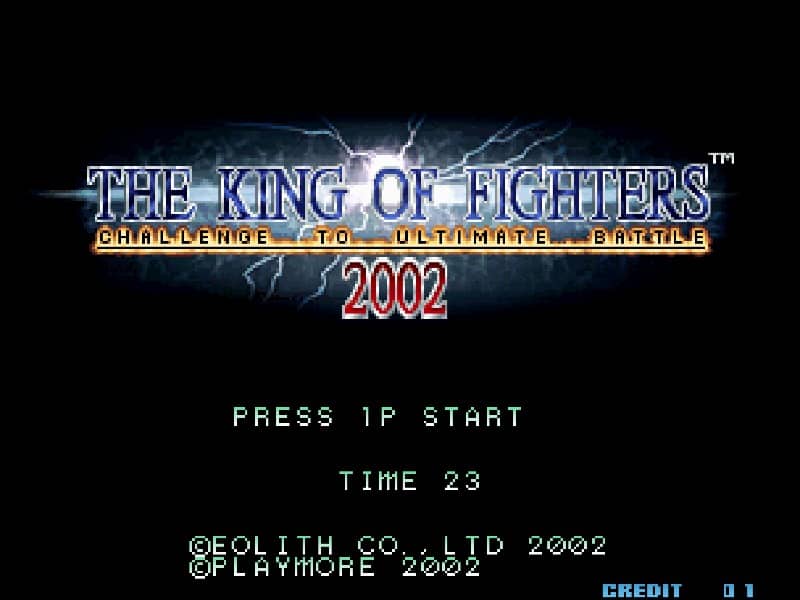
The King of Fighters 2002 is the ninth game in the King of Fighters series, developed by the Korean company Eolith and published by Playmore, released on the Neo Geo arcade platform in 2002. As the first game after the NESTS saga concluded in The King of Fighters 2001, this installment does not continue the previous storyline but instead adopts a dream match setting similar to The King of Fighters '98, allowing characters from different eras to compete against each other. This setup provided a fresh sense of novelty for players at the time.
The game's character roster is quite extensive, covering teams from The King of Fighters '96 through The King of Fighters 2001, including series mainstays like the Japan Team, as well as representatives from the Orochi and NESTS sagas. This mix allows players to control their favorite characters, whether it's the classic Kyo Kusanagi and Iori Yagami, or later additions like K' and Kula, all in one game. For series fans, this is undoubtedly a feast.
The final boss is Rugal Bernstein, a classic antagonist who has appeared multiple times in the series, returning in this game with new moves. His presence not only provides a challenge for players but also echoes the dream match theme—after all, Rugal is one of the most iconic bosses in the King of Fighters series. Defeating him became a goal for many players.
Notably, in the Neo Geo original, series regulars like King and Yashiro Nanakase are absent for the first time. This decision disappointed some players, but the subsequent Dreamcast version added these two characters, while the PS2 and Xbox versions additionally included Geese Howard, Goenitz, and Orochi Iori from SVC Chaos. These additions, though not part of the Neo Geo original, enriched the game's roster.
The arcade version began operation on October 10, 2002, followed by the Neo Geo home console version on December 19 of the same year. The game was later ported to Dreamcast, PS2, and Xbox platforms, with the PS2 and Xbox versions bundled with The King of Fighters 2003 in North America. These ports allowed more players to experience the game and laid the foundation for its subsequent reputation.
Development
The development of The King of Fighters 2002 was led by the Korean company Eolith, with assistance from Brezza Soft. This was Eolith's second King of Fighters game. Since the NESTS saga had concluded in The King of Fighters 2001, SNK decided to blend elements from the NESTS saga and the earlier Orochi saga, thereby bringing together characters from both storylines. This mixed roster design was both a tribute to the series' history and a strategy to attract players from different eras.
Early in development, the team decided to remove the Striker system because it had received negative feedback in the previous game. This decision directly influenced the overall design direction, bringing combat back to a purer one-on-one confrontation. At the same time, to balance the preferences of Korean and Japanese players, the team put considerable effort into character selection and system adjustments. SNK noted that there were approximately 4 million King of Fighters fans in Korea, so The King of Fighters 2001 had been aimed at the Korean audience, while this game needed to find a balance between the two markets.
The creation of Kusanagi, a clone of Kyo Kusanagi, stemmed from Kyo's continued popularity after the NESTS saga. The team decided to have this clone wear the school uniform that Kyo had abandoned in The King of Fighters '99, evoking memories for old players. However, Kusanagi has no storyline in The King of Fighters 2002; his backstory was not fleshed out until The King of Fighters 2003. This design satisfied players' expectations for classic characters while laying groundwork for future installments.
The game's illustrations were handled by Nona, whose art style sparked mysteries about the protagonist. Since the game has no standalone story, the protagonist's identity is not clear, giving players more freedom in character selection. Additionally, compared to previous works, the enemy AI difficulty was reduced, possibly to attract more casual players and make the playthrough less frustrating.
The development team introduced new mechanics such as quick emergency evasion and quick MAX activation, which made combat more flexible and varied. At the same time, some characters, especially those from the Orochi team, were redrawn to be closer to their The King of Fighters '98 style. These detailed adjustments reflect the team's respect for the series' traditions and their technical dedication.
Reception and legacy
The King of Fighters 2002 received considerable praise upon release. Hardcore Gaming 101 considered it a high point of the series, commending its character roster and balanced gameplay. GameSpot also praised the game's character count and reworked battle engine, calling it one of the best 2D fighting games. These reviews affirmed the game's success in system design and content richness, securing its important position in the series.
However, some media outlets offered differing opinions. MeriStation criticized the removal of the Striker system and the return to an older style, arguing that it lacked standout features. IGN praised the mix of old and new characters, as well as the new game mechanics and visual improvements, but lamented the removal of Strikers. GameRevolution considered it another take on The King of Fighters '98 but criticized its outdated graphics. These controversies reflect players' varying expectations for the series' evolution.
In Latin America, this game is widely regarded as one of the most popular in the series. Players in this region have a special affection for The King of Fighters 2002, and it has been a staple in arcades for years. This immense popularity not only led to commercial success but also influenced the direction of subsequent developments, such as the later remake Unlimited Match, which was enhanced with this market in mind.
The lasting impact of The King of Fighters 2002 is also evident in its remake, Unlimited Match. This remake added new characters and systems but differs from the original in content and balance. For players, both the original and the remake have their own fan bases, and the original holds an irreplaceable position in competitive play and nostalgia. The existence of these two versions enriches the series' history.
Furthermore, the Xbox version supported online multiplayer via Xbox Live, which was quite advanced at the time. Although the official online service was terminated in 2010, the community has restored online play through the Insignia service, allowing players to still enjoy online matches today. This community-driven maintenance is a testament to the game's significance in players' hearts, making it a classic that transcends generations.





