
Gameplay and design
The most significant change in The King of Fighters 2003 is the introduction of the 'Multi-Shift' system. During battle, players can press the shift button at any time to swap the active character with a teammate on standby, eliminating the need to rely on 'Strikers' for assist calls as in previous games. This system speeds up the pace of offense and defense, offering more tactical options: you can wear down an opponent with one character, then switch to a fresh one for combos, or use a swap to escape pressure. However, shifting is not without limits; after each swap, there's a brief cooldown before you can switch again, forcing players to think carefully about timing.
Complementing the Multi-Shift system is the 'Tactical Leader System.' Before a match, each team designates a leader, who has access to a unique 'Leader Super Special Move' that is more powerful than regular supers but consumes more of the power gauge. This design adds depth to team composition: the choice of leader often dictates the team's playstyle. For instance, setting a high-damage character as leader allows for comebacks with the leader super, while a nimble character can use their mobility to create opportunities.
The power gauge rules have also been adjusted. Players start with three power stocks, and each time a team member is lost, the gauge's maximum capacity increases by one stock. This means that as the battle progresses, remaining characters can accumulate more power and unleash stronger special moves. This design encourages aggressive play early on, as even if you lose members, you gain greater explosive potential later, making matches full of comeback possibilities.
The game's speed is faster than its predecessor, The King of Fighters 2002, with character movement, attacks, and recovery all feeling snappier. Critics generally regarded this as a major improvement, as the faster pace makes battles more exciting and aligns with the design intent of the shift system. However, the increased speed also demands quicker reactions and more precise inputs, which may require a period of adjustment for newcomers.
The game features 36 playable characters, forming 12 themed teams. New faces include Ash Crimson, Shen Woo, Duo Lon, Malin, as well as Tizoc and Gato from Garou: Mark of the Wolves. These new characters vary in style, with some excelling in close-range pressure and others focusing on zoning, offering players a rich selection. However, the game does not deliberately lower the skill floor; instead, system adjustments make it easier for beginners to get into, such as a more intuitive power gauge accumulation and simplified shift controls.
Background and release
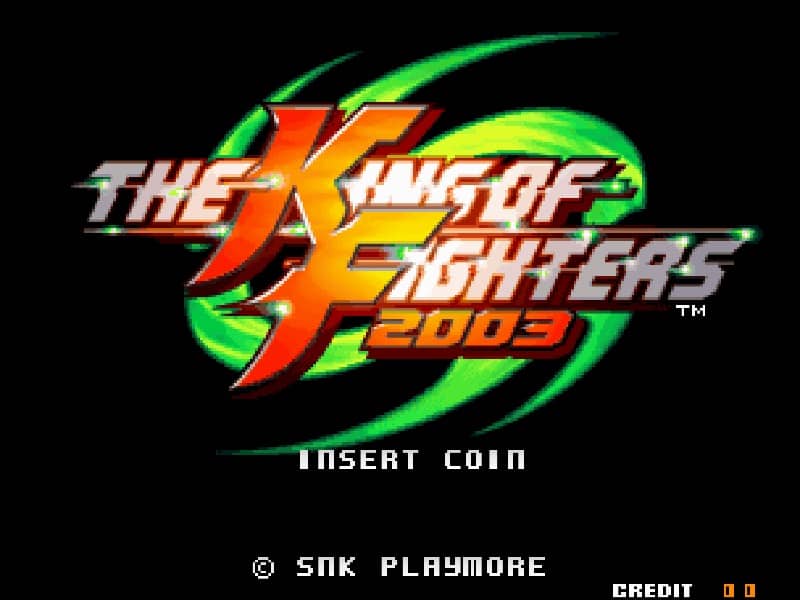
The King of Fighters 2003 was first released for the Neo Geo MVS arcade platform on December 12, 2003, marking the tenth main entry in the series. For the aging Neo Geo hardware, this was both a milestone and a farewell—it became the last King of Fighters game on that platform. Afterward, SNK Playmore shifted its focus to new hardware, but as the swan song of the Neo Geo era, The King of Fighters 2003 holds a unique place in the series' history.
The game's story kicks off the 'Tales of Ash' arc, a departure from the previous 'Orochi' and 'NESTS' sagas. New protagonist Ash Crimson appears, not as a traditional hero but as a 'charming villain' with mysterious motives and cunning behavior. The narrative revolves around him and introduces a mysterious organization called 'Those from the Past,' setting the stage for future plot developments. This shift in protagonist archetype gives the series' storytelling a new direction.
The game was initially planned for development on Atomiswave hardware but was ultimately changed back to Neo Geo MVS. This decision may have been influenced by considerations of installed base and player community, as the Neo Geo still had a large user base at the time. However, this also meant the game had to implement new systems on aging hardware, presenting the development team with technical challenges.
In terms of story, the game features two possible final bosses: Adelheid and Mukai. The player's performance in the mid-boss battle determines which final boss they face. The mid-boss, Kusanagi, is a clone created by Chizuru Kagura using the Mirror of Yata to test the winner's strength. If the player defeats Kusanagi, they face Adelheid; if they lose to Kusanagi, they proceed directly to the Mukai route. This design adds replay value and introduces branching story paths.
In the canonical ending, Ash absorbs Chizuru's Mirror of Yata after Mukai escapes, taunts Iori, and prompts Kyo to swear revenge. This ending breaks the pattern of the protagonist team triumphing over evil, leaving Ash's motives and identity as a mystery, creating significant narrative space for subsequent games. After clearing the game, players often wonder about Ash's true intentions, which is part of the charm of the 'Tales of Ash' arc.
Development
Character design and art for The King of Fighters 2003 were handled by Falcoon, marking his first involvement in a mainline King of Fighters title. Falcoon, previously known for illustrations and manga, brought a stylish and detailed aesthetic, infusing characters with a new visual flair. Ash Crimson's look—blond short hair, green flames, and a frivolous smile—was his design, contrasting sharply with the rugged image of previous protagonists and fitting the 'villain protagonist' role.
The Multi-Shift system was designed to replace the 'Striker' assist system from the NESTS saga. In The King of Fighters 2000 and 2001, players could call teammates for support attacks, but this system was controversial in terms of balance. The development team decided to overhaul it in The King of Fighters 2003, substituting 'shifting' for 'assists,' making teammates active participants in battle rather than mere tools. This change not only simplified controls but also made combat more intuitive.
SNK Playmore explicitly stated during development that they aimed to lower the game's difficulty to attract a broader player base. They believed the high difficulty of previous titles hurt playability, so they adjusted systems in the new game, such as smoother power gauge accumulation and easier shift controls. However, this does not mean the game became easy; rather, it allows newcomers to integrate faster while retaining depth for veterans to explore.
Adelheid's inclusion was intended to appeal to a wider audience and add story depth. As the son of Rugal Bernstein, he inherits his father's power and demeanor but has a more complex personality. In Adelheid's stage, the background music uses Chopin's 'Revolutionary Etude,' a classical piece that contrasts sharply with the battle scene, creating a unique atmosphere. However, due to Neo Geo hardware limitations, the development team had to remove dialogue from other characters to ensure the music played properly.
The development process also involved technical trade-offs. Due to Neo Geo's capacity and performance constraints, some content was compressed or adjusted. Despite this, the team managed to implement the Multi-Shift system and a rich character roster within the limited conditions. These efforts kept the game's graphics and sound up to series standards while accumulating experience for future technical upgrades.
Reception and legacy
The King of Fighters 2003 received mixed reviews, with critics divided on the story, graphics, and new gameplay, but generally agreeing that the game's speed was a major improvement. GameSpot felt the game was an improvement over its predecessor, The King of Fighters 2002, but that 2002 was more enjoyable; IGN compared the battle system to Marvel vs. Capcom 2 but lamented the lack of online mode in the PS2 version. These reviews reflect the game's balance between innovation and tradition, with both highlights and controversies.
As the final Neo Geo title, The King of Fighters 2003 was released alongside Samurai Shodown V Special, marking SNK Playmore's farewell to the Neo Geo. Subsequently, SNK canceled development of The King of Fighters 2004 in fall 2004 and instead signed with Sammy to use the Atomiswave system, with the arcade version of the sequel, The King of Fighters XI, adopting that hardware. This transition led the series into a new technological era, but The King of Fighters 2003's role as a transitional work cannot be overlooked.
The Multi-Shift system debuted in The King of Fighters 2003, and while not a series first (a similar system existed in Kizuna Encounter), it was fully developed within the King of Fighters series. The sequel, The King of Fighters XI, continued and refined this system, making it a key feature of the series. In this sense, The King of Fighters 2003 laid the foundation for the gameplay design of subsequent titles, influencing the series' direction.
The game spawned a manga adaptation of the same name, released in two parts in China and combined as The King of Fighters 2003 in North America. The manga is an adaptation and does not exactly match the game's story, but it offers fans an additional narrative perspective. This cross-media tie-in also expanded the work's influence, bringing more players into the world of 'Tales of Ash.'
Overall, The King of Fighters 2003 plays a bridging role in the series. It is both the finale of the Neo Geo era and the beginning of the 'Tales of Ash' arc, with its innovative shift system and villain protagonist injecting new vitality into the series. Despite mixed reviews, its unique position in King of Fighters history and the inspiration it provided for subsequent works make it a memorable entry.





