
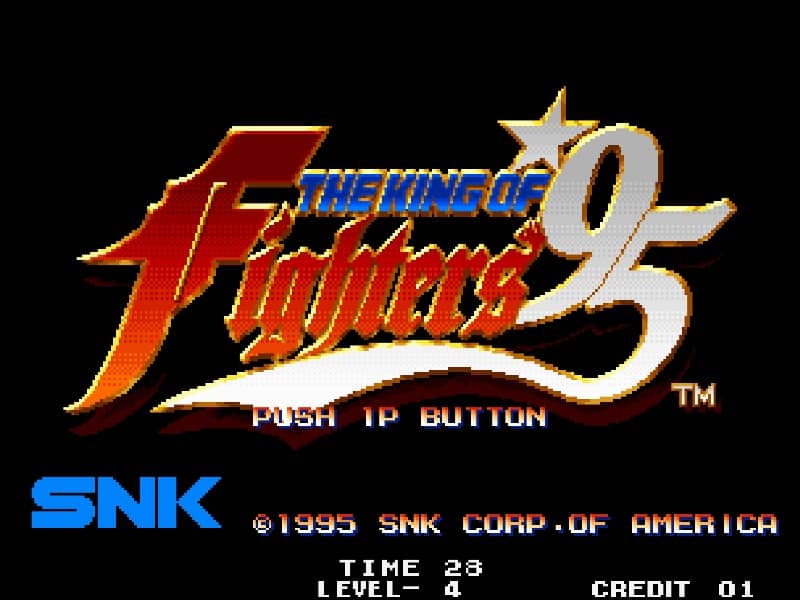
Gameplay and design
The core gameplay of The King of Fighters '95 continues the three-on-three team battle format of its predecessor, where players select three characters before a match and take turns fighting opponents in one-on-one bouts. While this mode wasn't uncommon in fighting games at the time, the biggest innovation here was the Team Edit system, which allowed players to freely choose any three characters from the full roster of 24, rather than being locked into preset teams as in the previous game. This seemingly simple change greatly deepened the strategic layer and replay value, letting players craft countless combinations based on personal preference and character synergy, and giving every match a distinct personal flavor.
Beyond the increased team freedom, the combat mechanics saw several tweaks. The somewhat clunky dodge move from the previous game was redesigned, allowing characters to transition more quickly into counterattacks after evading, which improved the pacing. The game also introduced more combo possibilities, with some characters' move properties and hitstun adjusted to enable skilled players to pull off flashier sequences. These changes weren't revolutionary, but they made the overall combat smoother and placed greater emphasis on reaction time and prediction rather than simply relying on character strength.
The CPU opponent AI was also specially tuned. The development team recognized that in the previous game, players could easily beat the computer by spamming the same move, so in The King of Fighters '95, the AI reacts to player habits, blocking, dodging, or using throws more frequently. This meant players had to constantly vary their tactics and couldn't rely on a single strategy. While this increased the difficulty of clearing the game, it also made the single-player mode more challenging and rewarding, as players could sense the opponent 'growing' rather than mechanically repeating actions.
In terms of character design, the game retained most of the previous roster and added several new faces, the most notable being Iori Yagami. As the rival of Kyo Kusanagi, he wields unique purple flames and a wild fighting style, with moves focused on claw strikes and lunges, extremely fast and contrasting sharply with Kyo's steadier approach. Iori's inclusion not only enriched the character lineup but also brought new tactical options; his high mobility and pressure made him an instant hit with players, quickly becoming a popular choice. Additionally, the game features a hidden mid-boss, Saisyu Kusanagi, Kyo's father, who uses similar fire-based moves but with greater strength, offering an extra challenge.
Overall, the gameplay design of The King of Fighters '95 builds on the framework of its predecessor, enhancing the experience through free team selection, system refinements, and AI improvements, making it more varied and deeper. It didn't blindly chase innovation but precisely captured the core appeal of fighting games—the interplay between players and the joy of team composition. These designs not only made the game stand out at the time but also laid a solid foundation for the series, with many mechanics and character traits becoming iconic elements.
Background and release
The King of Fighters '95 was first released in Japanese arcades on July 25, 1995, as a direct sequel to The King of Fighters '94, carrying SNK's ambitions in the fighting game market. The success of the previous title had shown SNK the series' potential, so this installment was highly anticipated from the start. After the arcade release, it quickly sparked a craze among players, with the free team selection system and Iori Yagami's debut becoming hot topics in arcades. On September 1 of the same year, the game was ported to the Neo Geo AES home console, and on September 29, a Neo Geo CD version was released, catering to different player needs.
In 1996, the game expanded to more home platforms. The PlayStation version was released on August 31, 1996, in North America and PAL regions, published by Sony Computer Entertainment, and featured a remixed soundtrack and new gameplay options for a richer experience. The Sega Saturn version came out the same year, notably requiring a special ROM cartridge to run, making it the first game in history to use both CD-ROM and ROM cartridge simultaneously. This technical approach was quite unique at the time but reflected SNK's commitment to port quality.
Beyond mainstream consoles, the game also received a Game Boy version, published by Takara in Japan and Nintendo in North America. Due to hardware limitations, the Game Boy version had simplified graphics and controls, but it supported the Super Game Boy and included a special hidden character—Nakoruru from the Samurai Shodown series. This crossover character delighted many players and showcased SNK's tradition of character interactions across its games. While the Game Boy version couldn't fully replicate the arcade experience, it offered handheld players a chance to enjoy The King of Fighters on the go.
In terms of story, this installment continued the previous game's narrative, with Rugal Bernstein hosting the KOF tournament again, but this time he harnessed the power of Orochi, seeking even greater strength. Kyo's father, Saisyu Kusanagi, appears as a mid-boss, brainwashed by Rugal and forced to fight his son, eventually regaining consciousness after being defeated. This setup added dramatic tension and set the stage for the 'Orochi Saga,' foreshadowing future installments. Iori Yagami's debut was also closely tied to Kyo's fate, with their rivalry becoming a core thread in the series' story.
From a release perspective, The King of Fighters '95 was the first in the series to be widely ported to multiple home platforms, marking SNK's attempt to broaden its audience. Although different versions varied in content and performance, they all retained the core gameplay, allowing more players to experience the game. This multi-platform strategy also provided a reference for future series ports, helping the franchise's influence extend beyond arcades and become a classic IP across platforms.
Development
Development of The King of Fighters '95 began in the winter of 1994, shortly after the release of the previous game. Director Masanori Kuwasako returned to helm the project, and he recalled that the team was exhausted from the intense work on the previous title, making it hard to come up with entirely fresh ideas. The initial concept was to make a 'fun version' rather than a complete overhaul. This pragmatic approach shaped the development direction: to make targeted improvements and additions while preserving the core framework, rather than starting from scratch.
The birth of the Team Edit system was a significant turning point in development. The idea was initially proposed by director Kuwasako, who discussed it with producer Takashi Nishiyama and decided to implement it. In fighting games of that era, players typically had to choose preset teams, and free team selection was uncommon. Kuwasako believed that allowing players to freely mix characters would increase strategic depth and personalization, and this design ultimately became one of the game's biggest highlights, establishing a tradition of team freedom for the series.
During development, the team faced many trade-offs. Due to time constraints and balance considerations, some planned content was cut. For example, the team considered adding characters from the Samurai Shodown series, but ultimately abandoned the idea because weapon-based fighting didn't fit The King of Fighters' hand-to-hand style, and there were balance issues. Additionally, Geese Howard, a villain from Fatal Fury, was originally planned as a playable character but was also dropped. These decisions disappointed some fans but reflected the team's strict control over overall quality.
The limitation on team count was also a practical issue. Due to development cycle and hardware constraints, the game could only accommodate eight teams, meaning the American team from the previous game had to be removed. This decision wasn't story-driven but purely technical and resource-based. Nevertheless, the team compensated by adding new teams like Iori's Rival Team, making the character selection more diverse.
For the story, the game drew inspiration from the Japanese myth of the eight-headed serpent, Yamata no Orochi, with Kyo and Iori both connected to the power of Orochi. Saisyu Kusanagi's inclusion was a last-minute decision; he was originally thought dead in the previous game, but to add dramatic conflict, the team brought him in as a mid-boss. The final boss, Omega Rugal, was also meticulously designed, with his shirtless, white-haired appearance, mechanical right arm and eye, and an Omega tattoo on his back, all contributing to a menacing villain.
Reception and legacy
The King of Fighters '95 received widespread acclaim upon release, with many media outlets and players considering it one of the pinnacles of 2D fighting games. Computer and Video Games magazine even called it 'one of the greatest 2D fighting games ever made,' a high praise at the time. The game also won the 'Best Neo Geo Game' award from Electronic Gaming Monthly in 1996, further cementing its status in the fighting game genre. These accolades were not only a recognition of quality but also reflected its significance to players.
Commercially, the game performed strongly in Japan. The Neo Geo AES version sold 108,883 units in its first week, and the Neo Geo CD version sold 142,825 units, totaling over 310,000 units. The Sega Saturn version sold 135,214 units in its first week and accumulated 257,294 units by 2004. These numbers were quite impressive for fighting games at the time, demonstrating the game's popularity. Although the PlayStation version faced some criticism for load times and control response, it didn't hurt overall sales and reputation, and it actually introduced the game to a wider audience.
Iori Yagami's debut was one of the game's greatest contributions to the series. With his distinctive look, wild moves, and rivalry with Kyo, he quickly became one of the most popular characters in the franchise. In subsequent The King of Fighters titles, Iori has almost never been absent, becoming a series icon. His presence not only enriched the story but also provided players with more character choices, and many fans were drawn to the series because of him. It's fair to say that Iori's successful creation is the most valuable legacy of The King of Fighters '95.
Omega Rugal, as the final boss, also became a classic villain in fighting game history. His immense power and imposing design left a lasting impression, so much so that he returned as a hidden character in The King of Fighters '98, once again challenging players. This reuse of a beloved boss showcased SNK's understanding of player nostalgia and kept elements of The King of Fighters '95 alive in the series.
Furthermore, as the beginning of the 'Orochi Saga,' this game laid the groundwork for the series' future storylines. The introduction of Orochi's power and Iori's debut made the world of The King of Fighters more expansive and mysterious. In 2008, the game was included in The King of Fighters Collection: The Orochi Saga, re-released on PS2, PSP, and Wii, allowing a new generation of players to experience this classic. In summary, The King of Fighters '95 is not only an excellent fighting game but also a significant milestone in the series' history, with its influence still felt today.





