
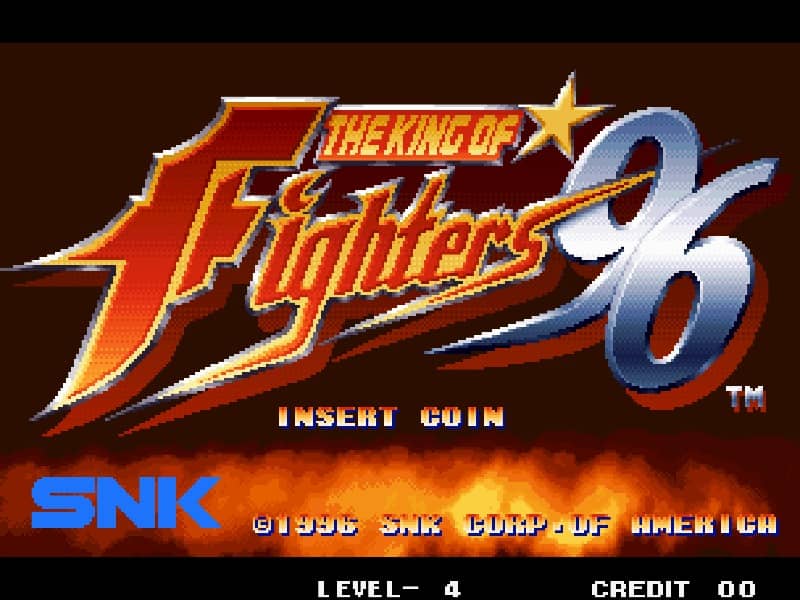
Gameplay and design
The King of Fighters '96 made several bold changes to its systems, the most noticeable being the replacement of the previous game's sidestep with an emergency evasion. The old in-place sidestep was removed, replaced by a forward or backward roll, giving players more options when responding to an opponent's attacks. Emergency evasion not only allowed characters to quickly escape unfavorable positions but also enabled immediate follow-up attacks, speeding up the rhythm considerably. For veterans accustomed to the previous game's pace, this change took some getting used to, but once familiar, the flow of offense and defense became smoother.
In addition to emergency evasion, this installment introduced two new jump types: the small jump and the medium jump. The small jump has a quick start and short airtime, ideal for aerial strikes or baiting opponents into attacking; the medium jump sits between the small and large jumps, allowing players to leap over projectiles while maintaining some mobility. These three jump types enriched character movement options and gave players more ways to close in on opponents. Combined with emergency evasion, the overall pace of the game was noticeably faster, shifting away from the previous style of zoning with projectiles or slow probing to a more aggressive, quick-reaction approach.
The super special move system was also adjusted, introducing MAX super special moves for the first time. When a character's health bar drops into the red zone and the power gauge is full, players can unleash a MAX version of their super special move, which deals more damage and features flashier effects. This design made the final moments of a match unpredictable, with comebacks from near-defeat happening frequently. However, the conditions for triggering MAX super special moves were strict, requiring players to take risks and build power while in danger, testing their courage and timing.
To complement the faster pace, most characters' projectiles were weakened, with slower startup and increased recovery, making it less viable to spam them mindlessly. Additionally, many characters had their special moves removed, streamlining their move lists. These changes shifted the game's focus toward close-quarters combat, requiring players to rely more on normal moves, special moves, and movement to create opportunities. This design appealed to players who enjoyed up-close brawling, but those accustomed to projectile zoning might have found it less comfortable.
In terms of character selection, this game continued the three-person team mode from the previous installment, but players could freely choose characters to form their team, no longer restricted to fixed teams as in the first game. Furthermore, two hidden playable characters were included: Chizuru Kagura and Goenitz, who could be accessed by entering specific codes on the character select screen. Chizuru Kagura was a key figure in the story, while Goenitz was the final boss, and being able to use him in arcade mode was a pleasant surprise for players. These hidden elements increased the game's replayability and allowed players to discover more enjoyment through repeated attempts.
Background and release
The King of Fighters '96 is the third entry in the King of Fighters series, with the story picking up right after the ending of The King of Fighters '95. In the previous game, Kyo Kusanagi defeated Rugal, but the shadow of the Orochi clan had already begun to loom. In this installment, members of the Orochi clan became active, intending to resurrect Orochi and plunge the world into darkness. To counter this threat, Chizuru Kagura, one of the guardians of Orochi's seal, decided to host a new KOF tournament, using it to gather Kyo Kusanagi and Iori Yagami to fight against the Orochi clan. This setup shifted the story from a simple fighting tournament to a grander mythological narrative.
Chizuru Kagura was the organizer of this tournament and a significant new character in this game. She came from the Kagura family, which, like the Kusanagi and Yagami families, was tasked with guarding the seal of Orochi. In the story, she sensed that the Orochi blood within Iori Yagami was awakening, and that Kyo Kusanagi was the only one capable of opposing Orochi. She hoped that through the KOF tournament, these two rivals would join forces to prevent Orochi's resurrection. Chizuru's introduction not only enriched the plot but also laid the groundwork for the subsequent Orochi saga.
The final boss of this game was Goenitz, the leader of the Four Heavenly Kings of the Orochi clan, who possessed the power to control storms. Goenitz appeared at the end of the tournament, attempting to resurrect Orochi by sacrificing powerful fighters. In battle, he displayed overwhelming strength, making players feel the terror of the Orochi clan. However, after being defeated, Goenitz realized that the plan to resurrect Orochi had failed, and he chose to end his own life, dissipating into a storm. This ending was both tragic and mysterious, leaving players eager for the continuation of the Orochi saga.
Iori Yagami, for the first time, displayed the berserk state of his Orochi blood. After the tournament, Iori lost control due to the rampaging power within him, and in an unconscious state, he severely injured his teammates, Mature and Vice, leaving them in critical condition. This incident not only plunged Iori into self-blame but also made him aware of his connection to the Orochi clan. In his berserk state, Iori's attack power was greatly enhanced, but he completely lost his sanity, a setting that foreshadowed his fate in later installments.
Although the story of this game advanced the Orochi saga, it did not fully conclude it. The plan to resurrect Orochi was thwarted, but the Orochi clan was not completely eradicated, and Iori's berserk state hinted at a greater crisis. These unresolved threads were left to be revealed in the next installment, The King of Fighters '97. In a sense, The King of Fighters '96 served as a bridge in the storyline, continuing the previous game's narrative while setting the stage for the series' climax.
Development
The development of The King of Fighters '96 was extremely tight, with developers recalling that the game was still being adjusted right up to its release, leading to the removal of some characters and moves. For example, Whip, who was originally planned to be included, was postponed to The King of Fighters '99 because Leona was added to the Ikari Team. This kind of crunch was not uncommon at SNK at the time, but it was particularly pronounced in this game. Despite this, the development team managed to ensure the overall quality of the game, allowing it to make groundbreaking changes to the system.
This was the second game to push the technical limits of the Neo Geo platform, using 362 megabits (approximately 46 megabytes) of memory, breaking the system limits of the MVS arcade board for the first time. This allowed the game to include more characters, more detailed pixel art, and flashier special move animations. However, this also posed significant challenges during development, especially in drawing character sprites. It is said that Chizuru Kagura's sprite took a month to complete, forcing the designer in charge to work overtime.
The director of this game was Masanori Kuwasaki, who was responsible for creating the story of the Orochi saga. Kuwasaki drew inspiration from the Japanese myth of the eight-headed serpent Yamata no Orochi, setting Orochi as a sealed evil entity, with the Kusanagi, Yagami, and Kagura families as the inheritors of the seal. This setting elevated the King of Fighters story from a mere fighting tournament to a mythological battle between good and evil. Kuwasaki's work not only added depth to this game but also set the tone for the entire Orochi saga.
The development of this game took one year, while the original The King of Fighters '94 took two years. Although the development time was shorter, the system changes were substantial, thanks to the foundation laid by the previous game. Additionally, six musicians participated in the audio production, creating a diverse range of background music, from intense battle themes to mysterious boss themes, which effectively enhanced the game's atmosphere. The improved music quality was one of the reasons the game was well-received.
This game was originally planned to feature Geese in The King of Fighters '95, but that idea was abandoned until this installment. Geese, Krauser, and Big, three classic villains from the Fatal Fury and Art of Fighting series, joined as the Boss Team, becoming playable characters. This not only enriched the roster but also appealed to fans of SNK's other fighting games. However, due to time constraints, the Boss Team's move sets were relatively simple, but their presence still added to the game's appeal.
Reception and legacy
The King of Fighters '96 received mixed reviews from the media upon release. Some critics praised the graphics and character design, considering it the pinnacle of Neo Geo visuals at the time; others criticized the game's balance, noting that some characters were too strong while others were weaker. Despite this, the game achieved commercial success, with Japanese game magazine Game Machine listing it as the most successful arcade game of September 1996, and the AES version selling over 33,000 copies in its first week.
The system changes in this game had a lasting impact on the series. The introduction of emergency evasion and small/medium jumps significantly increased the pace of combat, a design that was carried forward and refined in subsequent installments. The MAX super special move also became a signature element of the series. In many ways, The King of Fighters '96 laid the foundation for the success of The King of Fighters '97, which further optimized the system and became one of the most popular entries in the series. SNK developer Yutaka Oda also considered this game to be the most important in the series.
The character roster of this game had a profound influence on the series. New characters like Leona and Chizuru Kagura became regulars in later installments, and Iori's berserk state became a significant plot element. The inclusion of the Boss Team created a crossover between Fatal Fury and Art of Fighting characters and the King of Fighters world, enriching the series' universe. These characters and settings are still frequently discussed by fans today.
The commercial success of this game also influenced SNK's subsequent development strategy. Since the bold system changes were well-received by players, SNK continued to deepen these systems in The King of Fighters '97 and further refined the story. In a sense, without the exploration of The King of Fighters '96, there would have been no glory for The King of Fighters '97. Although this game's status in the series is not as prominent as its predecessor or successor, it was a crucial link between them.
This game was later included in The King of Fighters Collection: The Orochi Saga, released on PS2, PSP, and Wii in 2008, allowing new players to experience this classic. In 2017, it was released on PS4 and Xbox One as part of the ACA Neo Geo series, and later ported to other platforms. These ports have allowed the game to continue to be enjoyed on modern platforms, letting old players relive their memories. Despite the controversy over its reception, its important position in the history of the King of Fighters series is undeniable.





