
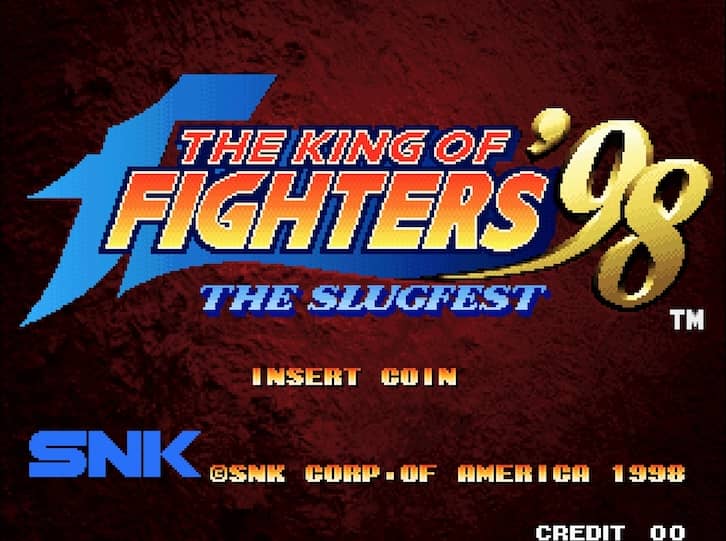
Gameplay and design
The core gameplay of The King of Fighters '98 continues the series' traditional 3-on-3 team battle mode. Players select three characters from a large roster and take turns fighting until all of one side's characters are defeated. This mode not only tests individual character skills but also requires players to consider team composition and order, adding strategic depth. The game has no story, with all characters under a "dream match" setting, allowing free combinations and letting players enjoy cross-series character clashes.
The game offers two fighting styles, Advance and Extra, which players choose when selecting their team. The Advance style is based on the system from The King of Fighters '97, featuring forward dashes, emergency evasions, and a gauge for super special moves, with a faster pace. The Extra style is closer to The King of Fighters '95 and '96, using a power gauge that builds up and dodge actions, suitable for players who prefer traditional mechanics. The two styles differ in energy management, evasion methods, and conditions for super special moves, allowing players to choose based on their habits and character traits, reflecting the game's integration and homage to the series' systems.
In addition to regular characters, the game introduces the concept of EX versions. These versions retain the basic appearance and move framework of the original characters but replace some skills with moves from previous installments. For example, the EX version of Kyo Kusanagi can use classic moves from '94 and '95. This design satisfies veteran players' nostalgia for classic moves and increases character selection diversity. EX characters are not simple palette swaps; their move differences offer different battle strategies, giving even those familiar with the originals a fresh experience.
The final boss is Omega Rugal, a modified form of Rugal from The King of Fighters '95, possessing immense attack power and multiple super special moves, recognized as a formidable foe in the series. Before facing the final boss, players may encounter the mid-boss Shingo Yabuki, who appears as a playable character and can be unlocked by defeating him. This consecutive challenge of mid-boss and final boss adds tension and a sense of accomplishment to the gameplay, allowing players to experience the legacy of series characters when facing strong enemies.
The battle system has been finely tuned in many details, such as attack hitboxes, stun times, and damage values, all carefully balanced to reduce the gap between characters, giving more characters a chance to shine. The game retains the super special move and MAX super special move systems from previous games, where players can use more powerful moves when the power gauge is full, but must time them and manage resources. These designs together form the core experience of The King of Fighters '98: deep yet accessible, offering enjoyment for both newcomers and veterans.
Background and release
The King of Fighters '98 is a 2D fighting game released by SNK on July 23, 1998, for the Neo Geo arcade platform, with the Japanese subtitle "Dream Match Never Ends," officially positioned as a "special edition" of the series. As the fifth entry in the King of Fighters series, it does not continue the story of previous games but adopts a "dream match" format, bringing together most characters from The King of Fighters '94 to '97, allowing players to freely combine them and experience battles beyond story constraints. This setting was quite novel at the time and reflected SNK's confidence in the popularity of its characters.
The game has no story mode, which is uncommon in fighting games, but this "storyless" positioning allows the game to focus purely on combat. Players can enjoy battles between characters without needing to understand complex backstories. This design also makes the game a "summary" of the series, allowing new players to quickly encounter a large number of characters while veterans can revisit classics. In the opening animation, Iori Yagami smashing the screen with his body became an iconic image of the series, hinting at the game's theme of "breaking conventions."
From the series' development perspective, The King of Fighters '98 occupies a transitional position. The previous game, The King of Fighters '97, concluded the "Orochi Saga" story, while this installment, as a special edition, does not advance the plot but lets players savor the series' essence through pure combat. This arrangement provided a buffer for the next game, The King of Fighters '99, to start a new storyline, and allowed the development team to adjust the game system, laying the foundation for the series' future. Thus, this game holds a unique place in the series, serving as both a retrospective and a look forward.
The game's character roster is extremely large, including almost all major characters from the previous four games, such as Kyo Kusanagi, Iori Yagami, and Chizuru Kagura, as well as guest characters from other SNK fighting games like Fatal Fury and Art of Fighting. Additionally, the return of the final boss Omega Rugal is a highlight. Rugal appeared in The King of Fighters '95, and in this game, he returns in a modified form, satisfying veteran players' expectations. This all-star lineup embodies the "dream match" concept.
The King of Fighters '98 achieved success in the arcade market. According to the Japanese game magazine Game Machine's September 1, 1998 issue, the game was listed as the most successful arcade game of that month. This achievement proved players' acceptance of the "dream match" concept and laid the groundwork for subsequent ports and remakes. Despite SNK facing financial difficulties during the release period, the game's success solidified the King of Fighters series' position in the fighting game genre.
Development
The development team of The King of Fighters '98 invested considerable effort in determining the character roster. They released all characters who had ever appeared in KOF at once and repeatedly discussed which ones should return, while also considering player feedback. This player-oriented approach ensured that the final roster covered representative characters from various periods of the series, reflecting SNK's attention to fan input. The team also created entirely new sprites and special moves for the newly added American Sports Team, ensuring their completeness despite the team's low popularity.
Rugal's return was a significant decision in the game's development. According to the development team, Rugal's return stemmed from the strong desire of the original creator, who believed Rugal was "the character best representing the ultimate KOF boss." Therefore, the game not only features Rugal in his Omega form but also grants him a powerful move set, making him a highly imposing boss in the series. This decision also met players' expectations for a classic boss, adding a nostalgic touch to the game.
Game director Toyohisa Tanabe held a negative view of this game, mainly because SNK went bankrupt during the release period and closed its U.S. operations. This event affected the game's promotion and distribution, and Tanabe worried about its market performance. Nevertheless, the development team completed the game and spent considerable effort on balance adjustments. According to Tanabe, the balance adjustments required the entire team to complete, showing their dedication to game quality.
There is an interesting easter egg during development: Tanabe inserted two images of Street Fighter characters Ryu and Ken into the game build. This action predates the release of Capcom vs. SNK and may have been a playful jab at competitors or a tribute to fighting game culture. Players discovered this easter egg in the game, becoming an anecdote and showcasing the developers' humor. However, this easter egg did not affect the game itself, existing only as a hidden element.
The victory screen design is also noteworthy. According to development materials, the victory screens were based on challenge images from the bonus battle against Shingo, drawn with more detail than previous games. This attention to detail made the game visually more refined. Additionally, since Kyo's move changes in The King of Fighters '96 were well received by players, the game added an alternate version of Kyo and expanded this to other characters, forming the EX version system. This design responded to player feedback and enriched character playability.
Reception and legacy
Since its release, The King of Fighters '98 has received widespread acclaim from critics and players, often regarded as one of the best entries in the series and even one of the greatest fighting games of all time. IGN's Jeremy Dunham gave the Dreamcast version a score of 8.4, praising its gameplay, characters, graphics, music, and background design, but lamenting the lack of a story. GameSpot's Jeff Gerstmann called it "one of the best 2D fighting games," but noted that newcomers might find it difficult to get into due to the execution difficulty of special moves and the AI's difficulty. These reviews reflect the game's standing among core players.
The game has had a lasting influence on subsequent works. Its opening animation, where Iori Yagami smashes the screen with his body, inspired works like The King of Fighters 2002 and led to the slogan "Shatter All Expectations" in The King of Fighters XV. This visual and thematic continuity makes The King of Fighters '98 an important source of the series' aesthetics and style. Furthermore, the game's balance design has served as a reference for later titles, with many players and developers considering it a benchmark for fighting game balance.
The game also achieved commercial success. According to Famitsu data, the AES version sold over 22,651 copies in its first week; the Dreamcast version sold 58,354 copies in its release week, increasing to 104,049 copies by 2004. While these numbers are not staggering, they were respectable in the fighting game market at the time. The game's arcade performance was also strong, being listed by Game Machine as the most successful arcade game of the month, proving its popularity in Japanese arcades.
The King of Fighters '98 has seen multiple ports and remakes. In 2008, the game was remade as The King of Fighters '98 Ultimate Match, adding more characters and systems, and released on multiple platforms. Additionally, the game was included in The King of Fighters Collection: The Orochi Saga in 2008 for home consoles, and in 2017, it was released on platforms like the Switch as part of the ACA Neo Geo series. On February 26, 2025, the arcade version was released on PlayStation 5 and Xbox Series X/S as the first game in the ACA Neo Geo 2 series, supporting online play and variable refresh rates, allowing new players to experience the classic.
The game has maintained enduring vitality in the player community. Even years later, it remains a staple in many fighting game tournaments, with its balance and character diversity making matches unpredictable. The game's storyless setting also allows players to focus on pure fighting fun, a design philosophy that has influenced many later fighting games. In summary, The King of Fighters '98 is not just an excellent game but a milestone in fighting game history, with an influence that continues to this day.





