
Gameplay and design
The most significant change in The King of Fighters '99 is the introduction of the Striker system. Instead of selecting three characters to fight in sequence as in previous games, players now choose a team of four, with one member designated as a Striker. This character can be called into battle via a specific command to perform a brief attack or assist. The number of Striker summons is limited, so players must manage their usage carefully, adding strategic depth to combat. This system altered the rhythm of traditional team battles, giving players more options for both offense and defense.
The game removes the Advanced and Extra modes from the previous installment, replacing them with a single battle mode, but introduces two new power-up states: Counter Mode and Armor Mode. Counter Mode can be activated while guarding, temporarily boosting attack power and speed, ideal for counterattacks. Armor Mode grants the character super armor for a period, allowing them to attack through incoming hits. Both modes consume the power gauge, and players must decide when to activate them based on the situation, making battles more dynamic.
The game retains the high-score challenge mechanic from the previous title. When players achieve a sufficiently high score under specific conditions, an extra battle is triggered against a hidden character, either Kyo Kusanagi or Iori Yagami. This extra battle is not part of the main storyline but serves as an additional test of skill, with a special ending for victory. This design enhances replayability, giving high-scoring players more goals to pursue.
In the Dreamcast version, The King of Fighters '99 Evolution, the graphics were enhanced, with all stages converted to 3D backgrounds, resulting in more spectacular visuals. Additionally, the Evolution version adds extra Striker characters and supports connectivity with the Neo Geo Pocket Color handheld, unlocking hidden content. These additions make the home console version richer in content, though the core gameplay of the arcade original remains unchanged.
Overall, the gameplay design of The King of Fighters '99 reflects SNK's exploration in the series' development. The Striker system, while somewhat controversial, undoubtedly brought new ideas to fighting games. The inclusion of Counter Mode and Armor Mode also made combat more intense. For veteran players, the game requires adapting to new systems, but once familiar, its unique appeal becomes apparent.
Background and release
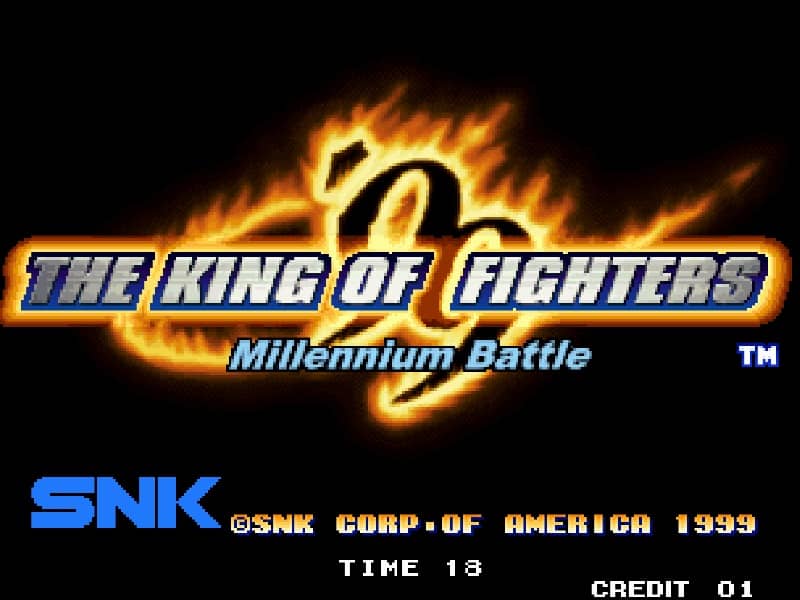
The King of Fighters '99 is the sixth installment in the King of Fighters series, released for arcades on the MVS board in Japan on July 22, 1999. The story follows the events of The King of Fighters '98, but rather than a simple continuation, it launches a new saga: the NESTS chapter. After the 1997 tournament, Kyo Kusanagi and Iori Yagami mysteriously disappear, and the world falls into turmoil. A mysterious organization called NESTS emerges, using Kyo's genes to create clones in an attempt to control the world.
The new protagonist, K', appears at this time. He is a young man with the ability to wield Kyo's flames, but his memories have been erased by NESTS, leaving only vague fragments. K' teams up with his partner Maxima to uncover the truth about his past. The story revolves around K''s confrontation with NESTS, while the mystery of Kyo and Iori's disappearance runs throughout. This setup shifts the series from traditional fighting tournaments to a grander conspiracy narrative.
The game's story is set two years after the 1997 tournament, but the events of that period are not directly explained; instead, they are gradually revealed through character dialogue and ending animations. NESTS uses Kyo's clones to build an army, and the game's boss, Krizalid, is one of its officers. Krizalid appears at the end of the game, engaging in a battle with K', but the true mastermind remains hidden, setting up the sequel.
Kyo Kusanagi and Iori Yagami are no longer protagonists in this game, appearing instead as hidden characters. This change stems from the development team's initial plan to remove them entirely, but strong player reactions during testing led to their inclusion as hidden characters. Kyo's costume also changed from his school uniform to casual clothes, a design shift not only to distinguish his new look but also to give rise to the clone characters Kyo-1 and Kyo-2, who use his old moves.
The story of The King of Fighters '99 opens the NESTS chapter, which holds an important place in the series. The development of the new protagonist K' and the NESTS organization gave the series a new direction in storytelling. Although the story is not fully explored in this game, it laid the groundwork for subsequent titles like The King of Fighters 2000 and The King of Fighters 2001, making it a pivotal turning point in the series' narrative.
Development
The producer of The King of Fighters '99 was Takashi Nishiyama, and this was his final work on the King of Fighters series. Nishiyama was a veteran producer at SNK, having worked on numerous fighting games. Due to internal company issues, he left SNK in 2000, making this game his swan song for the series. Nevertheless, he poured considerable effort into the game, especially in system innovation.
Development ran concurrently with Garou: Mark of the Wolves, and the character design teams for both games overlapped. K''s designer, Shinichi Morioka, had previously worked on The Fallen Angels. He was concerned that K''s design might be too similar to Rock Howard, the protagonist of Mark of the Wolves, so he deliberately differentiated K''s hairstyle and clothing. This simultaneous development fostered both competition and collaboration, resulting in stylistic differences and connections between the two games.
The decision to make Kyo and Iori hidden characters stemmed from the development team's attention to player feedback. During playtesting, players strongly objected to their removal, so the team decided to keep them as hidden characters. This decision not only satisfied player expectations but also led to the creation of the clone characters Kyo-1 and Kyo-2, who use Kyo's old moves but have different attributes, adding new gameplay elements.
The development team had planned to include a Robo Army team, a group of robot-themed characters, but the idea was ultimately abandoned. However, this concept did not disappear entirely; in The King of Fighters 2000, Maxima's Striker character Rocky pays homage to this plan. Additionally, the character Whip was originally intended to appear in The King of Fighters '96, but was postponed until this game due to Leona's inclusion. Her design also reflects the team's long-term planning for the character roster.
The game's character roster leaned younger, so to balance it, the team added older characters like Seth and Vanessa. The boss Krizalid's design was considered "over the top" by the designers, and some graphics were removed due to capacity limitations, but these were later restored in the Dreamcast version. These production details reflect the team's considerations in character design and game balance, as well as their creativity under technical constraints.
Reception and legacy
The King of Fighters '99 received generally positive reviews upon release. The battle system and Striker system were well-received, with many players praising the Striker system for adding a new strategic dimension to fighting games, though some questioned its balance. Despite the controversy, the game is recognized as an innovative entry in the series, and its system design influenced subsequent titles.
The Dreamcast version, The King of Fighters '99 Evolution, is considered one of the best fighting games on the Dreamcast platform. The version excelled in graphics and loading times, and the new 3D stages and extra Striker characters were well-received by players. In contrast, the PlayStation version received slightly lower praise due to longer loading times, but its overall quality remained commendable.
Game sales were decent but lower than the previous title, The King of Fighters '98, mainly due to poor home console sales. According to Famitsu data, the AES version sold over 14,620 copies in its first week, the Neo Geo CD version over 18,925 copies, and the PlayStation version sold 96,484 copies. The Dreamcast version, released around the time of the PlayStation 2 launch and the Dreamcast's decline, sold poorly, with only 41,387 copies in its first week. Nevertheless, the game was successful in the arcade market.
The King of Fighters '99 was included in the PS2 compilation The King of Fighters NESTS Collection and has been ported to modern platforms, including Wii Virtual Console and Nintendo Switch. This allows both new and old players to experience the game. An official novel, Beyond the "K", written by series writer Akihiko Ureshino, further expands the story background, providing fans with more insight into the NESTS saga.
The game's place in the series cannot be overlooked. It launched the NESTS chapter, introduced the new protagonist K', and brought in the Striker system, all of which were carried forward and developed in later works. Despite some controversies, The King of Fighters '99 is widely recognized as a key transitional work in the series, and its influence and historical value are well acknowledged, marking an important milestone in the King of Fighters series' evolution.





