Gameplay and design
The core gameplay of A Link to the Past revolves around the two worlds of Light and Dark. These worlds share the same map, but their terrain, inhabitants, obstacles, and accessible areas differ dramatically. Players must use their knowledge of the Light World's layout to deduce corresponding paths and secrets in the Dark World. This design is not a simple mirror image; it integrates spatial awareness, memory, and item use into a continuous puzzle experience. For example, a seemingly ordinary wall in the Light World might correspond to a hidden cave in the Dark World, while a chasm in the Dark World that cannot be crossed might have a bridge in the Light World. This correspondence encourages players to travel back and forth between the two worlds, constantly testing their assumptions.
The game's controls emphasize direct physical actions. Link can move in eight directions, jump down from ledges, push objects, lift and throw items, swim after obtaining flippers, and dash with the Pegasus Boots. These actions are executed directly via button presses, not selected from a menu. Swordplay is also varied, including a standard slash, a charged spin attack, a dash attack, and a beam when the sword is upgraded and health is full. This design gives combat and exploration a tactile feel, requiring players to master timing and direction rather than relying solely on stats.
Items are not just tools for combat; they are key to altering traversal. Bombs can blast marked walls, the Hookshot can cross gaps, the Hammer can smash stakes, the Book of Mudora can decipher ancient texts, and the Magic Mirror can switch between the Light and Dark Worlds. The acquisition and use of these items are often closely tied to dungeon structure. Dungeon maps show explored rooms and floor layouts, the Compass indicates the location of treasure, and the Big Key opens crucial locked doors. Multi-level floors, traps, switches, locked doors, and destructible walls together form puzzles that require spatial reasoning.
The game also offers a variety of optional preparation mechanics. The bottle system allows players to carry restorative potions, fairies, or captured creatures, with up to four bottles available. This design lets players flexibly adjust their carried items based on their play style and current needs, rather than being locked into a fixed loadout. Health is increased through Pieces of Heart and Heart Containers, while magic is replenished with Magic Jars; these exploration rewards directly enhance survivability, not just serve as collectibles.
Notably, the game's puzzle design allows for multiple solutions. For instance, when facing the Helmasaur King, both bombs and the Hammer can deal damage, with the Hammer's effectiveness being a later addition after the development team reconsidered its use. This design respects player creativity and makes battles and puzzles more open-ended.
Background and release
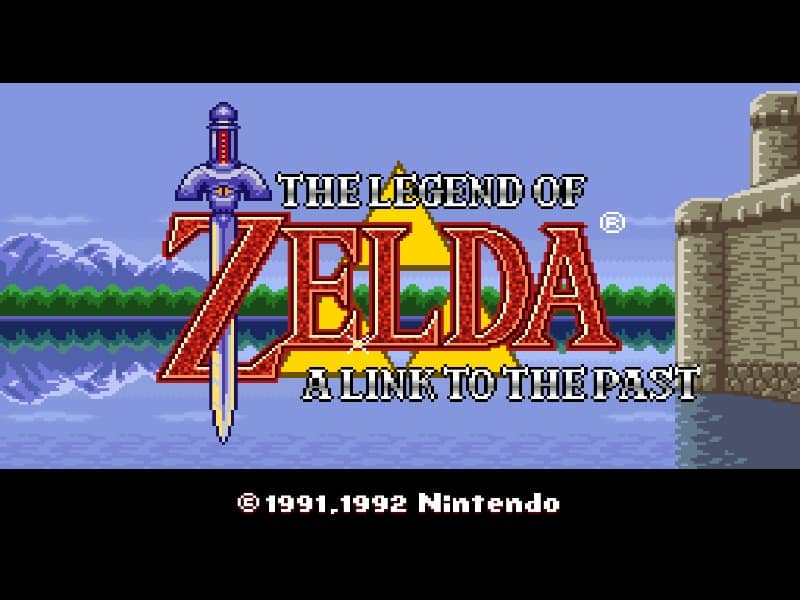
The Legend of Zelda: A Link to the Past was released in Japan on November 21, 1991, for the Super Famicom, and in North America in 1992 for the Super Nintendo. It is the third game in the Zelda series. After The Adventure of Link experimented with a side-scrolling perspective, this game returned to the top-down, real-time adventure structure of the original, though it was not the first top-down action-adventure game in the series.
The game's story is set in the official Zelda timeline, following the Imprisoning War. According to the game's manual, the Triforce, the Sacred Realm, and the Imprisoning War form the backstory: evil forces poured out from the entrance to the Sacred Realm, and the King of Hyrule ordered the Seven Sages to seal it. The game opens with Link hearing a telepathic call from Princess Zelda on a stormy night; she is trapped beneath Hyrule Castle. Link follows his uncle to the castle, setting off on his adventure.
The antagonist Agahnim gains influence in Hyrule, dethroning the king and sending the descendants of the Seven Sages into the Dark World in an attempt to break the old seal. Princess Zelda is his final target. After rescuing Zelda, Link must find the three Pendants of Virtue (Power, Wisdom, and Courage) and the Master Sword to confront Agahnim. The subsequent adventure revolves around rescuing the seven sages sealed in crystals and ultimately challenging Ganon.
The game's central setting is the two worlds of Light and Dark. The Light World is Hyrule as it normally is, while the Dark World is the Sacred Realm corrupted by evil. The two worlds roughly correspond geographically, but with vast differences in detail, requiring players to use their knowledge of the Light World to explore the Dark World. This dual-world design not only expands the game's map scale but also deepens the narrative theme of the struggle between light and darkness.
Development
The development of A Link to the Past took about three years, including planning and experimentation phases. Shigeru Miyamoto divided this period into roughly one year of planning, one year of experimentation, and one year of concentrated production. The initial team was very small, used mainly to test systems and hardware limitations, until more staff joined in November 1990. Takashi Tezuka joined midway through development and served as director; he later described it as a difficult production, with programmer Kazuaki Morita of SRD playing a crucial role in completing the game.
The game's world design underwent significant changes. Initially, three worlds were planned, but the team eventually reduced this to two, as three worlds would confuse players and exceeded what the project could realistically build. The final Light and Dark Worlds were split from a single map concept. The development team found that constructing the overworld map was vastly different from designing dungeons, feeling like making two separate games.
Controls and interface design also went through repeated iterations. The Super Nintendo controller offered more buttons, but assigning actions proved challenging. The team continually adjusted the feel of grabbing, pushing, and pulling to ensure that solving puzzles was a deliberate physical action, not an accidental one. The addition of diagonal movement initially made diagonal thrusts awkward, and the final solution was to introduce the spin attack rather than a separate diagonal attack command.
Enemy behavior in the game was also carefully designed. Some guards were programmed to react to sound: if a guard could not see Link through a wall but heard him fighting another soldier, it might approach. The team discussed the paradox of this behavior: a guard that respects walls might seem less aggressive than a simple enemy that ignores obstacles.
The difficulty of puzzle hints was adjusted through repeated playtesting. Too few hints left testers frustrated, while too many made solutions boring. Important information was sometimes placed in three locations, as a single piece of information was easily missed. The development team also abandoned some experimental ideas, such as fire spreading through grass, digging trenches, and using bombs to blast swamp barriers to let water flow. Miyamoto explained that these ideas had to become reusable, consistent game systems rather than isolated demonstrations.
For music and sound effects, Koji Kondo designed stereo effects that allowed players to determine direction by sound in dark spaces. He estimated the game contained about fifteen major musical tracks, plus short pieces, totaling around thirty. The opening music for Hyrule Castle was particularly labor-intensive. However, the music initially took up more memory than the cartridge could hold, forcing late-stage compression, and the team admitted that some planned features were not realized due to the game's scale.
There were also interesting details during development. Koji Kondo was proud of the chicken's clucking, and Takashi Tezuka insisted that the fortune teller charge a random fee rather than a fixed price. Additionally, the Bow-Wow concept and the rotating fire bar were shared between the Zelda and Mario series. The rotating fire bar was originally conceived for the first Zelda, later appeared in Mario games, and finally made it into this title.
Reception and legacy
A Link to the Past received widespread acclaim upon release. According to secondary sources, Japan's Famitsu gave it a 39/40 score in 1991, the first 39/40 in that magazine's history. In North America, Electronic Gaming Monthly (EGM) averaged 8.75/10 in 1992, and Nintendo Power scored it 4.9/5. These scores come from summaries in archived magazine archives; specific review comments require consulting original scans.
The game had a direct and traceable influence on subsequent Zelda games. After completing this title, SRD staff used a Game Boy development kit to create an experimental Zelda-like project in their spare time, which eventually evolved into The Legend of Zelda: Link's Awakening. This lineage is supported by explicit developer interviews, not just stylistic similarity.
When Nintendo developed The Legend of Zelda: A Link Between Worlds, it explicitly based the game on this one, adopting a similar top-down perspective and world design. That game retained the relevant Hyrule map while adding wall-merging mechanics, new dungeons, the Lorule world, and a different story. This direct reuse demonstrates the enduring value of this game's design language.
The game's most lasting legacy is a reusable design language: a readable open world, dungeons based on spatial rules, item-based progression, optional preparation mechanics, and two corresponding worlds. These elements were not original to this game, but it integrated them so well that they became a reference standard for many later action-adventure games. However, not all subsequent Zelda games directly copied this structure; for example, Ocarina of Time moved to 3D, and Link's Awakening adopted a different narrative approach. The game's influence is more about the transmission of design philosophy than simple pattern replication.