Gameplay and design
The Legend of Zelda uses a top-down perspective, with players controlling Link as he freely explores the vast land of Hyrule. At the start, Link carries only a small shield; after receiving a sword from an old man, he can officially begin his adventure. The old man's warning, "It's dangerous to go alone! Take this," has become a memorable opening for many players. The game imposes no forced main quest order, allowing players to explore the map at their own pace and discover hidden caves and secrets—a level of freedom that was rare at the time.
The game world consists of over 600 individual screens, with more than 97 overworld areas and nine multi-level dungeons underground. Each dungeon features unique puzzles and enemies, requiring players to find keys and defeat bosses to obtain crucial Triforce fragments. The dungeons are complex, with interwoven walls and corridors, demanding careful exploration to find the correct path. This tight integration of combat, puzzle-solving, and exploration established the core gameplay of the series.
In addition to the sword and shield, Link can acquire various items such as the boomerang, bow and arrows, bombs, and magical rods. These items are not only used in combat but are often key to solving puzzles—for example, using bombs to blast open hidden walls or shooting distant switches with arrows. The use of items enriches exploration and encourages players to think creatively when facing obstacles. The game encourages experimentation with different item combinations to discover new possibilities.
The game also introduced a save feature, an important innovation at the time. The Japanese version, using the Famicom Disk System's floppy disks, allowed players to save progress at any time, unlike many early games that relied on passwords. The North American cartridge version was among the first to use internal battery backup, letting players retain progress even after powering off the console. This design greatly eased the player's burden and made long adventures possible, leaving a lasting impact on future game design.
After completing the game once, a "Second Quest" mode is unlocked. In this mode, many locations, secrets, and dungeon layouts are changed, and enemies are stronger, offering a fresh challenge. This mode is known as "Ura Zelda" in the Japanese version, not the official translation "Rize Zelda." It provides motivation for repeated playthroughs and demonstrates the developers' ingenuity in creating more content within limited capacity.
Background and release
The Legend of Zelda was released in Japan on February 21, 1986, as one of the launch titles for the Famicom Disk System. The Famicom Disk System was an add-on for the Famicom that used floppy disks, offering larger storage capacity than traditional cartridges and supporting save functionality. Nintendo chose this new game to showcase the Disk System's potential, and The Legend of Zelda, with its expansive world and save feature, indeed became the most compelling title for the peripheral.
Over a year later, the game was released on cartridge in North America and Europe. The North American version launched on August 22, 1987, followed by the European version on November 15 of the same year. Due to cartridge capacity limitations, the North American version underwent some adjustments, but the core content remained unchanged. The North American cartridge used internal battery backup, a highly advanced design at the time, giving North American players their first experience of saving progress without passwords.
The game achieved tremendous commercial success, selling over 6.5 million copies worldwide. In North America, sales reached 2 million copies in 1988 alone, making it one of the best-selling Famicom games of its time. Nintendo also provided game tips to players through its official newsletter, the Fun Club, which later evolved into the famous Nintendo Power magazine—a testament to the game's influence among players.
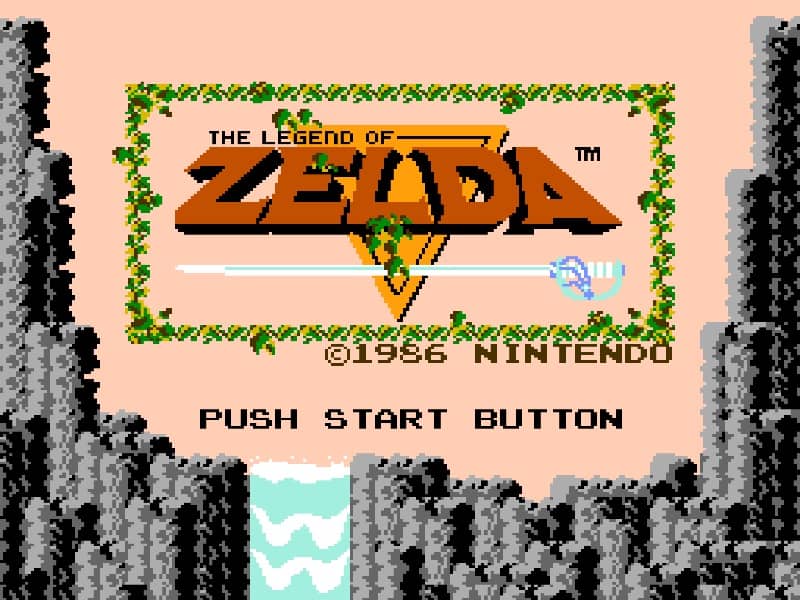
In 1994, the cartridge version was re-released in Japan under the title The Legend of Zelda 1, with the number "1" added to the title screen to distinguish it from sequels. Since then, the game has been ported to multiple platforms, including the GameCube, Game Boy Advance, Wii Virtual Console, and Nintendo Switch Online, allowing players of different generations to experience this classic.
In the series' official timeline, the story of this game takes place in the "Era of Decline," within the "Hero is Defeated" timeline. The plot follows the evil Ganon, who steals the Triforce of Power; Princess Zelda hides the Triforce of Wisdom in dungeons across Hyrule, and Link embarks on a journey to collect the fragments, defeat Ganon, and rescue the princess. This simple story framework established the mythic tone for the entire series.
Development
Development of The Legend of Zelda began in the fall of 1984, co-designed and directed by Shigeru Miyamoto and Takashi Tezuka. At the time, Nintendo was simultaneously developing Super Mario Bros., and the two games had contrasting philosophies: Mario was linear and focused on action skills, while Zelda emphasized exploration and freedom. Miyamoto wanted to give players a "miniature garden in a drawer," a tiny world they could open and explore freely at any time.
Miyamoto's inspiration came from his childhood explorations in the countryside near Kyoto. As a child, he loved wandering through fields, forests, and caves, seeking out unknown corners. This desire for discovery was translated into game design: players traverse a vast map, push rocks, burn bushes, and blast walls to uncover hidden caves or treasures. This cycle of exploration and discovery became the core joy of the Zelda series.
The game was also influenced by PC role-playing games of the time, particularly The Black Onyx and Ultima. Miyamoto found the character growth process interesting, but he did not want to make Zelda a pure RPG. He leaned more toward a blend of action and adventure, later describing the game as a "real-time adventure game" rather than a role-playing game. This positioning made Zelda stand out among action games of its era.
In early concepts, the game included technological elements, with Triforce fragments designed as electronic circuits and the story set between past and future. The protagonist's name, "Link," means "connection," symbolizing his role in connecting past and future. Princess Zelda's name was taken from Zelda Fitzgerald, wife of American author F. Scott Fitzgerald. Although these elements were simplified in the final product, traces remain.
The music was composed by Koji Kondo. Initially, Ravel's Boléro was planned as the theme, but due to copyright issues, it was abandoned, and Kondo composed a new theme. This piece later became one of the most iconic melodies in the Zelda series. The Japanese version also utilized the Disk System's extra audio channels, enhancing the musical expression. The development team made many creative attempts under limited technical conditions.
Reception and legacy
Upon release, The Legend of Zelda received high praise and was considered a killer app for the Famicom Disk System. Computer Gaming World named it the Best Adventure Game of 1988. Players and media alike lauded its expansive world, free exploration, and clever puzzles. At the time, few games offered such a rich experience, making players realize that video games could support more complex adventures and stories.
The game is widely regarded as a pioneer of action role-playing games, although Miyamoto himself does not classify it as an RPG. It inspired countless later works, including classic series like Final Fantasy and Metroid. Many game designers have acknowledged drawing inspiration from The Legend of Zelda when designing open worlds or non-linear exploration. It proved that games could be non-linear, letting players decide where to go and what to do.
The Legend of Zelda also established the core elements of the series: Link, Zelda, Ganon, the Triforce, and the land of Hyrule. These elements have been reinterpreted over the past three decades, becoming one of Nintendo's most valuable brand assets. The series has since produced dozens of titles, each innovating while honoring tradition, and it all began with this 1986 original.
The game's technical innovations were equally influential. The North American cartridge was the first to feature battery backup, allowing players to save progress at any time, a design that later became standard for many RPGs and adventure games. The Japanese version leveraged the Disk System's advantages to achieve richer sound and a larger map. These technical attempts not only enhanced the gaming experience but also pushed the industry's thinking on storage and save mechanisms.
In 2017, The Legend of Zelda was inducted into the World Video Game Hall of Fame, recognizing its significant place in gaming history. It has been listed by numerous media outlets as one of the greatest video games of all time and remains a classic in the hearts of many players. For today's players, the original Zelda's graphics and controls may seem dated, but the pure joy of exploration still transcends time, captivating anyone who picks up a controller.