Gameplay and design
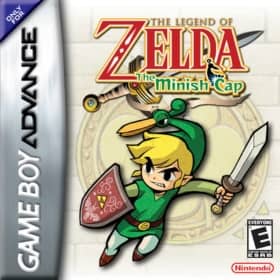
The core gameplay of The Minish Cap revolves around Link's shrinking ability. After obtaining the magical cap Ezlo, Link can use portals scattered across the world to shrink to Minish size, entering a miniature world that is otherwise inaccessible. When shrunk, ordinary grass, rocks, and pipes become massive obstacles or passages, and players must switch between sizes to explore every corner of the map. This mechanic not only changes movement but also reinvents puzzle-solving—many puzzles require shrinking to observe the environment, then returning to normal size to operate mechanisms, or vice versa.
In addition to shrinking, the game introduces three new items: the Mole Mitts, the Gust Jar, and the Cane of Pacci. The Mole Mitts allow Link to dig through soft ground to uncover hidden paths and treasures; the Gust Jar can suck up enemies or objects and also blow windmills and other mechanisms; the Cane of Pacci can create platforms or trigger special effects. These items are tightly integrated with the shrinking mechanic—for example, some tiny passages can only be dug with the Mole Mitts when shrunk, and the Gust Jar's suction can have unexpected effects in the miniature world.
The game's Kinstone system is also distinctive. Players can find pairs of Kinstone fragments scattered across the world, and by collecting and matching them, they can advance the story or earn rewards. Some fragments are hidden in treasure chests, while others require completing mini-games or helping NPCs, encouraging players to explore thoroughly and interact with the environment. Collecting Kinstones is not just a side objective but also provides essential keys for the main quest, giving exploration a sense of purpose.
The game also borrows ideas from the multiplayer game Four Swords, allowing Link to create multiple clones in certain areas. These clones mimic Link's actions and can be used to press multiple switches simultaneously, push boulders, or solve puzzles that require cooperation. This design cleverly blends single-player gameplay with multiplayer concepts, letting solo players experience the fun of cooperative puzzle-solving—a standout feature of the game.
Overall, The Minish Cap builds on the traditional Zelda formula, using the shrinking mechanic and item combinations to create a unique exploration rhythm. Players must interact with NPCs and advance the story in the normal world, while also shrinking to enter the miniature world to uncover secrets. This dual-perspective switching makes every corner of Hyrule feel full of surprises, and it's a game that players still talk about years later.
Background and release
The story of The Minish Cap takes place early in the Zelda timeline, shortly after Skyward Sword and before Four Swords. According to legend, the Picori once gifted a hero the Picori Blade and the Light Force, which sealed evil in a mysterious chest. However, a hundred years later, the evil sorcerer Vaati broke the seal, unleashing monsters and turning Princess Zelda to stone. Link must embark on a journey to find the Picori, reforge the sacred sword, and collect the Four Elements to save the princess and Hyrule.
The game's main antagonist, Vaati, has his backstory detailed in the game. Vaati was once the apprentice of the Minish sage Ezlo, who created a powerful mage's cap. Vaati stole the cap and used its power to become a mighty sorcerer. This backstory explains Vaati's motives and reveals Ezlo's past—he is the talking cap, cursed into that form by Vaati. The partnership between Link and Ezlo becomes an emotional thread throughout the adventure.
As a prequel to Four Swords, this game fills in the origin of the Four Sword. In the ending, after Link defeats Vaati, the Picori Blade combines with the Light Force to become the Four Sword, setting up the events of Four Swords and Four Swords Adventures. This timeline connection gives veteran players a sense of continuity in the series and cements the game's importance in the larger Zelda universe.
The game's story has a strong fairy-tale atmosphere. The Picori are a race of tiny beings living in a miniature world, with an ancient pact with the humans of Hyrule. When Link shrinks, he can communicate with the Picori and learn about their culture and history, giving the adventure a pure and mysterious fantasy feel. The story also explores themes of trust, courage, and growth, as Link evolves from an ordinary boy into a hero, and Ezlo rediscovers himself along the journey.
Although the plot of The Minish Cap is relatively linear, it creates a vivid Hyrule through rich NPC dialogue and side events. Players can interact with townsfolk, take on various small tasks, and learn about their lives. These details flesh out the world and make players emotionally invested in Hyrule, making the final victory over Vaati and the restoration of peace all the more impactful.
Development
The Minish Cap was developed by Capcom and Flagship, not Nintendo itself. Development began after these two companies completed Oracle of Seasons and Oracle of Ages, but was paused so the team could focus on Four Swords. This arrangement allowed the game to draw on Four Swords' multiplayer cooperative concepts and adapt them into the single-player clone mechanic. In February 2003, Shigeru Miyamoto and Eiji Aonuma revealed that development was "proceeding smoothly," building anticipation among fans.
The game's visual style uses cel-shading similar to The Wind Waker, and this was no accident. The development team felt that the game's fairy-tale setting was a perfect match for The Wind Waker's fresh, vibrant art style, so they chose that approach. The cartoon look not only makes characters and scenes more lively and endearing but also enhances the fantasy feel of the miniature world. This art direction shines on the GBA, with bright colors and rich detail, becoming a visual hallmark of the game.
The development team paid special attention to the "living city" design of Hyrule Town. They wanted the town to be more than just a place to buy items and accept quests—it should be a vibrant community with residents who have their own routines and stories. Combined with the shrinking ability, the town itself was designed as a kind of "dungeon": players must shrink to enter mouse holes, ant nests, and other miniature areas to discover hidden passages and secrets. This fusion of town and dungeon is a key innovation of the team and a major feature that sets the game apart from other Zelda titles.
The Gust Jar was inspired by the gourd from the Chinese classic novel Journey to the West, which can suck up anything. The team turned this concept into a game item, allowing Link to suck up enemies, objects, or blow mechanisms. This cross-cultural inspiration adds a unique charm to the game. Additionally, the shrinking ability itself was an extension of the "Minish Cap" feature from Four Swords, which the team developed from a multiplayer support function into the core mechanic of this game.
The game's release strategy is also noteworthy. The game launched in Japan and Europe in 2004, but North America had to wait until 2005. This was the first time a Zelda game was released in Europe before North America, because Nintendo of Europe wanted it as a Christmas title. In Europe, a special edition was released, including a limited run of 25,000 Zelda-themed Game Boy Advance SP units, as well as seven 24-karat gold-plated GBA SPs, six of which were given away via golden tickets, with the seventh used for a magazine promotion. These efforts showed Nintendo's commitment to the game.
Reception and legacy
The Minish Cap received unanimous critical acclaim upon release, with an average score of 90% on GameRankings. GameSpot named it the Best Game Boy Advance Game of 2005, and IGN ranked it as the 20th best GBA game. Reviewers generally praised its innovative shrinking mechanic, well-designed puzzles, and vibrant graphics, saying it perfectly captured the essence of the Zelda series while offering a unique experience.
Commercially, the game sold 97,000 units in its first week in Japan, making it the best-selling game of that week. By March 2005, global sales had surpassed one million units, eventually reaching 1.76 million. This was an impressive performance late in the GBA's life cycle, demonstrating player appreciation for the title. Although sales didn't match some of the series' bigger hits, The Minish Cap left a lasting impression on players through word of mouth.
The game's standing in the Zelda series has solidified over time. As a prequel to Four Swords, it filled a gap in the timeline and added depth to the series' lore. Many players consider The Minish Cap one of the pinnacles of 2D Zelda, and its shrinking mechanic and town design are still frequently discussed. Elements of its design philosophy can be seen in later Zelda games, such as the wall-merging mechanic in A Link Between Worlds, which bears a resemblance to shrinking.
Ports and re-releases have kept The Minish Cap alive. In 2014, the game was released on the Wii U Virtual Console, allowing new players to experience the classic on a home console. In February 2023, it was added to the Nintendo Classics service, further expanding its audience. These efforts have ensured that the game remains accessible to new generations of players, sustaining its influence.
Overall, The Minish Cap is a work that balances innovation and tradition. It preserves the core Zelda gameplay while offering a unique adventure through its shrinking mechanic and lively town design. Despite a rocky development, the final product was of high quality, earning widespread praise from players and critics alike. In the vast Zelda series, this game holds a special place, becoming a classic in the hearts of many players.