
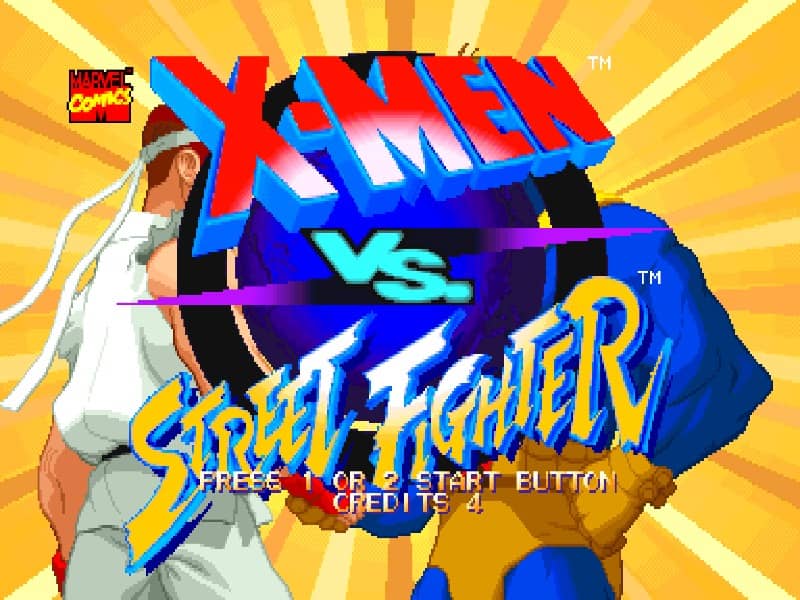
Gameplay and design
The core gameplay of X-MEN vs Street Fighter revolves around two-on-two tag team battles. Before the match begins, players select two characters and can switch between them at any time by pressing a button. The character on the sidelines slowly recovers a small amount of health. This design speeds up the pace of combat and requires players to be familiar with both characters' moves and how they work together, rather than focusing on just one character as in traditional fighting games.
Matches are single-round, rather than the usual best-of-three. If time runs out, the system compares the total remaining health of both teams, and the team with the higher total wins. This rule encourages aggressive play and makes outcomes more unpredictable, since even if the active character has low health, a well-preserved partner can still turn the tide.
The game builds on the systems from Capcom's previous two Marvel fighting games, including super jumps, air combos, and the Hyper Combo gauge. The Hyper Combo gauge fills as you land and take hits, and can be spent to unleash powerful Hyper Combo special moves, or to use Variable Combination, where both characters appear on screen simultaneously to perform a super move, and Variable Counter, which calls in your partner for a counterattack while blocking. These mechanics make battles both strategic and spectacular.
The roster features 17 playable characters, representing both the X-Men and Street Fighter sides. The X-Men character sprites are taken from the previous game X-Men: Children of the Atom, but Rogue, Gambit, and Sabretooth make their first appearances in a Capcom fighting game. The Street Fighter characters are reused from Street Fighter Alpha 2, but their special moves are greatly exaggerated to balance the two sides, such as Ryu's Super Hadoken filling the entire screen.
The PlayStation version, due to hardware limitations, removes the tag team battle mechanic and instead uses a best-of-three format, with the partner only being able to assist during certain attacks. This version also includes a hidden code that enables a 'pseudo-tag team' mode, but it requires both players to use the opponent's starting character as their partner. Additionally, the Hyper Combo gauge fills at about half the speed of the arcade version, making combos easier to execute, but the overall experience differs noticeably from the arcade original.
Background and release
X-MEN vs Street Fighter is Capcom's third fighting game to use Marvel characters, following X-Men: Children of the Atom in 1994 and Marvel Super Heroes in 1995. It is also the first title in the Marvel vs. Capcom series, with the title directly highlighting the crossover between the two IPs. The game debuted in Japanese arcades in September 1996 and was released worldwide shortly after, quickly becoming a popular fixture in arcades.
The arcade version runs on the CP System II board, Capcom's advanced 2D arcade hardware at the time, capable of rendering detailed sprites and smooth animation. The game's success in Japan was immediate, with the October 1996 issue of Game Machine magazine listing it as the most successful arcade game of the month, surpassing contemporaries like Quiz Nanairo Dreams and Stakes Winner 2.
The home console release was fraught with complications. On November 6, 1996, Capcom announced the game as a Saturn exclusive, but later retracted that statement, opting instead to release versions for both PlayStation and Saturn. This decision reflected the intense competition in the console market at the time and Capcom's stance toward both platforms.
The Saturn version was released in Japan on November 27, 1997, and was the first game to support the Saturn 4MB RAM cartridge, which was bundled with the game. However, because the 4MB RAM cartridge was never produced for the US market and retailers were planning to clear out Saturn hardware, the Saturn version was never officially released in North America, though some Electronics Boutique stores sold imported copies. In Europe, publisher Virgin Interactive declined to release it due to the cost of the cartridge, and Sega's plan to bundle the cartridge for a European release was eventually shelved.
The PlayStation version was released in Japan on February 26, 1998, under the title X-Men vs. Street Fighter: EX Edition, in North America on June 11, 1998, and in Europe in November 1998. Due to the PlayStation's memory limitations, this version cut sprite animation frames and removed the tag team battle mechanic, leading to mixed reviews.
Development
The game's development was built on Capcom's prior experience with Marvel fighting games. The X-Men character sprites were taken directly from X-Men: Children of the Atom, but Rogue, Gambit, and Sabretooth were newly created, with their designs referencing the 90s animated series and using the original voice actors. This faithful adherence to the source material made the game feel familiar to X-Men fans.
The Street Fighter character sprites were reused from Street Fighter Alpha 2, but their special moves were designed to be more exaggerated to stand up to the X-Men superheroes and villains. For example, Ryu's Super Hadoken can fill the entire screen, and this visual impact enhances the thrill of the crossover, showcasing the development team's creativity in balancing the two IPs.
The development of the Saturn version was a technical milestone. To achieve near-arcade quality on the Saturn, Capcom utilized the 4MB RAM cartridge, marking the first use of this hardware. The cartridge was bundled with the game, allowing the Saturn version to present full animation frames and fast loading times, and it is often regarded by players as a benchmark for arcade ports.
The development of the PlayStation version faced more challenges. Due to insufficient memory, the development team had to cut sprite animation frames and remove the tag team battle mechanic, switching to a best-of-three format. They also adjusted the fill rate of the Hyper Combo gauge to about half that of the arcade version to balance the pacing. These compromises made the PlayStation version technically inferior to the Saturn version, but it was still one of the few notable 2D fighting games on the PS at the time.
The game also hides Akuma as a playable character, continuing his cameo tradition from X-Men: Children of the Atom. Akuma's inclusion provided players with extra exploration fun and demonstrated Capcom's dedication to the character roster.
Reception and legacy
X-MEN vs Street Fighter achieved notable success in the arcade market and received positive reviews from the media. Next Generation gave the arcade version 3 out of 5 stars, praising the tag team mechanic but also noting that the genre was oversaturated. AllGame's retrospective review gave it 4 out of 5 stars, commending its combination of two popular series and the tag team mechanic. The game was highly regarded among players and became a popular competitive choice in arcades.
The Saturn version received high praise from critics. GameSpot's Jeff Gerstmann called it 'the best-looking 2D fighting game on any console,' and reviews praised its near-arcade fidelity, animation and sound quality, fast loading, and lack of slowdown. The Saturn version was seen as a benchmark for arcade ports, and despite never being officially released in North America, it still gained a following through import channels.
The PlayStation version received mixed reviews due to technical compromises, with a GameRankings score of 64%. Criticism focused on the removal of the tag team battle mechanic and frequent slowdown, but the game still had some appeal due to its character roster and core gameplay. This version became a cautionary tale in discussions of console ports, highlighting the advantages of the Saturn version's hardware support.
As the inaugural title in the Marvel vs. Capcom series, this game established the core concepts of the series: two-on-one team battles and cross-IP character matchups. The sequel, Marvel Super Heroes vs. Street Fighter, was released in 1997, introducing the 'assist' mechanic and replacing most of the X-Men characters with other Marvel characters, further expanding the series' possibilities.
Years later, the game is still remembered by Capcom and players alike. In 2020, Arcade1Up announced that the game would be included in a home arcade cabinet, alongside Marvel Super Heroes vs. Street Fighter and Marvel vs. Capcom: Clash of Super Heroes. In 2024, Capcom announced that the game would be included in the Marvel vs. Capcom Fighting Collection: Arcade Classics compilation, released in September 2024 for Switch, PS4, and Windows, allowing a new generation of players to experience this classic.





