Gameplay and design
The Adventure of Link boldly innovated in its gameplay, dividing the game world into an overhead adventure map and side-scrolling battle scenes. Players move across the overworld, and when entering towns, caves, or encountering enemies, the view shifts to a side-scrolling action mode. This design creates a clear rhythm between exploration and combat, making the game stand out within the series and contrasting sharply with the purely top-down play of the original.
The game introduced an experience point system, where Link gains experience by defeating enemies to raise his Attack, Magic, and Life attributes, each up to level eight. This mechanic makes character growth more tangible and encourages active combat. Notably, there are differences between the Japanese and Western versions: in the Japanese version, attributes reset after the game ends, while in Western versions they are permanently retained, affecting the player experience across regions.
The combat system emphasizes strategy and precision, allowing Link to jump, crouch, and use a shield for defense. Enemy designs are clever, such as the Iron Knuckle, which adjusts its attacks based on Link's stance, forcing players to observe and react. This interactivity turns battles into thoughtful duels rather than simple button-mashing, providing a reference for later action games.
The magic system is another hallmark. Link has a magic meter and can learn spells from sages in eight towns, such as healing and fireballs. Some spells are essential for progression, like using specific magic to pass certain areas. This integration of magic with puzzle-solving enriches the gameplay depth.
The game also employs a life system, where losing all lives ends the game, but in Western versions, attribute upgrades are permanent, while in the Japanese version, they reset to the lowest level. This adds challenge and requires careful play. Additionally, elements like the 1-up doll are unique to this game, further cementing its distinct identity.
Background and release
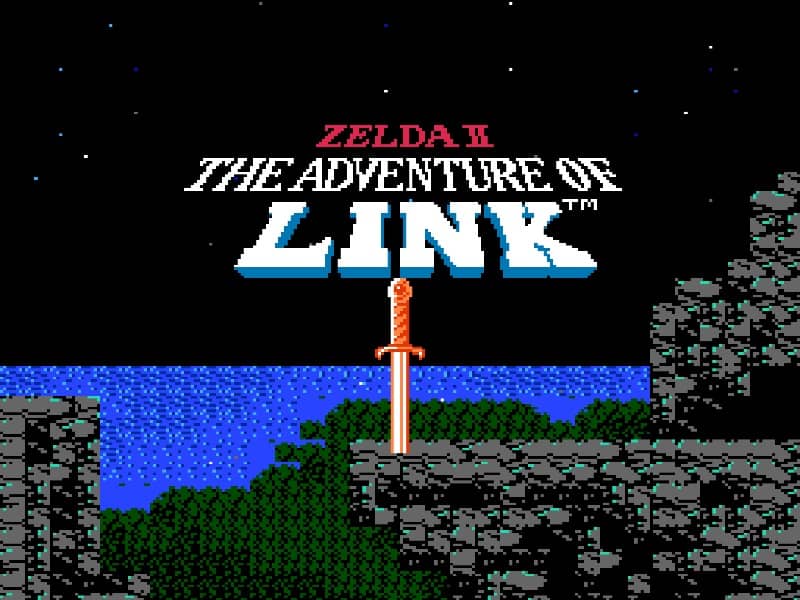
The Adventure of Link was released on January 14, 1987, in Japan for the Famicom Disk System, followed by a NES version in PAL regions on September 26, 1988, and in North America on December 1 of the same year. As a direct sequel to the original The Legend of Zelda, it was highly anticipated, and it met expectations with its bold changes.
The story takes place after the first game, with Link now sixteen years old, discovering the mark of the Triforce on his left hand. Guided by Impa, Link enters North Castle and finds a sleeping Princess Zelda. She had been cursed by a wizard, and the prince decreed that all royal princesses be named Zelda in her memory.
To awaken her, Link must collect six crystals and place them in statues in six palaces to open the Great Palace and obtain the Triforce of Courage. This journey spans Hyrule, requiring Link to defeat powerful foes and solve ancient puzzles, culminating in a battle with Shadow Link. After defeating him, Link gains the Triforce of Courage, and the three Triforces unite, awakening Zelda.
The story laid important groundwork for the series, introducing the concept of the Triforce of Courage, which became a core element in later games. It also fits into the official timeline in the 'Hero is Defeated' branch, connecting to the downfall ending of Ocarina of Time, providing a key link in the series' expansive lore.
Released during the transition between the Famicom Disk System and the NES, the game attracted many players with its unique gameplay and story. Despite differing from the original, it achieved commercial success, becoming one of the best-selling NES games in North America in 1988, with global sales of 4.38 million copies, solidifying the series' foundation.
Development
The development team for The Adventure of Link differed from the original, with Shigeru Miyamoto serving only as producer (under the pseudonym Miyahon), while Takashi Tezuka handled the story and script, and Naoki Sugiyama and Yasuhisa Yamamura directed. This change in roles brought a new direction to the narrative and gameplay, reflecting Nintendo's exploration of diversity within the series.
The combat system was influenced by Irem's Kung-Fu Master, a side-scrolling action game that inspired the emphasis on jumping, attacking, and blocking. The role-playing mechanics drew from Chunsoft's Dragon Quest, with its experience points and leveling system. This cross-genre borrowing made the game an early attempt at blending action and RPG elements.
There are several differences between the Famicom Disk System and NES versions, including dungeon colors, boss appearances, and game over screens. These differences stem partly from hardware limitations and reflect adjustments during porting. For example, the NES version lacks the extra sound chip of the Disk System, resulting in simplified music, but the overall experience remains intact.
The music was composed by Akito Nakatsuka, and the FDS version took advantage of the extra sound chip for richer audio. The NES port had to simplify the music, contributing to differences between versions. Nevertheless, the game's music is fondly remembered, especially the main theme.
During development, the team faced technical challenges, such as implementing the switch between the overworld and battle scenes within cartridge limits. These efforts resulted in the game's unique dual-mode design and provided valuable lessons for future action RPGs. Behind-the-scenes, Miyamoto's focus on the combat system and the team's inspiration from Kung-Fu Master and Dragon Quest exemplify the open and innovative spirit of game development at the time.
Reception and legacy
The Adventure of Link was a commercial success upon release, selling 4.38 million copies worldwide and becoming one of the best-selling NES games in North America in 1988. Japanese magazines like Famicom Hisshoubon and Famicom Tsūshin praised it as a perfect blend of puzzle and action. Nintendo Power awarded it Game of the Year in 1988 and gave it high scores in 1990.
The game has continued to receive accolades, with Electronic Gaming Monthly ranking it 72nd on their 1997 list of the 100 best games, and Nintendo Power placing it 12th on their 2008 list of the best NES games. These honors affirm its status among players and critics, despite its stylistic differences from other series entries.
Elements introduced in this game, such as the magic meter, the Triforce of Courage, and Shadow Link, became recurring motifs in later titles. For instance, the sages in Ocarina of Time are named after towns from this game, and Shadow Link appears as a boss or hidden character in several sequels. This legacy gives the game a pivotal role in the series.
It is also the only mainline game to use a life system and the only one whose English title does not include 'The Legend of Zelda.' This uniqueness makes it an outlier, but it is precisely this bold experimentation that paved the way for the series' later diversification.
The game influenced other titles like Faxanadu and The Battle of Olympus, and inspired modern indie games such as Elliot Quest. Its blend of side-scrolling action and RPG mechanics left a lasting mark on gaming history. Despite some controversy over its difficulty and style shift, The Adventure of Link remains an unmissable milestone in the Legend of Zelda series.