Gameplay and design
The core gameplay of Bomberman is simple and direct: players control a round-headed character who places bombs in a maze to blast through walls, eliminate enemies, and ultimately find the exit to the next level. The game uses a top-down perspective, with mazes composed of bricks and indestructible walls. Bombs can destroy bricks but not walls. Players must use the bombs' power to clear paths while avoiding enemy pursuit, a design that keeps every level tense.
Bombs aren't just placed randomly; players need to calculate blast radius and timing. There's a few seconds' delay between placing a bomb and its explosion, so players must ensure they aren't caught in the blast while also considering how to trigger chain reactions, detonating multiple bombs at once to clear obstacles more efficiently. This strategic layer gives the game plenty of depth despite simple controls, which is why it's often called a puzzle game.
Though enemy types are few, each has distinct behaviors: some move in straight lines, some track the player, and others wander randomly. Players must plan routes based on enemy patterns, sometimes attacking aggressively and other times waiting patiently for the right moment. The game lacks a complex item system, but the level design is clever, with maze layouts and enemy configurations becoming increasingly intricate as you progress, demanding sharper reflexes and better planning.
The mazes in Bomberman aren't entirely random; they're carefully designed, with each level having a fixed exit location, though the paths under bricks and item placements vary. Players need to replay and memorize key spots to clear levels efficiently. The game also supports a two-player mode, allowing cooperative or competitive play. This multiplayer aspect later became a series hallmark, but in the original, it was just simple turn-based play, though it already hinted at social fun.
Overall, Bomberman's gameplay felt fresh and pure in 1985. It had no complex story or systems, yet its solid level design and strategic depth kept players engaged. The pace is brisk, with short sessions perfect for picking up and playing anytime. This 'easy to learn, hard to master' quality is a key reason it became a classic that endured for decades.
Background and release
Bomberman's roots trace back to 1983, when Hudson Soft released Bomber Man on several Japanese computer platforms, including PC-8801, PC-6001 mkII, FM-7, MZ-700, MZ-2000, X1, and MSX. These were mainstream personal computers in Japan at the time, and the game was distributed on cassette or disk, with visuals and controls typical of the 8-bit era. The 1983 version is the series' origin, but it's far less known than the later Famicom version.
In 1984, Hudson Soft brought Bomber Man to Europe, but the game was renamed Eric and the Floaters for the MSX and ZX Spectrum. The rename was to avoid association with the Irish Republican Army (IRA) bombings, as the word 'Bomber' had negative connotations in Europe at the time. The graphics were also altered, changing the protagonist from a robot to a regular little guy, but the core gameplay remained unchanged.
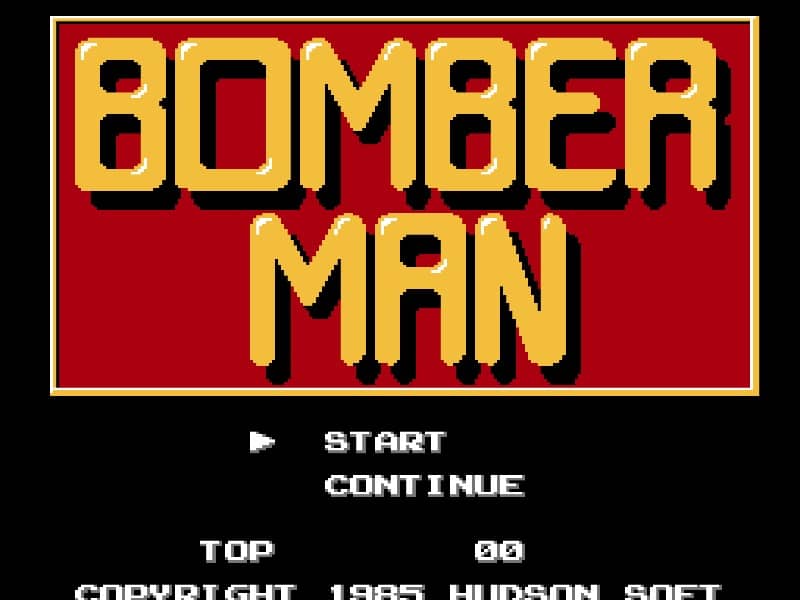
In 1985, Hudson Soft released a remake for the Famicom (Nintendo Entertainment System) titled Bomberman. This wasn't a simple port; it was a full upgrade with better graphics, smoother controls, and new enemies and levels. The Famicom version brought Bomberman into the mainstream, becoming a cherished memory for many players. The series then continued with multiple sequels on the Famicom, gradually building its brand.
It's worth noting that the 1983 computer version and the 1985 Famicom version, despite sharing the same name and core gameplay, are distinct works. The computer version was limited by hardware, with crude visuals and stiff controls, while the Famicom version leveraged the console's gamepad for more precise movement and bomb placement. This difference made the Famicom version far superior in experience and set the stage for the series' future.
Bomberman's publishers included not only Hudson Soft but also SoftBank Group and Sinclair Research, reflecting its distribution across different regions and platforms. Wikidata classifies Bomberman as a maze and puzzle video game, accurately capturing its gameplay essence. The game was originally written in 1980 as a technical demo for Hudson Soft's BASIC compiler, later packaged as a commercial game, adding a touch of legend to its history.
Development
Bomberman originated from a technical demo. In 1980, a programmer at Hudson Soft created a simple game prototype to showcase the capabilities of the company's BASIC compiler, where players controlled a character placing bombs. Though crude, this prototype already contained the core elements of Bomberman's gameplay. At the time, Hudson Soft was primarily a developer of programming tools and game software, and this demo was meant for internal testing, but it was later discovered and evolved into a commercial product.
In 1983, Hudson Soft refined the prototype and released it as Bomber Man on multiple computer platforms. According to Zero magazine, the gameplay drew inspiration from Coreland/Sega's arcade game Pengo (1982), which featured a penguin pushing ice blocks in a maze to crush enemies. This wasn't plagiarism but rather an absorption of Pengo's maze and strategy elements, combined with a bomb mechanic, to create a unique gameplay experience.
The European rename was an interesting episode in the development history. In 1984, Hudson Soft planned to release the game in Europe, but due to the sensitive connotations of 'Bomber' at the time, they decided to rename it Eric and the Floaters. The new name sounded more like a children's game, and the protagonist was changed to a regular character to downplay the bombing theme. This change was commercially motivated but also reflected the era's societal concerns about terrorism.
The 1985 Famicom version was a comprehensive remake by Hudson Soft. The development team redesigned the graphics and sound, leveraging the Famicom's hardware to make colors more vibrant and animations smoother. They also adjusted level designs and added enemy types, making the game's pace more suited to home console players. The success of the Famicom version was largely due to these improvements, which made the originally hardcore computer game more accessible.
It's worth noting that Hudson Soft always prioritized fun during development. They didn't make Bomberman a purely violent game; instead, through clever level design and enemy AI, they encouraged players to enjoy the thinking process. This design philosophy persisted throughout the series and is a key reason for Bomberman's enduring popularity. From technical demo to classic IP, this development journey showcased Hudson Soft's creativity and execution.
Reception and legacy
As the series' debut, Bomberman's influence extends far beyond the game itself. The 1985 Famicom version was widely praised by players, and although there was no formal review system then, it ranked 23rd in the AllGamesGo local directory, indicating its popularity. This game made the Bomberman character iconic, with the round-headed robot becoming a classic figure in gaming history.
Bomberman's success directly led to the sequel 3-D Bomberman, which boldly innovated by expanding the maze from flat to three-dimensional space. Though the 3D attempt received mixed reviews, it proved the series wasn't content to rest on its laurels but was always exploring new possibilities. Subsequently, the series released dozens of titles across Famicom, Super Famicom, PlayStation, and other platforms, with gameplay branching into versus and adventure modes.
From a gaming history perspective, Bomberman holds a significant place in the maze action genre. It wasn't the first maze game, but it combined bomb mechanics with maze exploration so ingeniously that it influenced many later works. When players think of 'Bomberman,' they often recall the classic gameplay of placing bombs and blasting walls, a design that has become a cultural symbol, widely imitated and referenced.
Bomberman's multiplayer versus mode, especially in later Super Bomberman titles, became a staple at social gatherings. The original only had a simple two-player alternating mode, but it already planted the seed for competitive social play. This 'simple rules, intense competition' design allowed Bomberman to transcend age and gender, becoming a fixture in family entertainment, which is why it continues to attract new players.
Looking back at Bomberman's history, from the 1980 technical demo to the 1983 computer game and the 1985 Famicom classic, each step aligned with its era. It witnessed gaming's transition from a geek hobby to mainstream entertainment, and showcased Hudson Soft's creativity as a developer. Today, even though Hudson Soft has been acquired, the Bomberman series remains active, a testament to its lasting vitality.