Gameplay and design
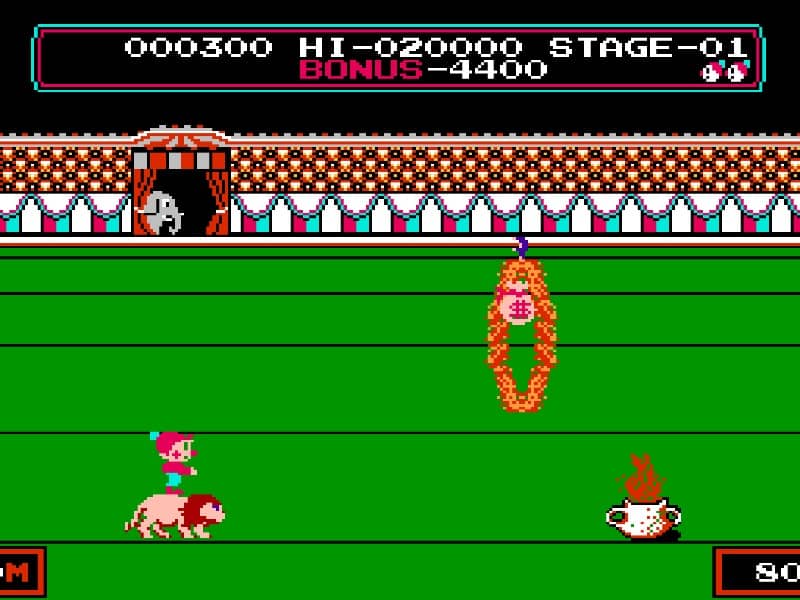
The core gameplay of Circus Charlie is simple: players control Charlie the Clown and complete challenges in six circus-themed mini-games. Each stage has a different objective, such as riding a lion through burning hoops, walking a tightrope while dodging monkeys, jumping between balls, riding a horse over trampolines and walls, and finally swinging from trapeze to trapeze. The game has no ending; after completing a round, all stages restart at a faster speed, with difficulty gradually increasing until lives run out.
The game employs a time limit mechanic: each stage has a countdown, and players must complete the objective within the allotted time. Remaining time converts to bonus points, while running out of time costs a life. This design encourages players to balance speed with precision, creating a tense and exciting experience. Transitions between stages are smooth, and failure allows immediate retry, preventing frustration.
The Famicom version removed the third stage (the trampoline stage) from the arcade original, leaving only five regular stages. This change made the game more streamlined but also reduced variety. To compensate, the Famicom version added a B mode, which repeats all stages at higher difficulty, such as trickier hoop placements and more frequent monkey jumps, offering new challenges for veteran players.
The controls are very direct, with only left/right movement and a jump button, but each stage demands different timing and distance for jumps. Riding the lion requires precise jumps before the hoops, while tightrope walking requires careful rhythm to avoid monkeys. This simple yet reaction-testing design makes the game easy to pick up, but mastering it requires practice.
The graphics and sound of Circus Charlie are simple but evoke a circus atmosphere. Charlie's movements are comical and endearing, the backgrounds are colorful, and the music, adapted from classical pieces, gives the game a lighthearted and lively feel. The game has no complex story or item system, relying purely on level design and gameplay appeal, which is why it stood out in the arcade era.
Background and release
Circus Charlie was originally an arcade game released by Konami in 1984, with North American distribution by Centuri in March of that year and a Japanese release in April. At the time, the arcade industry was in its golden age, with a wide variety of themes, but the circus theme was rare. Konami's choice of a clown protagonist and diverse stage designs made the game distinctive among action titles.
The arcade version included six regular stages and one bonus stage. After completing all stages, the game loops, but speed and difficulty increase. The arcade version also had a special stage-select feature that allowed players to choose stages a limited number of times, but even so, the game had no ending, eventually repeating the trapeze stage until lives ran out.
On March 4, 1986, the Famicom version was ported and released by Soft Pro. It retained the core gameplay of the arcade version but removed the trampoline stage and added a B mode. This change may have been to adapt to the Famicom's hardware capabilities or to adjust the game's pacing. In the same year, a Commodore 64 version was also released in 1987, further expanding the game's audience.
Circus Charlie performed well in the Japanese arcade market. On May 15, 1984, Japan's Game Machine magazine ranked it as the third most successful arcade table game of the month. This achievement demonstrated its popularity at the time and contributed to Konami's experience in developing subsequent action games.
The protagonist, Charlie the Clown, later became one of Konami's iconic characters. In another Konami arcade game, Mikie, if the player hits the teacher's desk from below three times in a row, characters from Circus Charlie appear and award points. Such cross-game cameos were rare at the time and reflected Konami's confidence and humor regarding its own works.
Development
The music of Circus Charlie is a notable feature, but it is not original; it is adapted from two classical pieces: "American Patrol" and "The Blue Danube." "American Patrol" is a march with a brisk tempo, well-suited to the game's jumping actions, while "The Blue Danube" is used in the trapeze stage, its melody complementing the swinging rhythm. This adaptation approach was common at the time, saving development costs and giving players a sense of familiarity.
The Famicom port was handled by Soft Pro, a company specializing in game conversions. During the porting process, the development team made some adjustments, most notably removing the trampoline stage. The official reason for this removal was not detailed, but it was likely due to Famicom hardware limitations or to make the game flow more tightly.
The B mode added in the Famicom version is a noteworthy design. In B mode, all stages repeat at higher difficulty, such as trickier hoop placements and more frequent monkey jumps. This mode provided new challenges for players already familiar with the normal mode and extended the game's longevity. This approach of increasing replayability through difficulty variations was uncommon in Famicom games at the time.
The stage-select feature in the arcade version was another interesting design. Players could choose stages a limited number of times, giving them some freedom to practice weak points. However, the feature did not change the game's lack of an ending; players still faced looping stages and increasing difficulty. This feature was removed in the Famicom version, possibly to simplify controls.
Although details about the development process are scarce, the final product shows that Konami put considerable thought into stage design and music selection. Each stage has a unique theme and gameplay, and the music matches the scenes well. These details have kept the game memorable for years, making it a representative early action game from Konami.
Reception and legacy
Circus Charlie received positive reviews upon release, especially in the arcade sector. Its simple controls and varied stage designs attracted many players. In May 1984, Japan's Game Machine magazine ranked it as the third most successful arcade table game of the month, proving its popularity at the time. For a circus-themed game, this was a notable achievement.
The Famicom version brought Circus Charlie into more homes. Although the trampoline stage was removed, the addition of B mode kept the game challenging. Many players have fond memories of the Famicom version's music, especially "American Patrol," which almost became a hallmark of the game. Even today, older players can hum that melody, showing its lasting impact.
Circus Charlie has been included in several Konami compilations. It appeared in Konami 80's Arcade Gallery, including an arcade remake and a PlayStation version, and was also featured in Konami Classics Series: Arcade Hits for Nintendo DS. On June 24, 2015, the game was released on Wii U Virtual Console; in August 2016, Hamster Corporation released the arcade version on Nintendo Switch and PlayStation 4 as part of the Arcade Archives series. These re-releases allow new and old players alike to revisit the classic.
Beyond the game itself, Circus Charlie has spawned other works. In April 1999, Kōji Hirano created the manga "Go! Go! Aoyama Gakuen Denshi Kenkyūbu," which included elements from Circus Charlie. Though such cross-media collaborations were limited, they indicate the game's cultural influence.
Overall, Circus Charlie is a simple yet enduring action game that left its mark on the arcade era and, through Famicom port and multiple re-releases, became a shared memory for a generation of players. Its stage design, music adaptation, and difficulty mechanics have influenced later action games. Although its graphics and gameplay may seem plain today, the spirit of the era it represents is still worth remembering.