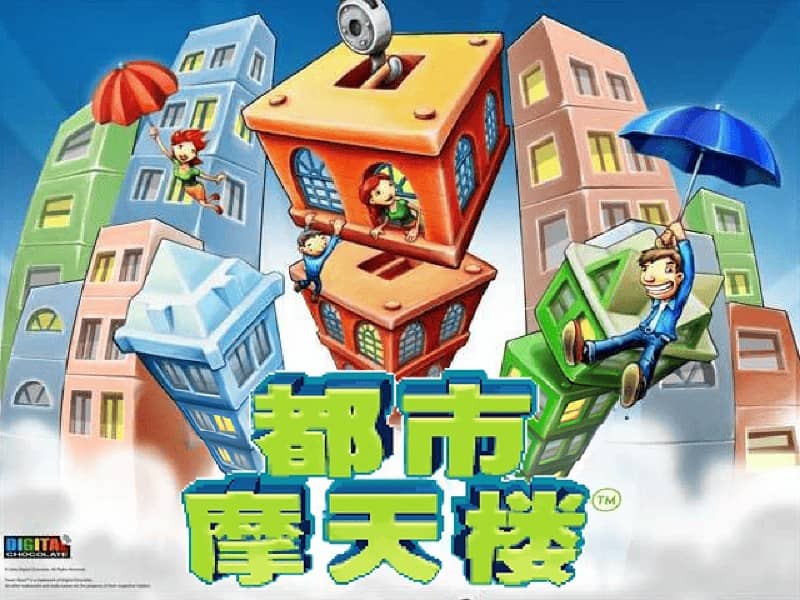
Gameplay and design
The core gameplay of "Tower Bloxx" is surprisingly simple: players press a single button to control the swinging motion of a crane, releasing it at the right moment to stack floors precisely on the existing tower. The better the alignment, the more stable the tower; misalignment causes wobbling or even collapse. This one-button design means anyone can grasp the rules in seconds, but building tall and steady requires practice and precise timing.
The game offers two distinct modes. In Quick Game mode, players focus solely on stacking a single tower, but with only three mistakes allowed; the game ends if the tower collapses or floors are severely misaligned. This mode is fast-paced, ideal for chasing high scores in short bursts. City Building mode, on the other hand, adds depth: players place completed towers on a city grid, gradually developing their own metropolis.
In City Building mode, players start with basic residential towers and unlock more building types—such as commercial and office buildings—as the city's population and level increase. High-value buildings not only look more impressive but also have stricter placement requirements, like being near roads or maintaining distance from other structures. This design encourages players to consider urban layout, adding a strategic layer beyond just height.
The two modes complement each other: Quick Game hones players' mechanical skills, while City Building puts those skills to use for long-term goals. The precise placement ability developed in Quick Game is equally crucial in City Building, as each tower's stability affects the city's aesthetics and score. This blend of action and strategy is what makes the game most appealing.
Notably, the game's feedback is highly intuitive. When a floor lands well-aligned, the tower emits a crisp sound and slight vibration, giving positive reinforcement; if misaligned, the tower visibly shakes or even cracks, immediately signaling trouble. This instant feedback keeps every action tense and makes successful stacking deeply satisfying.
Background and release
"Tower Bloxx" was originally released for mobile phones in December 2005, published by Digital Chocolate. At the time, the mobile gaming industry was transitioning from feature phones to smartphones, with Java and BREW platforms dominating, and hardware limitations constrained graphics and controls. Digital Chocolate's decision to launch such a minimalist, visually bright game during this period was clearly deliberate.
After its success on mobile, the game was ported to several other platforms. In 2007, a Facebook application version was released, allowing players to enjoy the stacking fun on social networks. Additionally, some phone manufacturers, such as LG and Nokia, pre-installed the game on their devices, further expanding its audience. These ports and pre-installs elevated "Tower Bloxx" beyond its initial mobile player base.
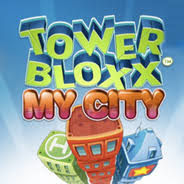
It's worth noting that on some Nokia phones, the game appeared under the name "City Bloxx"—not a different game, but an alternate title for the same work in certain regions. Such naming variations were not uncommon in mobile games of that era, though they could cause confusion. For players, whether called "Tower Bloxx" or "City Bloxx," the core gameplay remained identical.
A Flash version emerged around 2006, but it's important to clarify that the Flash version was not the original; it was a subsequent port of the mobile version. The Flash version introduced the game to more PC players, but its controls and interface were adapted from the mobile version's characteristics. Therefore, in discussing the game's history, the mobile version remains the source and foundation.
From its 2005 debut to multiple later ports, "Tower Bloxx"'s distribution path clearly illustrates the typical pattern of mobile games expanding to other platforms at that time. It first established itself on phones in a compact, polished form, then leveraged pre-installs and social platforms to broaden its reach, ultimately becoming a cross-platform mini-classic. This trajectory also reflects the mobile gaming industry's ecosystem of that era.
Development
"Tower Bloxx" was developed by Digital Chocolate's Helsinki studio, which had its roots in Sumea, a Finnish mobile game developer. In 2004, Sumea was acquired by Digital Chocolate and became its Helsinki division. Digital Chocolate's founder, Trip Hawkins, was a veteran in the gaming industry, having co-founded EA, and brought unique insights to game design.
Executive producer Trip Hawkins oversaw the project, while Mikko Kodisoja played a key role in development. Kodisoja later detailed the iterative development process in a retrospective article for Game Developer. According to him, the team's initial goal was to create a game that was simple to play yet deep, suitable for mobile platforms; they selected the tower-stacking concept from several prototypes.
The design revolved around short sessions and single-button controls. The team recognized that mobile players often had only a few minutes of spare time, so the game had to deliver a complete experience quickly. The single-button control not only lowered the entry barrier but also suited the limitations of phone keypads at the time. To add long-term appeal, they incorporated City Building mode, giving players a sense of gradual achievement beyond the quick game.
During development, the team extensively tuned the game's physics and feel. Details like floor alignment detection, tower wobble amplitude, and collapse animations were repeatedly refined to ensure players felt challenged without being frustrated by overly harsh judgment. Kodisoja mentioned that they even tested key response speeds on different phone models to optimize the experience.
The game was released to mobile operators in December 2005, a timing that was carefully considered. The year-end holiday season saw an active mobile game market and new handset releases, making it an opportune moment for visibility. The team's efforts paid off: the game quickly garnered praise from players and media, won several gaming awards, and earned Digital Chocolate a strong reputation in the mobile gaming space.
Reception and legacy
"Tower Bloxx" received widespread acclaim from both the industry and players upon release. The game won the Best Puzzle Game award at the 2005 Mobile Awards and the Mobile Game Award at MEM 06, affirming its design philosophy. IGN's editors gave it a 9/10 score and an Editor's Choice award, praising its "clever blend of puzzle and strategy elements." GameSpot also rated it 7.2/10, noting that City Building mode added lasting value.
Media reviews consistently highlighted the game's accessibility and replayability. Pocket Gamer's review was particularly representative, stating that the game "takes seconds to understand, but may take weeks or months to master." This aptly captures the game's appeal: simple rules hiding deep skill pursuit, encouraging players to repeatedly challenge their stacking records. Game Developer described the concept as "Tetris meets SimCity," pinpointing its unique fusion of action and strategy.
The success of "Tower Bloxx" made it a significant series for Digital Chocolate. In 2008, the sequel "Tower Bloxx Deluxe" was released for PC and Xbox 360, retaining the core gameplay while adding more building types and game modes. The series later expanded with titles like "Tower Bloxx: New York" and "Tower Bloxx 6-D," further broadening the game's world and mechanics.
As the first entry, "Tower Bloxx" laid a solid foundation for its successors. Its single-button control philosophy and City Building mode were carried forward and evolved in later games. While the game didn't invent the stacking genre, its success on mobile brought this simple yet challenging type of game more attention and influenced the design of many subsequent casual puzzle games.
Looking back at its impact, "Tower Bloxx" is not only one of Digital Chocolate's flagship titles but also a highlight in mobile gaming history. It proved that with clever design and pure fun, widely beloved games could be created even on hardware-limited platforms. For many players, the game evokes memories of the feature-phone era, and its core gameplay still delivers simple joy today.