
Gameplay and design
The core of the arcade version of Contra lies in its crisp, responsive shooting mechanics. Players control their character with an eight-way joystick, moving freely, while two buttons handle shooting and jumping. When jumping, the character tucks into a somersault, a detail that not only makes movement feel agile but also became a signature visual for the series. The default weapon is a rifle with unlimited ammo, which, while not particularly powerful, is reliable and lets players focus on positioning and dodging.
The weapon system is a major highlight. By destroying certain flying power-up carriers, players can upgrade their rifle to a machine gun, laser, spread gun, or fireball gun. Each weapon has distinct trajectories and power; for instance, the laser pierces through enemies, while the spread gun excels at close-range bursts. Additionally, there are rapid-fire and barrier power-ups, though they appear only under specific conditions, giving veteran players plenty to study.
The most memorable aspect of the arcade version is its shifting perspectives across the seven stages. Most levels are traditional side-scrollers, but the fourth stage becomes a vertical scroller, requiring players to advance from bottom to top. The second and fifth stages boldly adopt a pseudo-3D depth perspective, simulating a view extending into the screen, with enemies approaching from afar, forcing quick reactions in a limited space. This mix of perspectives was uncommon in arcade shooters at the time.
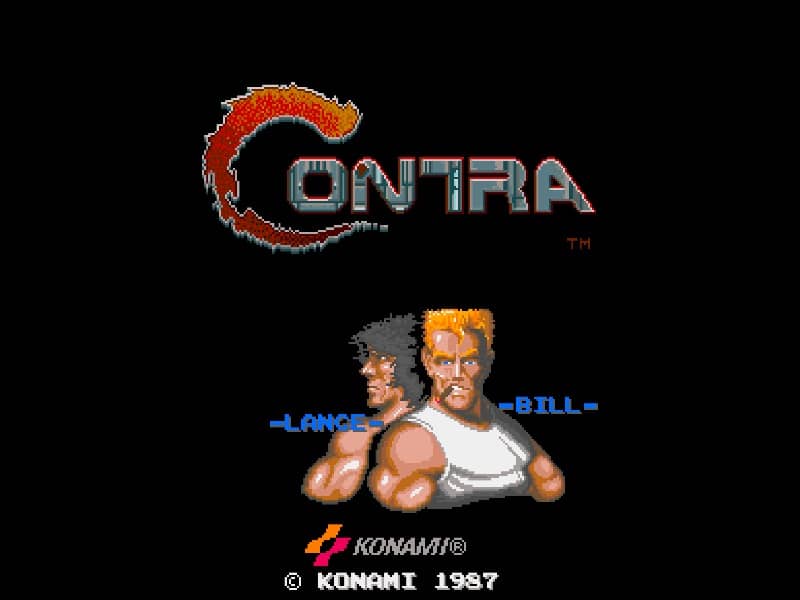
Two-player simultaneous play is a cornerstone of the arcade design. Two players can take on the roles of Bill and Lance, fighting side by side on the same screen. Cooperation not only doubles firepower but also tests coordination—for example, in narrow corridors, one player clears enemies while the other covers the flanks. This emphasis on teamwork gave arcade-goers a reason to bring friends along and became one of Contra's most enduring hallmarks.
The game's difficulty and continue system are also characteristic of the arcade era. Players have a limited number of lives, and when they run out, they can continue, but only up to three times. In two-player mode, both players must exhaust their lives before they can choose to continue together. This design ensures a challenge while making cooperation more meaningful—one player's mistake can drag down the whole team. This tension was one of the most thrilling experiences in arcades back then.
Background and release
The arcade version of Contra was released by Konami in 1987, marking the first installment in the series. The game is set in the year 2633 on the fictional Galuga Islands, where an armed organization called Red Falcon has taken over. Players control Bill Rizer and Lance Bean, who must infiltrate enemy territory and thwart their plans. This futuristic sci-fi setting wasn't particularly unique among arcade games of the time, but combined with the hard-edged action style, it still caught players' attention.
The arcade version was released in Japan and the United States with nearly identical content, both titled 'Contra'. In Europe, however, the game was renamed 'Gryzor' and featured a significant gameplay difference: the European version only supported alternating two-player play, meaning players couldn't act simultaneously but had to take turns. This change had a notable impact on the cooperative experience, giving European players a subtly different impression of the game compared to their Japanese and American counterparts.
Commercially, the arcade version performed quite well. In Japan, it topped the Game Machine magazine arcade charts in April 1987, a testament to its popularity. In the United States, it was among the top four highest-grossing dedicated arcade games of 1987. In the UK, the version released as 'Gryzor' also became a hit in arcades, and after being ported to home computers, it appeared on Gallup's sales charts.
The success of the arcade version led to quick ports across multiple platforms. In 1988, the NES and MSX2 versions were released, and Ocean Software also ported the game to home computers like the ZX Spectrum, Commodore 64, and Amstrad CPC under the name 'Gryzor'. These ports varied in content; for example, the NES version added new levels and cheat codes, while the MSX2 version featured a health bar and 19 stages, but all were based on the arcade framework.
As the starting point of the series, the arcade version's influence continued through subsequent ports and re-releases. In 2006, it was reissued on the PS2 as part of the 'Oretachi Gēsen Zoku' series, and later that year, it hit Xbox 360 via Xbox Live Arcade, with the conversion handled by Digital Eclipse. In 2016 and 2020, Hamster's Arcade Archives series brought the arcade version to PS4 and Switch, respectively. The 2019 'Contra Anniversary Collection' bundled the arcade, NES, and Famicom versions, allowing both new and veteran players to revisit this classic.
Development
The development of the arcade version of Contra was heavily influenced by Hollywood action movies of the time. The two protagonists, Bill and Lance, were designed with Arnold Schwarzenegger from 'Predator' and Sylvester Stallone from 'First Blood' as references, respectively. This tough-guy hero setup wasn't uncommon in gaming then, but Konami integrated that cinematic feel directly into the characters and atmosphere, letting players experience the thrill of an action movie protagonist in the arcade.
The origin of the title 'Contra' is also interesting. The word comes from Spanish, meaning 'counter-revolutionary', referring to the Nicaraguan rebel forces. Konami chose this name to add a touch of real-world political color to the game, and while most players probably didn't dig deep, the name did make the game stand out among the many shooters of its time.
Beyond the characters and title, the alien enemies were inspired by the 1979 film 'Alien'. Those bizarre, organic-looking foes shared a similar vibe with the movie's xenomorph. This design made the enemies more than just simple targets, imbuing them with a sense of horror and pressure that heightened player immersion.
Interestingly, the arcade version's promotional strategies varied by region. In the US, the arcade marketing downplayed the futuristic setting, and the NES manual even changed the background to a contemporary Amazon jungle. This shift may have been to appeal to local tastes, but it also led to some inconsistencies in the lore. In contrast, the arcade game itself remained largely unchanged, with only the promotional angle differing.
The arcade version's music is also worth mentioning. The soundtrack was composed by Konami's in-house team and later included on the 1988 album 'Konami Game Music Vol.4: A Jax'. These electronic tracks, with their strong rhythms, complemented the game's tense atmosphere. While they didn't receive as much attention as later game music, as the series' beginning, they laid the groundwork for the musical style of subsequent entries.
Reception and legacy
The arcade version of Contra received generally positive reviews from critics upon release. Clare Edgeley of 'Computer and Video Games' magazine called it 'tiring but exciting', a description that precisely captured the game's nature—its high difficulty and fast pace kept players on edge yet eager for more. This sentiment echoed the feelings of many players at the time, as evidenced by the lines of people waiting to play in arcades.
As the first game in the Contra series, the arcade version set the tone for the entire franchise. Its two-player cooperative gameplay, weapon upgrade system, and mixed perspective design became signature elements. Later that year, Konami released the sequel 'Super Contra', further cementing these features. Without the groundwork laid by the arcade version, the classic titles that players often talk about wouldn't exist.
The two-player cooperative mode was a key factor in the game's popularity. In the era of arcade halls, teaming up with a friend was a unique social experience. This cooperation extended beyond the game itself—players would exchange tips, share strategies, and even argue over who got to pick which character. This interaction made Contra more than just a game; it became a cultural phenomenon.
The arcade version's multiple re-releases also attest to its enduring appeal. From PS2 to Xbox Live Arcade, and then to PS4 and Switch, each port has given a new generation of players the chance to experience this classic. The 2019 'Contra Anniversary Collection' bundled the arcade version with the NES version and others, allowing players to compare differences between versions and appreciate the evolution of gaming history.
Looking back at the arcade version of Contra, it was not only a successful endeavor for Konami in 1987 but also a significant milestone in the history of shooters. Its design principles influenced many later games, and its mixed perspectives and two-player co-op are still regarded as classics by many players. Though the arcade era has passed, the name Contra continues to shine brightly in gaming history.





