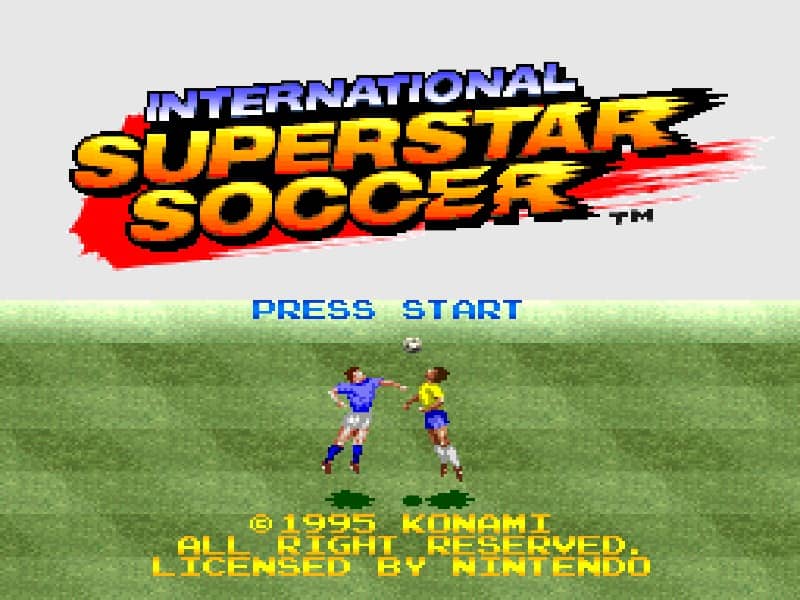
Gameplay and design
The core gameplay of International Superstar Soccer revolves around six modes, each offering a different experience. Open Match is the most free-form, allowing players to compete against the CPU, invite a friend for a head-to-head match, or even sit back and watch CPU-controlled teams battle it out—a feature that was uncommon at the time, giving the game both competitive and spectator appeal.
International Cup simulates the full World Cup journey, from qualifiers through the knockout stages to the final. World League uses a round-robin format where all teams play each other, and the team with the most points lifts the trophy. Both modes support a password system, letting players save their progress and continue later—a practical feature for cartridges without battery backup.
Training Mode is a standout feature, breaking down dribbling, passing, shooting, defending, and corner kicks into separate challenges, each requiring players to complete objectives within a time limit. This mode not only helps newcomers learn the controls but also offers veterans a place to hone their skills, showing extra care in a football game of that era.
Scenario Mode presents nine preset match situations, each with a specific score and remaining time, challenging players to turn the tide within the limited time. This mode tests quick thinking and tactical execution, adding a puzzle-like layer beyond regular matches. Penalty Kick Mode uses five rounds of alternating shots, with sudden death after a draw, ramping up the tension.
Overall, the gameplay emphasizes quick reactions and precise passing, with a faster pace than later Pro Evolution Soccer titles. While there are no complex tactical commands, player movement and shooting feel are finely tuned, making the game easy to pick up yet still offering depth. This clean, solid design is why it stood out at the time and became the foundation of the series.
Background and release
International Superstar Soccer was born in 1994, when the football game market was dominated by EA's FIFA International Soccer series. Konami wanted to create a competitor, so they assembled an internal team and developed this game for the Super Nintendo. The Japanese version was released on November 11, 1994, under the title Jikkyou World Soccer: Perfect Eleven, while the Western versions hit shelves in 1995 as International Superstar Soccer.
As the first entry in the ISS series, the game's naming reflected Konami's ambitions. The Japanese title's 'Jikkyou' emphasized a live broadcast feel, while 'Perfect Eleven' hinted at the pursuit of an ideal lineup. The Western name was more international, aiming for global market appeal.
At the time of release, the SNES was in the late stage of its lifecycle but still had a massive player base. Konami chose this platform for the new IP to solidify its existing user base and because the SNES excelled in sports games. The game fully utilized the console's hardware, delivering detailed player animations and smooth match visuals.
In terms of content, the game covered many of the era's top international teams, but due to the lack of FIFA licensing, player names were fictional. For example, Brazilian forward Allejo was modeled after Bebeto. This approach disappointed some players but also spawned a unique cultural phenomenon, especially the name Allejo, which became widely known in the player community.
After release, the game quickly gained a strong reputation among players thanks to its rich modes and solid gameplay. Although it didn't have official licensing like FIFA, its quality earned it a place in the football game genre and paved the way for Konami's later Pro Evolution Soccer series.
Development
The development of International Superstar Soccer was handled by an internal Konami team, which had already accumulated extensive experience in sports game production. The team aimed to create a football game that was both realistic and fun, investing heavily in visual presentation and control feel. The game used detailed pixel art, with player running and shooting animations carefully designed to replicate the dynamics of real matches.
Without FIFA licensing, the team couldn't use real player names, so they created a fictional roster. These names were often based on real players' phonetic similarities or characteristics, such as Allejo for Bebeto. This compromise gave the game a unique identity, and Allejo in particular became a frequent topic of discussion among players.
A notable feature of the Japanese version was the inclusion of live commentary, which was quite advanced for its time. The commentator's voice added to the match atmosphere, making players feel like they were in a real stadium. However, this feature was removed in the North American version, likely due to language adaptation and cost considerations. Many reviewers expressed regret over this, feeling it diminished the game's immersion.
The team put considerable thought into the game mode design, especially Training Mode, which was not just a simple add-on but a carefully crafted teaching tool. Each training exercise had clear objectives and scoring criteria, helping players gradually master the game's mechanics. This design philosophy was uncommon at the time and showed the team's attention to player experience.
The development process also faced technical challenges, such as fitting enough teams and modes into the limited cartridge capacity. The team overcame this by optimizing code and compressing data, successfully implementing all features. The game's post-release performance proved these efforts worthwhile, making it one of the most popular football games on the SNES.
Reception and legacy
International Superstar Soccer saw impressive sales after release. According to Famitsu, the game sold 96,608 copies in its first week in Japan, with total sales reaching 207,467 units. In Western markets, it also succeeded, selling over 500,000 copies in the first week of release. These numbers demonstrate the game's popularity and laid a solid market foundation for the series' sequels.
Media reception was generally positive. GamePro praised it as 'one of the best soccer games, second only to FIFA International Soccer,' noting its detailed graphics and rich options, though it fell slightly short of FIFA in control precision and sound effects. Electronic Gaming Monthly's two reviewers both gave it a 7/10, appreciating the graphics and options but noting imperfect controls.
Next Generation magazine gave the SNES version three stars out of five, saying that the simple, easy-to-learn controls and extensive season options made up for minor flaws. IGN ranked the game 64th on its list of the 'Top 100 SNES Games of All Time,' praising its detail and accuracy. These reviews indicate that the game was considered a high-quality sports title by professional critics.
In the player community, the game's influence was equally profound. The fictional player Allejo, in particular, became a cultural icon among Brazilian players. Due to Bebeto's outstanding performance in the 1994 World Cup, the name Allejo took on special meaning, with players frequently mentioning him in discussions and even creating memes and fan works.
As the first game in the ISS series, it laid the groundwork for the subsequent ISS Deluxe and the later Pro Evolution Soccer series. Its fast pace, rich modes, and focus on control feel were carried forward and evolved in later titles. Although its graphics are dated today, its place in football game history is undeniable, and it remains an unforgettable classic for many veteran players.