Gameplay and design
The core of TV Animation Slam Dunk: Super SLAMS is 2-on-2 basketball, which was quite unusual at a time when 5-on-5 was the norm in basketball games. Players pick one of four teams and engage in rapid-fire offense and defense on the arcade screen. With fewer players on the court, the space feels more open, and the pace of play is incredibly fast, with every possession packed with direct, tense confrontations. This design makes the game easy to pick up and fits the arcade ethos of delivering high-intensity thrills in short bursts.
Controls use an 8-way joystick and four buttons for passing, shooting, stealing, and special moves. The button layout is simple, but combinations allow for various tactics, such as quick passes followed by drives to the basket, or using steals to trigger fast breaks. Special moves are a major highlight, especially the dunks, which are exaggerated and flashy, perfectly matching the title 'Super SLAMS.' Players need to time and position themselves correctly to pull off these spectacular moves, adding depth and replay value.
The game offers four selectable teams, each with different strengths in speed and power, influencing playstyle. For example, some teams excel at outside shooting, while others rely on inside power. This variety encourages players to experiment with different styles across multiple playthroughs, boosting replayability. However, the game doesn't detail specific stats, so players must discover each team's traits through play, which adds a layer of exploration.
As an arcade game, TV Animation Slam Dunk: Super SLAMS emphasizes fast pacing and immediate feedback. Matches are shortened, with each game concluding in a few minutes, ideal for the arcade setting. The game also supports up to two players simultaneously, allowing for cooperative play against the CPU or head-to-head competition. This multiplayer mode makes it a great choice for friends to challenge each other and enhances the social atmosphere of the arcade.
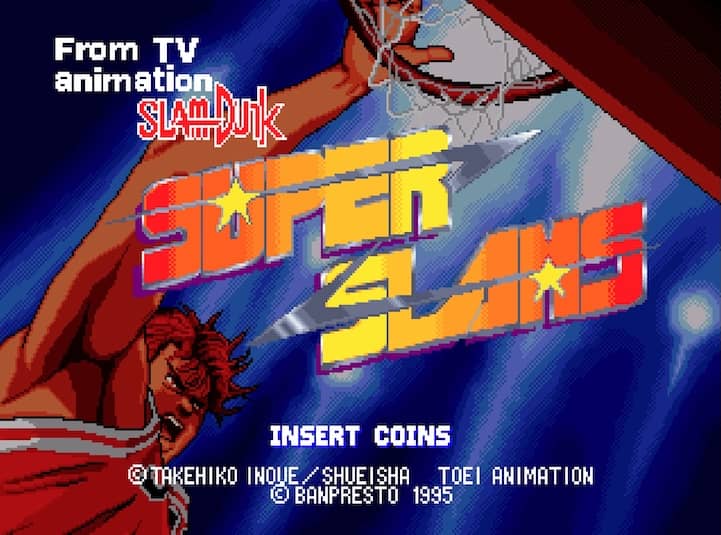
The game also pays close attention to graphics and sound. Despite hardware limitations, the characters and stages strive to capture the manga's style, with vibrant colors and smooth animations. Sound effects like the thud of dunks and the roar of the crowd heighten the immersion. Together, these elements create a lively court atmosphere, making players feel like they're in the world of Slam Dunk, experiencing the passionate basketball duels from the manga.
Background and release
TV Animation Slam Dunk: Super SLAMS was released in May 1995, at the peak of the Slam Dunk manga and anime's popularity. The manga had been serialized in Weekly Shonen Jump since 1990, and its realistic basketball portrayal and youthful, passionate story quickly made it a phenomenon. The anime's broadcast further fueled the hype, and releasing an arcade game at this time was a natural move to capitalize on the market, letting fans experience the excitement of basketball in game centers.
This game is part of the larger Slam Dunk series of adaptations, primarily developed by Banpresto and published by Bandai. Unlike the home console versions, the arcade version made bold changes to gameplay and content, adopting a 2-on-2 format that emphasizes action and entertainment. This differentiation avoided redundancy with console releases and fully utilized arcade hardware, offering players a unique experience.
In 1995, the arcade market was transitioning from 2D to 3D, but TV Animation Slam Dunk: Super SLAMS stuck with 2D graphics. This wasn't a step backward but a faithful homage to the manga's art style. Competing alongside fighting and shooting games in arcades, it attracted attention thanks to its popular IP and distinctive basketball gameplay. It proved that sports titles could thrive in the arcade and provided a reference for future basketball arcade games.
The game was later preserved in the MAME emulator, with the ROM name 'suprslam,' first supported in version 0.61 on July 4, 2002. MAME is a renowned arcade emulator dedicated to preserving and restoring classic arcade games. Its inclusion allows modern players to experience the arcade fun of yesteryear and offers valuable material for researchers. In MAME, the game's emulation status is generally good, though graphical emulation is imperfect, while sound and color are well emulated.
As an adaptation, TV Animation Slam Dunk: Super SLAMS doesn't directly replicate the manga's story but instead extracts characters and basketball elements to create an independent game experience. This approach was common at the time, satisfying fans' expectations of the IP while avoiding narrative constraints on gameplay. The game's success demonstrated that a balance between innovative gameplay and faithful adaptation is achievable.
Development
TV Animation Slam Dunk: Super SLAMS was developed by Video System and published by Banpresto, with producer K. Suzuki. Video System was an experienced arcade developer known for titles like Ninja Gaiden, boasting solid technical expertise. Banpresto, a subsidiary of Bandai, specialized in IP-based games, making this collaboration a strong partnership. The full development team, including planners, programmers, designers, and sound staff, reflects the typical division of labor in arcade game development at the time.
The main planner was S. Nozaki, with K. Matsunami as sub-planner, responsible for overall design and gameplay planning. From the 2-on-2 setup to the introduction of special moves, the planning team showed a deep understanding of arcade players' preferences. They knew arcade games needed quick pick-up-and-play and intense stimulation, so they simplified basketball rules and highlighted flashy dunks, delivering instant gratification.
The lead programmer was Yagiyama, with other programmers including Yoko, Kazuya "Kazuma", M. "RX-R" Kawaguchi, and Any L3. They used a Motorola 68000 (16MHz) as the main CPU, a Zilog Z80 (4MHz) for sound, and a Yamaha YM2610 (8MHz) sound chip. These were mainstream specs for the era, but the team optimized code to achieve smooth 60fps graphics and rich audio, showcasing solid programming skills.
The chief designer was Kaz. Adachi, with Nakajima 500 as sub-chief, and designers including Hiki, Ikeneko, Gigus, Suga Shoko, and H. Motono. They handled character, stage, and UI design, aiming to replicate the manga's style. The game's visuals show character models and animations inspired by the manga, with vibrant colors and detailed sprites. The designers also crafted various dunk animations to enhance visual appeal.
Sound was handled by Hoso-Q, who used the YM2610 chip to create dynamic background music and effects. The YM2610, a Yamaha FM synthesis chip common in arcade games, produced a wide range of tones. Hoso-Q composed upbeat BGM and effects like the thud of dunks and crowd cheers, boosting immersion. These audio elements, combined with the visuals, created a lively court atmosphere.
Reception and legacy
TV Animation Slam Dunk: Super SLAMS is described in arcade history databases as 'well-designed and simple to play,' which sums up its core appeal. With its polished graphics and easy controls, it drew players in arcades. While it didn't cause a sensation like some major titles, it left a positive impression among basketball game fans and stands as a representative 90s arcade basketball game.
In the MAME emulator community, the game is included and its emulation status is continuously updated. Although graphical emulation is imperfect, sound and color are well handled, providing a case study for emulator developers. Players can experience the game via MAME, reliving the arcade charm of the past. This ensures the game remains known to new generations even as arcade hardware fades.
As an arcade adaptation of Slam Dunk, this game offered a reference for subsequent related titles. It proved that a balance between innovative gameplay and faithful adaptation is possible. While the series later focused on home consoles, the arcade version's unique features, like 2-on-2 battles and special moves, had some influence on later basketball games.
The source manga Slam Dunk had a profound impact on basketball's popularity in Japan, and the game indirectly benefited. The manga and anime's popularity boosted the game's profile, and the game, in turn, introduced more players to the IP. This symbiotic relationship gave the game cultural significance beyond its own merits, making it part of the Slam Dunk transmedia franchise.
Today, the game is a subject of study for retro game collectors and emulator enthusiasts. It represents a facet of 90s arcade gaming and captures the glory days of the Slam Dunk IP. Though it may not be as well-known as console versions, it left a unique mark in arcade game history and deserves to be remembered.