Gameplay and design
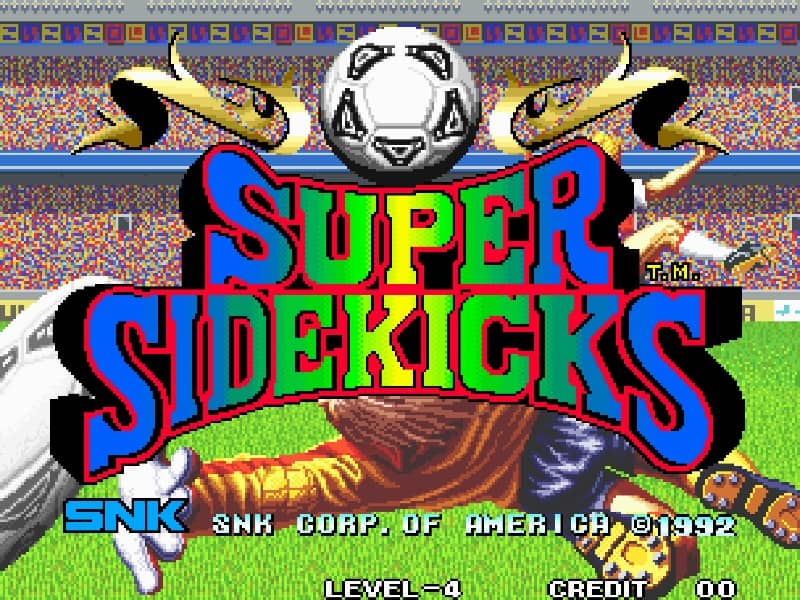
The gameplay of Super Side Kicks is immediately recognizable as arcade-style, not a realistic soccer simulation. The game uses a top-down view, with players as 2D sprites, oversized field and character proportions, exaggerated animations, and a breakneck pace. Players control a team and aim to score as many goals as possible within a limited time. The rules are broadly similar to real soccer but greatly simplified, with no offside and fewer fouls, emphasizing physical play and shooting.
The game features 12 national teams divided into two groups, competing for a championship called the "SNK Cup." Group A consists of Germany, Italy, Spain, England, Mexico, and Japan, while Group B includes Argentina, the Netherlands, Brazil, France, the United States, and South Korea. Players first play each of the five teams in their group, and good results in the group stage lead to the knockout rounds, followed by the semifinals and final, until they lift the trophy.
In terms of controls, the game uses only two buttons: one for passing and one for shooting. Running and tackling are mostly handled through the directional stick and physical contact. This design makes it easy for newcomers to pick up, but mastering it requires timing and positioning. Passes automatically find teammates, while shots depend on power and angle. Goalkeepers make dramatic saves, often diving spectacularly, and goal celebrations have a distinctly arcade feel, making players want to insert another coin.
The game also hides a subtle mechanic: when the AI opponent is awarded a free kick, pressing the A button on the 2P controller makes the AI take a short pass, while pressing the A button on the 1P controller makes it take a long pass. This detail is not mentioned in the manual and was discovered by players later, serving as a small easter egg for veterans and reflecting the hidden elements common in arcade games of that era.
Overall, the appeal of Super Side Kicks lies in its directness and excitement. There are no complex tactical boards or stamina bars; players run like the wind, and shots are powerful. This design philosophy aligns with SNK's fighting game style at the time, prioritizing competition and spectacle, allowing players to experience a thrilling match in just a few minutes in the arcade.
Background and release
Super Side Kicks first hit the Neo Geo MVS arcade platform on December 14, 1992, as SNK's second soccer game on its MVS board, following Soccer Brawl in 1991. The MVS was SNK's main arcade board at the time, with swappable cartridges, and many arcades relied on it. The game was later released for the Neo Geo AES home console on February 19, 1993, allowing players to enjoy it on their home TVs.
In 1993, the game was showcased at the IMA show in Frankfurt, Germany, one of Europe's important gaming expos, where SNK presented this new soccer title to overseas markets. By then, the Neo Geo had gained popularity in the West, and soccer being a global sport, the exhibition attracted attention and paved the way for international releases.
On March 31, 1995, the Neo Geo CD version was released in Japan, taking advantage of the CD's large capacity, though with longer loading times than cartridges, but at a more affordable price. In October 1996, the Neo Geo CD version also launched in North America, giving more players a chance to experience the game. However, the CD version didn't sell as well in North America, with the arcade MVS version remaining the primary way to play.
In the 21st century, Super Side Kicks reappeared in various forms. In 2010, the NEOGEO Station version, developed by M2, was released on the PlayStation Network, allowing players to play the authentic arcade version on PS3 and PSP. In July 2017, Hamster Corporation included it in the Arcade Archives series, re-releasing it on Nintendo Switch, PlayStation 4, and Xbox One, letting new players experience this classic.
Additionally, the game was included in the pre-installed game list of the Neo Geo X handheld and in retro hardware like the international Neo Geo mini, Neo Geo Arcade Stick Pro, and Neo Geo MVSX. In short, although the original Super Side Kicks is nearly three decades old, it remains a classic Neo Geo title that hasn't been forgotten, returning to players' attention every few years in some form.
Development
Super Side Kicks was developed by an internal SNK team, with producer Kawasaki Hideki and designer Ishizuka Kenji. Ishizuka later worked on various SNK projects, but this soccer game was one of his early significant works. The team also included sound staff Kitamura Yoshihiko and Osaka Yoko, who were part of the "Shin Sekai Gakkyoku Zatsugidan," an in-house group dedicated to game music, with a name that sounds quite adventurous.
Pixel art was handled by Miyagi Masato, S K, Younger Face, Uechi Eri, J. Mikami, and Mori-P. Some of these names are pseudonyms, like "Younger Face," which doesn't sound like a real name, but their work was solid, with player running, shooting, and tackling animations drawn fluidly and with impact, quite impressive for 2D soccer games of the time.
Programming was done by coders using pseudonyms like "Mabushi," "Narutaki," and "EP82boy." Using pseudonyms was not uncommon within SNK, possibly to maintain a low profile or as part of team culture. These programmers faced significant technical challenges, as the Neo Geo hardware, while powerful, required optimization to handle multiple player animations and physics collisions in a top-down view while maintaining a smooth 60 frames per second.
The SNK team had a clear vision during development: to infuse soccer with the spectacle and action of fighting games. At the time, SNK's fighting games like Art of Fighting and Fatal Fury were popular, with their visceral impact and exaggerated special moves captivating players. They wanted to bring that excitement to the soccer field, so tackles, collisions, and shots in Super Side Kicks carry a fighting game's intensity, and goal celebrations are particularly flamboyant.
There were also some errors during development, such as the Spanish team's jersey being drawn like Portugal's, and the Mexican team's colors being incorrect. These mistakes went unnoticed in the initial release and were only corrected in the sequel, Super Side Kicks 2. These minor flaws didn't cause much controversy at the time but were later pointed out by players and media, becoming a small talking point in the series' history.
Reception and legacy
Super Side Kicks performed quite well in arcades. In its March 1, 1993 issue, Japan's Game Machine magazine listed the game as the fourth most popular arcade game at the time; America's RePlay magazine also reported it as the tenth most popular arcade game. Ranking high in the competitive arcade market indicates it truly captured players' hearts.
Media reviews were generally positive, though not unanimous. French magazine Consoles +'s Marc Menier and Robert Barbe criticized the presentation but praised the graphics, animation, sound, playability, and longevity; Player One's Christophe Delpierre highly rated the visuals, sound, playability, difficulty, and longevity. Germany's Video Games' Andreas Knauf considered the game superior to Soccer Brawl, with detailed graphics and great playability.
Some media also expressed reservations. Italy's Computer+Videogiochi's Paolo Cardillo praised the visuals, audio, playability, and longevity but said, "Undoubtedly fun, but expected more from Neo Geo"; Consolemania's Piemarco Rosa liked the visuals and sprite animation but criticized the sound as inappropriate; France's Joypad's Jean-François Morisse and Nourdine Nini praised the graphics, animation, controls, and sound but noted slowdown when too many sprites appeared in the penalty area.
Spain's HobbyConsolas' Marcos García praised the visuals, sound, and playability but criticized the small team roster and lack of certain gameplay aspects. These criticisms mainly focused on the limited number of teams and shallow gameplay depth, but given that this was the first entry and aimed at arcade-style fun, these shortcomings didn't affect its popularity at the time.
The success of Super Side Kicks opened a new series for SNK, with sequels like Super Side Kicks 2 and Super Side Kicks 3 following, but the original, as the pioneer, established the series' foundational style. It was also listed by HobbyConsolas as one of the best Neo Geo AES games, holding a place in the hearts of retro gamers. Today, players can still enjoy it on various re-release platforms, experiencing the pure fun of arcade soccer from that era.