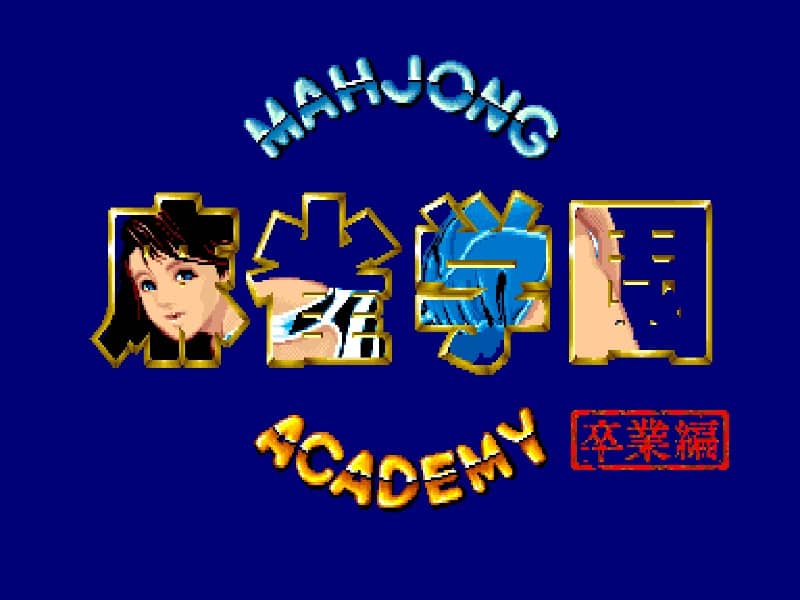
Gameplay and design
Mahjong Gakuen: Sotsugyouhen is an arcade Japanese mahjong game, and its core play follows the rules of Japanese mahjong. Matches are played with mahjong tiles rather than using the tiles for matching and clearing, which sets it fundamentally apart from puzzle games like mahjong solitaire. At the arcade cabinet, players take part in mahjong matches with opponents and hands, advancing the game through Japanese mahjong's winning hands and scoring logic. Its foundation is a four-player-style match structure, not the arranging or clearing of tiles as patterns; this is the key to understanding where the game sits genre-wise, and it is also where it is most easily confused with other games that share mahjong tile elements. The sources do not provide specific rule details, player counts, or special scoring arrangements, so all that can be confirmed is that it uses Japanese mahjong play; the flow of any particular hand cannot be described further.
The game combines Japanese mahjong with a school theme and anime-style character presentation. The characters are rendered in an anime style that creates a school atmosphere, but the sources do not provide specific character setups or a story mode, so character relationships and plot direction cannot be described further. What can be confirmed is that this thematic wrapping is part of how the game presents itself, giving the mahjong matches a clear character and setting theme. This combination also reflects a documented direction in Japanese arcade mahjong of the time: mahjong matches as the main gameplay, with characters and theme used as packaging to give a work its identity. That said, the sources do not say what role the characters play during matches, nor whether the school theme affects the rules themselves, so these points remain unconfirmed and one should not infer gameplay from the word "academy" in the title.
It is important to distinguish this game from school simulation games on home consoles. Despite the words "academy" and "graduation edition" in the title, it does not use raising or management simulation gameplay; arcade mahjong matches are the only confirmed gameplay framework. The sources do not say whether the game includes branching storylines, special rules, or extra modes, so these remain unclear. The release platform should likewise be kept separate from how the game is run today: it was originally a Japanese arcade game, and the fact that a browser can launch an old title does not mean it was an HTML5 game at release. Only by putting this together with the genre distinction above can its gameplay identity be understood accurately: it is a Japanese mahjong work developed by Yuga and published by Capcom for the Japanese arcade market in 1988, not a mahjong tile-matching game and not a school simulation for home consoles.
Background and release
The game's Japanese title is 麻雀学園 卒業編, romanized as Mahjong Gakuen: Sotsugyouhen. The "Sotsugyouhen" part means graduation edition or graduation version and is part of the official name, not a nickname added later. The game was developed by Yuga and published by Capcom for the Japanese arcade market in 1988. Earlier claims that Sega developed it or that it was released in 1989 are incorrect; Yuga and Capcom, 1988, is the accurate account. This correction comes from checking advertisements from the time and surviving product records, which support the 1988 release year. It should be noted that the available sources do not give a more specific release month or date, so only the year can be confirmed.
Yuga was a brand label under Capcom associated with adult-oriented mahjong games. This relationship places the game within Capcom's arcade mahjong publishing setup at the time, but the sources do not provide organizational details about Yuga or how the brand operated, so its internal structure or staffing cannot be described further. What can be confirmed is that the development and publishing relationship should be written as Yuga and Capcom; the publisher should not be mislabeled as Sega, and Mitchell hardware information found in other databases should not be taken directly as developer information. The Mitchell brand or related hardware information appears in some databases, but the available evidence does not support rewriting this as development by Mitchell, so the game's identity remains development by Yuga and publishing by Capcom.
The game was released for Japanese arcades in 1988, a year supported by both period advertisements and surviving product records. The sources do not provide release information for regions outside Japan, nor reliable worldwide sales figures or review score aggregates. The release scope can therefore only be confirmed as the Japanese arcade market; the situation elsewhere remains unclear. Likewise, the sources do not say whether the game was ported, remade, or licensed for adaptation, nor whether it had any form of official release outside Japan. A distinction must be made between the original arcade game and its later running in a browser; the fact that a browser can launch an old title does not mean the original was an HTML5 game at release. That the game began as a Japanese arcade title is confirmed, while its status on other platforms remains unknown.
Development
According to verified sources, the game was developed by Yuga and published by Capcom as part of Capcom's adult-oriented mahjong publishing line. The sources do not provide a specific development team roster, development period, or design documents, so behind-the-scenes details of the production process cannot be expanded upon. What can be confirmed is that Yuga, as a brand label, was associated with Capcom's mahjong game publishing, which provides a framework for understanding the game's publishing context. In other words, Yuga here is better understood as a label tied to Capcom's adult mahjong works rather than an independent company whose organizational chart can be freely filled in; that the game appeared under this label and was brought to the Japanese arcade market by Capcom is the full extent of the development and publishing relationship the sources support. As for who handled programming, art, or music, the sources do not say, and this section will not speculate.
On hardware and how the game ran, the sources mention only that it was originally a Japanese arcade game. Some databases may connect the Mitchell brand or related hardware information with the game, but the available evidence does not support rewriting Mitchell directly as the developer. It should be clear that the original arcade game and its later running in a browser are two different things; the fact that a browser can launch an old title does not mean the original was an HTML5 game at release. The arcade cabinet was its original medium, while the browser is merely one way to encounter the old game today, and the two should not be conflated. Similarly, the Mitchell name appearing in databases is hardware information that warrants caution and should not be casually written as "developed by Mitchell," which would treat a record of uncertain origin as a production fact.
The sources do not say whether the game was ported, remade, or licensed for adaptation, nor do they provide specifics about rule conversion or theme licensing. In the development background, therefore, only the developer, publisher, release year, and platform can be confirmed; everything else remains unknown. This restraint is meant to avoid filling gaps with common assumptions and to keep the encyclopedia content trustworthy. Specifically, whether the game was ever released in another form, whether the school theme and anime-style character presentation involved outside licensing, and how Japanese mahjong rules were implemented on the arcade cabinet are all questions the sources leave unanswered, so this section does not take them up. Stating clearly what is known—Yuga and Capcom, 1988, Japanese arcades—is more reliable than filling space with plausible-sounding guesses.
Reception and legacy
The preservation value of Mahjong Gakuen: Sotsugyouhen lies mainly in how it connects Yuga, Capcom, and late-1980s arcade mahjong publishing. As a work in that publishing lineage, it records the Japanese arcade market's continued investment in mahjong themes at the time and the way school-themed anime-style characters were used as packaging. The sources do not provide sales figures, review scores, or awards, so its commercial performance or reputation cannot be assessed quantitatively.
In terms of series position, this is the entry in the Mahjong Gakuen series carrying the "Sotsugyouhen" subtitle, but the sources do not describe other entries in the series or this game's specific place in the order. Its representativeness in rules lies in using Japanese mahjong rather than tile-matching play, which helps distinguish arcade mahjong from puzzle-style mahjong games. For players and preservationists studying late-1980s arcade mahjong, this game is a verifiable sample.
The sources do not provide evidence that the game influenced later works or the industry, so its influence should not be invented. It can be said cautiously that clarifying the game's identity—developed by Yuga, published by Capcom, Japanese arcades in 1988—has bibliographic value in itself, correcting the earlier mistaken Sega attribution and 1989 date. Its historical place lies more in publishing records and genre distinctions than in any widely spread cultural impact.