Gameplay and design
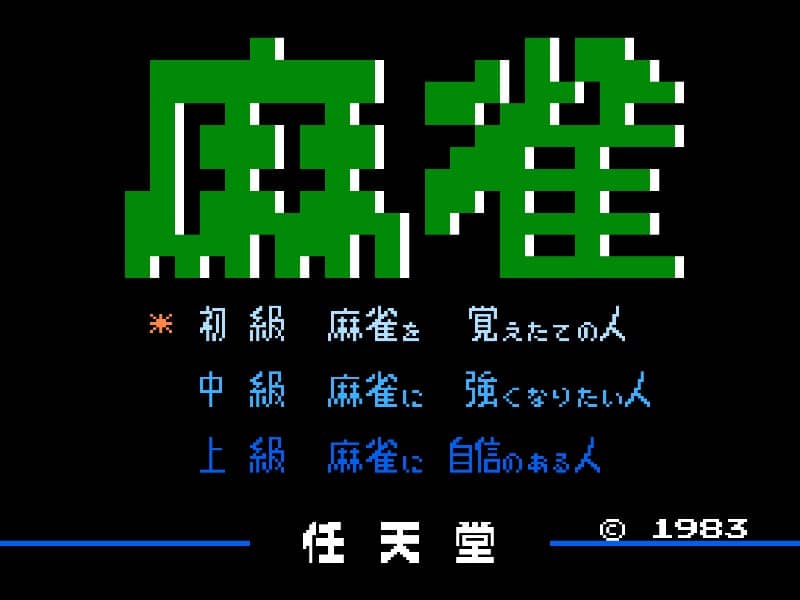
Mah-Jong is a Japanese mahjong game in which a single player faces computer-controlled opponents. It offers three computer difficulty levels, so players of different skill levels can find a suitable challenge. Matches follow the basic rules of Japanese mahjong, with players building winning hands and competing against the computer. The available material confirms only the three difficulty levels; it does not describe how the computer's play differs between them.
Within the display limits of the early Famicom, the game shows the player's hand, discards and table information. Players use this to decide whether to draw, discard or call a tile. The hardware's limited capabilities meant the screen layout and controls were simplified, but the core logic of a mahjong match was preserved. The material does not provide specific screen resolutions, button layouts or control details.
It is worth noting that this Mah-Jong is not a tile-matching puzzle game. An older English description used the phrase "tile matching," but the game is actually a genuine four-player mahjong title and has nothing to do with match-elimination play. Tile-matching games merely borrow mahjong tile designs for pairing; this game involves the full set of rules for drawing, discarding and calling tiles and forming a winning hand.
Background and release
Mah-Jong went on sale in Japan on August 27, 1983, for the Family Computer. Nintendo developed and published it, making it part of the Famicom's early lineup and the platform's first mahjong game. This refers to the Japanese-market Family Computer; the material gives no information about a release in North America or other regions, so whether the game ever came out outside Japan remains unconfirmed. Details such as the makeup of the development team and the development period are also not covered by the available material.
The game's English catalog name is usually written as Mah-Jong, a name common in overseas material of the time, though the game itself was released only in Japan. Some web addresses contain "NES," but no NES existed in North America in 1983, so the game should not be confused with the North American NES. The material does not say where this English title first appeared or who settled on it.
The game is one of the Famicom's earliest titles and, alongside other tabletop and board games Nintendo released around then, helped form the platform's initial software lineup. Its historical significance comes more from its release timing and platform role than from any narrative campaign or story. Nintendo's official product page confirms the release date and genre. The material does not give its exact position in the overall Famicom software sequence or the precise number of tabletop and card games released around the same time.
Development
Mah-Jong was developed by Nintendo R&D1 and published by Nintendo. R&D1 was an important development team at Nintendo at the time and worked on several early Famicom games. This project was an attempt to bring complex tabletop mahjong matches to early home hardware. Rather than designing a new rule set from scratch, the team had to move an established form of Japanese mahjong onto a home console, letting a single player face computer-controlled opponents across three difficulty levels.
Early Famicom hardware was limited, and the screen had to hold the player's hand, discards and table information at once within those constraints. These layout compromises were themselves part of the porting work. The available material does not describe the specific methods used during development or the technical problems the team encountered, so this cannot be explored further.
It should be clear that the material provided here does not cover browser ports or modern ways of running the game. The original is a Famicom cartridge game, and any method of running old titles in a modern browser differs from how the game was released. The fact that a browser can launch an old game does not mean the game was a web-based product at the time of its release. The material also contains no further information about licensed properties or rule adaptations, so those aspects remain unknown.
Reception and legacy
Mah-Jong's significance lies mainly in its timing and its place in platform history. As the Famicom's first mahjong game, it arrived at a time when Nintendo was working to establish tabletop and board game genres on the console. The game paved the way for later titles of the same kind on the platform, though its own influence is not reflected in data such as sales figures or awards. Nintendo's official product page confirms its release date and genre, giving it a clear place in the early Famicom software catalog.
In terms of preservation value, Mah-Jong is a sample for studying the early Famicom software lineup and Nintendo's genre experiments. It shows how a company of the time turned a complex tabletop game into a single-player home console experience: the player faces computer-controlled opponents rather than real people across a table, the game offers three computer difficulty levels, and the screen presents the hand, discards and table information within the early Famicom's display limits. Because the material is limited, no further claims can be made about its specific reception or its impact on the industry.
Overall, the game is part of the Famicom's early history, and its standing is defined by its release date and platform role. It is not notable for story or characters but exists as a mahjong game with clear rules. For players curious about the diversity of Nintendo's early console software, it offers a concrete example. It is worth distinguishing once more: this is a Japanese mahjong game, not a tile-matching puzzle game, and the phrase "tile matching" in older English descriptions can easily mislead. Its English catalog name is usually written as Mah-Jong, and its original platform was the Japanese Family Computer.