Gameplay and design
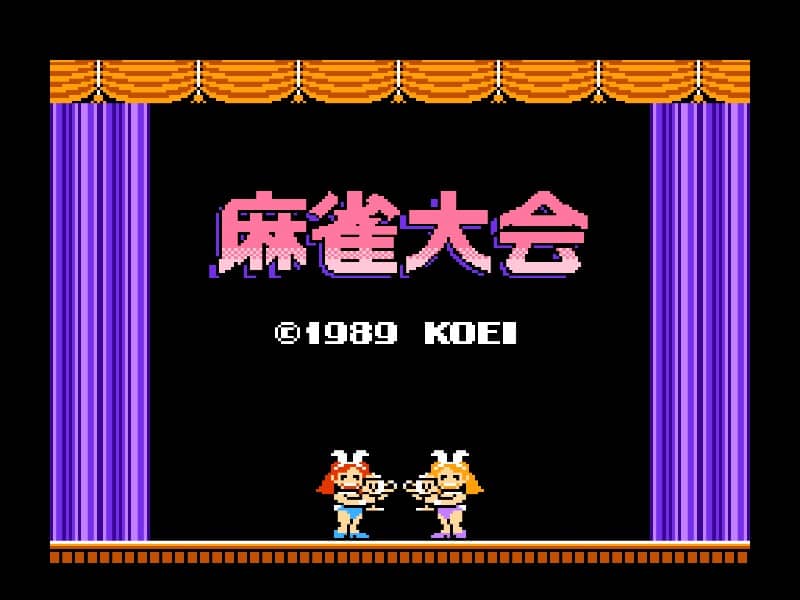
Mahjong Taikai is a Japanese mahjong game in which the player faces computer-controlled participants on the Family Computer. It follows the basic framework of Japanese mahjong rather than the tile-matching style of play. The "taikai" in the title means tournament, but that is only part of the name; it does not mean the game includes offline events or online competition modes. The opponents are computer-controlled, not other human players.
This title is fundamentally different from mahjong solitaire or tile-matching games. Those revolve around removing exposed pairs of tiles, while Mahjong Taikai is a genuine Japanese mahjong game involving the usual flow of drawing, discarding, and winning hands. Because the available material does not provide specific rule details, the number of modes, or the quality of the computer opponents' play, we cannot describe any unique rule variants or difficulty settings. What is certain is that its design goal was to recreate the experience of a Japanese mahjong match on a home console.
As a Famicom game released in 1989, it belongs to the then-growing wave of tabletop games brought to consoles. Players did not need to gather four people to enjoy a mahjong match, since computer opponents made it possible, which shows the advantage home consoles offered for simulating traditional tabletop games. However, the existing material does not mention whether the game includes ranking, a story, or special items, so this cannot be confirmed. Its core gameplay is Japanese mahjong itself, and there is no evidence that it adds the matching or puzzle mechanics that other games with the same name might have.
Background and release
Mahjong Taikai was developed and published by Koei for the Family Computer, and it was released in Japan on October 31, 1989. An earlier attribution of the game to SETA was mistaken and has now been corrected to Koei. The product code is KOE-IQ, which is consistent with Koei as the publisher. This information comes from Japanese catalog records and establishes the game's basic identity. It should be noted that what is confirmed here is Koei as developer and publisher, not another company; the product code and the publisher identity corroborate each other, giving the attribution correction a verifiable basis. As for the specific members of the development team, the producer, or design documents, the available material does not mention them, so they cannot be discussed. The platform and date likewise follow Japanese catalog records; whether the game was released in other regions or had localized versions is not covered by the material and should remain unknown.
The title "Mahjong Taikai" translates literally as "Mahjong Tournament," but the name alone does not prove the game is connected to any external esports tour. It is simply a Japanese mahjong game on a home console, with computer-controlled opponents. The game is part of Koei's early catalog, from a time before the company became widely known for its historical simulation games. This context helps place it within Koei's product line, but it should not be overread as the company's main focus at the time. In other words, "taikai" is only part of the title and cannot be used to infer that the game includes offline competitions, online play, or any tournament mode; the material contains no such record. Nor is it a tile-matching mahjong game; its content is a Japanese mahjong match. Seen against the trend of Famicom tabletop adaptations around 1989, it looks more like a specific entry in Koei's early catalog than the product of some tournament system.
No reliable data has been found on the game's global sales or on contemporary review scores. As a result, no judgment can be made about its commercial performance or its reputation at the time. What can be confirmed is that it is a Famicom game released in Japan, with the platform and date supported by Japanese catalog records. Whether it was released in other regions or had localized versions is not covered by the material and should remain unknown. A related distinction is between the original release platform and how the game might be played today: the original was made for the Family Computer, and if it can now be launched in a browser, that is only a matter of emulation or porting and does not mean it was a web game in 1989. The material provides no information about an official browser release, so such modern forms of play can only be regarded as non-original. On questions of sales, scores, awards, and influence, the gaps in the material are themselves something to state honestly, rather than filling them with plausible-sounding numbers or conclusions.
Development
According to verified facts, Koei was both the developer and the publisher of Mahjong Taikai, and the product code KOE-IQ further supports this. The game was released in Japan on October 31, 1989, for the Family Computer. This information comes from Japanese catalog records and is the currently confirmable development and publishing background. As for the specific development team, producer, or design documents, the material does not mention them, so they cannot be discussed.
The game was part of the late-1980s wave of tabletop game adaptations on the Famicom. At the time, home consoles were beginning to be used to simulate traditional tabletop games, and mahjong, as a popular tabletop game in Japan, naturally became one of the subjects of adaptation. Koei worked across a variety of subjects in this period, and a mahjong game was one entry in its early catalog. However, the material does not explain the specific circumstances or licensing behind Koei's development of this game, so its production motives or partnership details should not be guessed at.
A distinction needs to be made: the original release platform was the Famicom, not a modern browser. If the game can be run in a browser today, that is only a matter of emulation or porting and does not mean it was an HTML5 or web game in 1989. The material provides no official information about a browser release, so modern ways of playing it can only be regarded as non-original forms. The core facts of the development background are limited to Koei's development and publishing, the platform, and the date; other details remain to be verified.
Reception and legacy
The catalog value of Mahjong Taikai lies in correcting the earlier mistaken attribution of the company, establishing its connection to Koei, and serving as an example of the late-1980s wave of Famicom tabletop game adaptations. It is not a tile-matching mahjong game but a Japanese mahjong game, and this distinction helps in understanding its genre accurately. As a work in Koei's early catalog, it appeared at a time when the company was not yet internationally known for historical simulation games, offering a footnote for studying the diversity of Koei's product line.
Because reliable global sales data and contemporary review summaries are lacking, no judgment can be made about the game's market performance or how players received it. Its influence may have been limited to Japan, but the material provides no evidence for this. We should not invent its sales, awards, or community memory. What can be said is that its significance for preservation and cataloging lies more in its identity as a late-Famicom tabletop game adaptation and in the correction of its company attribution.
The game's historical standing should be treated with restraint. There is no evidence that it sparked widespread discussion or influenced later works. Its value lies in being a specific, verifiable Famicom mahjong game that helps people understand the diversity of the Japanese home console market at the time. In evaluating it, one should avoid applying the framework of other mahjong games or of Koei's later works, and should instead rely on verified facts, acknowledging that gaps in the material are themselves part of an encyclopedia's credibility.