Gameplay and design
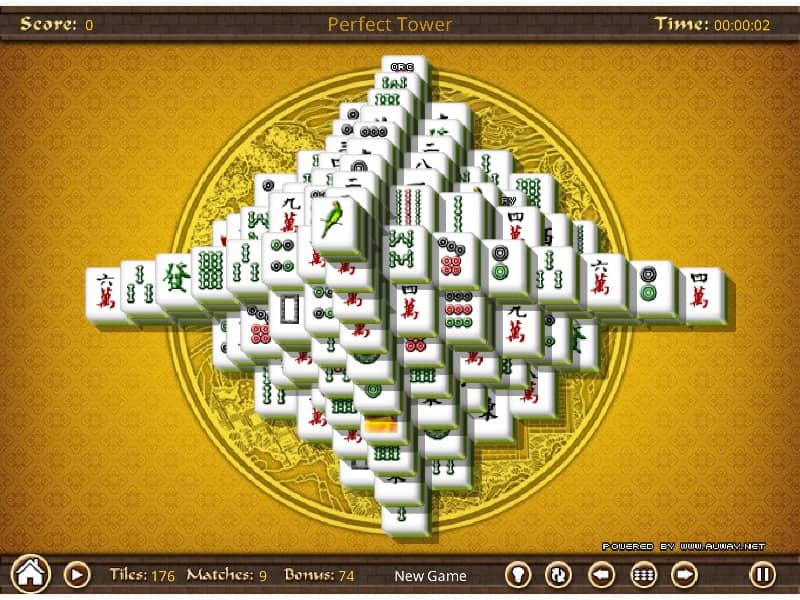
The heart of Mahjong Tower 2 is mahjong solitaire, not four-player mahjong. The tiles are stacked into a tower-like layout, and players hunt for matching pairs to clear away. Removal isn't free-form, though: only tiles in open, selectable positions can be picked. An open position generally means no other tile covers it from above and at least one side is clear, so the player can actually "reach" it. That restriction makes spatial visibility and how exposed a tile is central to the puzzle.
The goal is to dismantle the whole layout until every tile is gone, or until no legal pair remains. Because the stack has depth, each move requires reading which tiles are currently reachable and planning the order of removal. The tower presentation reinforces that sense of space: how tiles block one another directly shapes what's available, and players have to peel the layers back from the outside in and from top to bottom, like taking apart a block structure. This gives simple matching rules real strategic weight, since one bad choice can leave you with no pair to make later.
To be clear, this game does not simulate drawing, discarding, or traditional hand scoring in four-player mahjong. The tile faces serve only as visual symbols for matching elements, and the rules are entirely different from tabletop mahjong. It's closer to a tile-matching puzzle built from mahjong tiles, with the emphasis on spatial reasoning and planning the order of moves rather than competitive mahjong rules. Keeping that distinction in mind helps players understand how the game actually plays and avoids confusion caused by the name.
Background and release
Mahjong Tower 2 is a Flash-era game that presents mahjong solitaire as a stacked tile layout. The "2" in the title marks it as a sequel, but there's no reliable information available about the first game's story. Neither the original developer nor the first release date can be confirmed, so it's impossible to say precisely what year it appeared or who made it. That anonymity was not unusual in the Flash game era; many small titles gradually lost their authorship as they circulated.
Today, some modern game portals offer an online version of the game, and the page date may show 2020. Note, though, that this date reflects the portal's own publishing record and can't safely be treated as the Flash original's launch year. Flash games were distributed through web pages back then, and original upload times are often hard to trace; reuploads and reposts blur the timeline further. So without solid evidence, the first release year has to be treated as unknown.
The game currently runs in browsers through a modern compatibility layer, letting players experience it without installing the Flash plugin. That doesn't mean it was originally an HTML5 game; the compatibility layer simply keeps old Flash content working in modern environments. This kind of preservation lets Mahjong Tower 2 survive technological change, but it also reminds us that many Flash-era works face similar questions about whether they'll continue to exist.
Development
Verifiable information about Mahjong Tower 2's development is very limited. We don't know the identity of the development team, and no reliable records of the development process, design inspiration, or technical details have been found. The only thing that can be confirmed is that it's a Flash-based game that used the web technology of the time to implement stacked tile layouts and pair-matching removal. Flash gave independent developers a relatively low-barrier creative tool back then, and many similar small games were born from it, though the specific production stories of quite a few have been lost to time.
The game's use of mahjong tiles is a borrowing of subject matter, not a conversion of rules. The developer clearly just took mahjong tile faces as matching elements and made no attempt to recreate four-player mahjong. The choice may have come from visual recognizability or cultural familiarity, but the specific reasons can no longer be traced. We shouldn't assume that because the game uses mahjong tiles, it contains mahjong rules or has a deep connection to mahjong culture. It's more of a puzzle game that uses tile faces as its medium, with spatial matching at its core.
The game continues to run in browsers today through a modern compatibility layer, which is a preservation and migration measure rather than part of the original development. The compatibility layer's job is to emulate the Flash runtime so old works stay playable on new platforms. This is neither a remake nor a port, but a kind of technical maintenance of a historical work. As for how the compatibility layer is implemented and how it solves the problem of running after Flash was discontinued, the available material doesn't explain it in detail, and we won't speculate.
Reception and legacy
Mahjong Tower 2 left behind no reliable sales data, media scores, or award records, so its commercial performance or industry impact can't be measured. In the history of Flash games, it's just one of many small titles with limited recognition. From a preservation standpoint, though, it's somewhat representative: it shows a common form of Flash-era game—lightweight, easy to pick up, built around a single mechanic—and at the same time highlights the survival difficulties such works face as technology changes.
As a mahjong solitaire puzzle, its rules are simple and complete, and the core spatial-matching mechanic works effectively within the tower layout. It can't be compared to big commercial releases, but it offers puzzle fans a relaxed way to pass the time. Its existence also reminds us that mahjong tiles can serve not only traditional tabletop games but also as visual material for other kinds of games. That kind of cross-genre borrowing is common in game design, but the rules and the subject matter need to be kept clearly separate.
Overall, Mahjong Tower 2's value lies more in the history of preservation: it's a sample of an anonymous Flash work kept alive through a modern compatibility layer. For people studying Flash game history or preservation practice, it may be an interesting case. For ordinary players, it's just a small puzzle game you can open and set aside at any time. Without more material, we should keep our judgment of its historical standing measured—neither exaggerating nor belittling it.