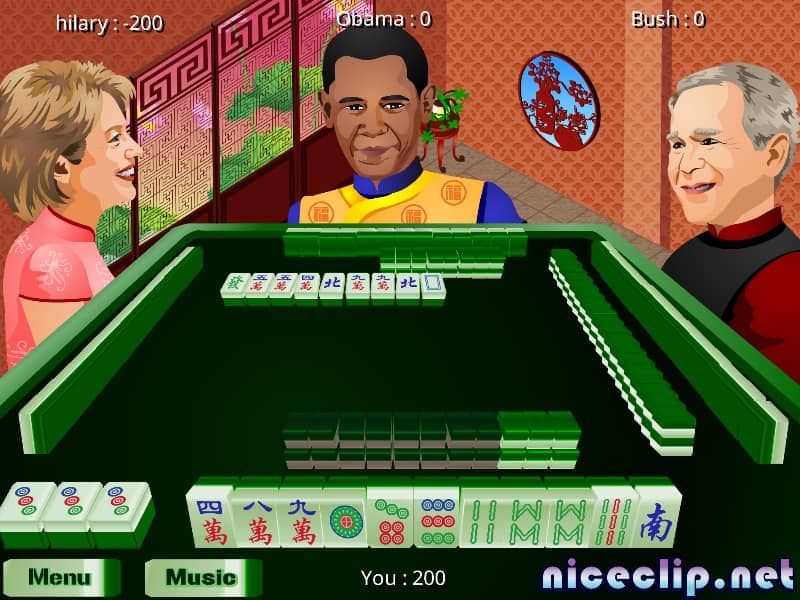
Gameplay and design
The core interaction here is mahjong solitaire or tile matching, not four-player mahjong. Players scan the layout for identical tiles that can be paired, removing them until the board is cleared or a goal is reached. There is no drawing, discarding, claiming or kong, and no need to build a traditional winning hand. The game borrows mahjong tile imagery, but its rules sit much closer to an elimination puzzle. In other words, you face a spread-out layout and hunt for matching pairs, rather than taking turns to draw and discard and judge hand values as in four-player mahjong. The tiles mostly serve as visual symbols, letting players who know the faces quickly grasp the find-a-match, clear-it-away idea, though the tiles never form traditional mahjong hand relationships. This design blends mahjong's graphic elements with the rhythm of a matching puzzle, so play feels more like observing and clearing a layout than sitting at a table with opponents and trading attack and defense.
The American political figures in the game, Obama, Hillary and Bush, appear as caricatures that serve as visual theme and satirical flavor. These likenesses do not represent any political endorsement or official connection, and the game is not a campaign product for the three politicians. Players see the caricatures throughout the matching process, giving the lightweight tile play a topical look. It is worth noting that the caricatures exist to make the tiles more recognizable and to add a teasing tone, not to convey a political stance or campaign message. The game was not authorized by the politicians involved and should not be read as an endorsement or as their participation in making it. From a gameplay standpoint, the figures are surface-level packaging; what players actually do is still pair and remove tiles. The politicians give this small game a timely visual theme without changing its basic structure as a tile-matching puzzle.
Because the available material only states that weapons are limited, there is no way to describe items, level structure or difficulty changes in more detail. What is certain is that the game combines mahjong tile imagery with political caricature to create a browser minigame experience tied to a particular moment. Its focus is observation and matching, not simulating the competitive flow of real mahjong. Precisely because the material is limited, it is impossible to confirm how many levels there are, how the tiles are arranged, or whether there is a timer or hint system, and it would be wrong to fill those gaps from experience with similar games. All that can be confirmed is that it is a browser puzzle from the Flash era, and the current site keeps it accessible through a modern browser compatibility runtime, though that accessibility does not mean the original used modern web technology when it was released. Putting mahjong tile imagery alongside political caricature is the game's most immediate characteristic, and it is also what gives it value as a cultural sample of web games.
Background and release
The game's name is misspelled in the catalog title; the correct English spellings of the figures are Obama, Hillary and Bush. It is a browser puzzle game from the Flash era that places mahjong tile images alongside caricatures of American political figures. It should be understood as a lightweight web game, not a formally released commercial mahjong product. In terms of genre, its core interaction is mahjong solitaire or tile matching: players find identical tiles in the layout and remove them one by one, rather than drawing, discarding, claiming or kong-ing and forming a winning hand as in four-player mahjong. The mahjong tile designs mainly serve as visual symbols, and together with the caricatures of Obama, Hillary and Bush they form a satirical theme. These likenesses are visual theme and satire, not any kind of political endorsement, and the game is not an official campaign product for the three politicians. Of the details at hand, title, publisher, year, region and original platform, only the title and the original platform, Flash, can be confirmed; publisher, year and region remain unknown and should be clearly left that way.
The original developer and first release date have not been reliably confirmed. Flash distribution often led to widespread rehosting, so dates shown on hosting pages cannot be treated as the original release date. No reliable review roundups, sales data or named developers have been found. These gaps mean it is impossible to accurately describe its debut year, region or team makeup. It is important not to infer a release date from the era in which the politicians were active, and not to fill the gaps with plausible-sounding years, publishers or influence. Likewise, with no named developers, budget records or licensing information, the specifics of production cannot be described. All that can be confirmed is that it borrowed the combination of mahjong tile imagery and political caricature; who put that combination together and why is not provided by the material.
The current site preserves access to this Flash game through a modern browser compatibility runtime. A distinction is needed here: the fact that a browser can launch an old game does not mean the original was an HTML5 game when it was released. Its original platform was Flash, and its current accessibility is the result of migration or emulation; the two should not be conflated. This accessibility is a preservation effort that lets the old game start in a new environment, but the material provides no technical details or timing for the migration, so it cannot be used to infer the original development choices or release strategy. Historically, the game's significance is as a concrete sample showing how a timely visual theme could be applied to a lightweight browser puzzle; at the same time, the widespread rehosting of the Flash era blurred the original release information, hosting-page dates are unreliable, and the developer and first release date remain unknown. Together these show that its historical record has gaps, and current compatibility access cannot fill them.
Development
Verifiable information about how this game was made is very limited. There are no named developers, no budget records and no explanation of licensed subject matter. What is certain is that it used caricatures of Obama, Hillary and Bush as a visual theme, but these likenesses were used satirically and were not authorized, endorsed or contributed to by the politicians. In other words, there was no official collaboration between the game and the three political figures; the likenesses serve a visual and satirical function rather than supporting a campaign or a political stance. Because of this, when discussing its production, the only solid ground is the choice of subject matter; team size, development cycle, funding and other details common in commercial game records cannot currently be confirmed. The original developer and first release date have likewise not been reliably identified, which further limits any reconstruction of the production background.
In terms of adapting rules, the game borrows mahjong tile imagery for a tile-matching format rather than implementing the full rules of four-player mahjong. This kind of adaptation was common in browser minigames of the Flash era: use familiar tile symbols to lower the barrier to understanding, then use matching to provide lightweight puzzle solving. Players face a layout in which they must find and remove matching tiles, not the full flow of drawing, discarding, claiming and kong-ing to form a winning hand. The material does not say who carried out this adaptation or what specific considerations drove it, so only the result can be described: mahjong tiles are appearance and symbol here, while matching is the actual gameplay. Keeping the two separate helps place the game among similar web minigames and avoids the mistaken assumption that sharing mahjong tile imagery means it simulates the competitive rules of four-player mahjong.
The current site keeps this Flash game accessible through a modern browser compatibility runtime. This migration lets the old game start in a new environment, but the material provides no technical details or timing for it. What is clear is that this accessibility is a preservation effort and cannot be used to infer the original development choices or release strategy. It is especially important to distinguish this: the fact that a browser can now launch the game does not mean the original was an HTML5 game when it was released; its original platform was Flash, and its current operation is the result of compatibility or emulation. Flash distribution often produced widespread rehosting, so dates on hosting pages cannot be treated as the original release date, which makes the game's debut information even murkier. Based on the available material, its historical significance lies more in being a concrete sample of how a timely political visual theme could be applied to a lightweight browser puzzle than in offering a complete development story.
Reception and legacy
With no reliable review roundups, sales data or named developers, it is impossible to give a quantitative assessment of the game's historical standing. Its historical interest lies in being an example of how a timely visual theme could be applied to a lightweight browser puzzle. The combination of political caricature and mahjong tile imagery is a product of a particular internet culture. In other words, its significance is not in how many people played it or how many outlets reviewed it, but in how it took the topical political figures of the moment and dropped them straight into a very accessible tile-matching format. This approach was inexpensive to make and easy to spread, and it captures a common creative impulse of Flash-era web minigames: use ready-made visual symbols and light rules to quickly produce a small piece that is easy to pick up and can raise a knowing smile. As for where it ranks among similar works, the material offers no basis, so no inference is made here.
The game also draws attention to the preservation problem for Flash-era web games. Widespread rehosting blurred the original release information, hosting-page dates are unreliable, and the developer and first release date remain unknown. The access currently provided through a compatibility runtime is a preservation effort, but it cannot fill the gaps in the game's identity and historical record. It is important to be clear that being able to open it in a browser now depends on modern compatibility runtimes supporting old Flash content, not on the game having originally been an HTML5 work. Such preservation lets later audiences still see what the game looked like, but it cannot restore the page environment, distribution path and credit information from when it first went online. For researchers or ordinary players, being able to play it and being able to explain its origins are two different things.
In terms of what it represents, it belongs to the mahjong solitaire or tile-matching genre, not four-player mahjong. This distinction matters for understanding its design position: it borrows the look of mahjong tiles, but its core is matching. Players find and remove identical tiles rather than drawing, discarding, claiming or kong-ing and forming traditional winning hands. The game has no confirmable sales or awards, so its influence should not be overstated. Its value lies more in being a concrete sample of web game culture: it shows that mahjong tile imagery can be pulled away from its original rules and used on its own as visual material. Placed in the context of a series or genre, it is more a slice of its era than a milestone in the evolution of rules.