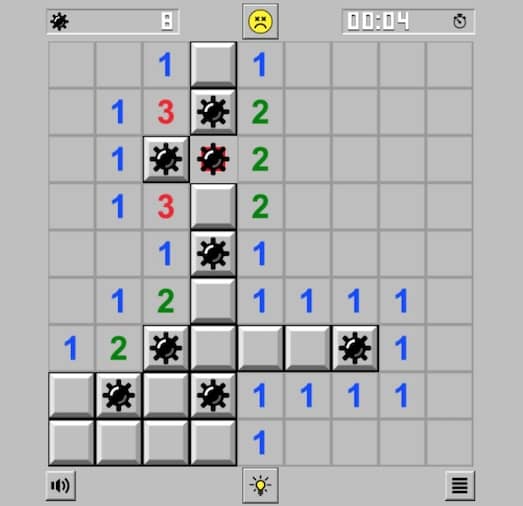
Gameplay and design
The goal in Minesweeper is simple: uncover every square on the board that doesn't hide a mine, without setting one off. At the start, all squares are covered, and the only way to test them is to click. If you hit a mine, the game ends immediately; if you reveal a number, that number tells you how many mines are tucked into the eight surrounding squares. These numbers are the basis for your deductions, and every move calls for careful observation and judgment.
The core mechanic revolves around numerical clues. For instance, a square marked "1" means exactly one mine sits among its eight neighbors; a "3" means three. Using these numbers and the already revealed areas, you gradually work out which squares must contain mines and which are safe to click. This process of logical deduction hides a surprising amount of strategic depth beneath the simple rules, and it's a big part of the game's enduring appeal.
Beyond the numbers, the game offers a flagging feature. You can right-click a suspected mine to plant a flag, marking it as confirmed, or use a question mark for squares you're unsure about, as a reminder to come back later. This thoughtful design helps with memory and keeps the reasoning process clear. When you successfully uncover all non-mine squares, you win, and any unflagged mines are automatically flagged as a small celebration.
The game offers three preset difficulty levels: Beginner, Intermediate, and Expert. Beginner uses a 9×9 board with 10 mines, perfect for newcomers; Intermediate is 16×16 with 40 mines, offering a moderate challenge; Expert is 16×30 with 99 mines, a real test of your deductive skills. You can also customize the board size and mine count to adjust the challenge to your liking.
One notable feature is the cascading reveal of blank areas. When you click a square with no adjacent mines, the game automatically reveals all surrounding squares, and if any of those are also blank, the reveal spreads further, opening up a large area. This design speeds up the pace and makes the early exploration feel satisfying. However, when the board gets down to a certain size, you often have to resort to pure guessing, which is an unavoidable part of the game.
Background and release
Minesweeper wasn't originally developed for Windows. Its roots trace back to IBM's OS/2 operating system, where Curt Johnson wrote the initial version. Later, Robert Donner ported the game to Windows and refined it. In 1990, it made its debut as part of Microsoft Entertainment Pack 1, a collection of small games designed to showcase Windows' entertainment potential.
What truly made Minesweeper a household name was the release of Windows 3.1 in 1992. From that version onward, Minesweeper was integrated directly into the standard installation of the operating system, replacing the previous Reversi (Othello). This meant every Windows 3.1 user could play Minesweeper right out of the box, with no extra installation needed. This move quickly turned Minesweeper into the first game for countless computer users and cemented its classic status within the Windows family.
After Windows 3.1, Minesweeper became a standard part of Windows, included in subsequent versions like Windows 95, 98, 2000, and XP. Although the interface and details were tweaked, the core gameplay remained unchanged. For many people born in the 80s and 90s, Minesweeper was one of the first games they played when using a computer, carrying a wealth of memories.
However, the game's mine theme sparked controversy in 1999. A movement called "International Campaign to Ban Winmine" argued that the mine element was insensitive to mine victims and suggested replacing mines with flowers. The campaign gained support and influenced Microsoft's decisions. In some localized versions of Windows 2000, ME, and XP, the game was renamed "Flower Field," and mines were replaced with flowers as a sign of respect for victims.
This "Flower Field" variant didn't last long, but it reflected the interaction between games and social issues. Microsoft restored the mine theme in later versions but kept "Flower Field" as an optional theme. This incident shows that even seemingly harmless games can spark discussion in certain cultural contexts. The history of Minesweeper is not just about the game's development but also mirrors the changes of the times.
Development
The creation of Minesweeper owes much to two key figures: Curt Johnson and Robert Donner. Curt Johnson originally wrote the code for IBM OS/2, while Robert Donner handled the port to Windows. During the port, Donner adjusted the game to better fit Windows' graphical interface and operating habits. This early collaboration laid the foundation for Minesweeper's basic framework.
In Windows 3.1, Minesweeper was chosen as a standard pre-installed game, and this wasn't accidental. Microsoft wanted to add some fun to Windows while showcasing its graphical capabilities. Minesweeper's simple rules and clean visuals made it an ideal entry-level game. Its inclusion not only enriched Windows' entertainment features but also helped users become familiar with mouse operations, such as left-clicking and right-clicking to flag.
As Windows versions evolved, so did Minesweeper. The Windows Vista version, developed by Oberon Media, underwent a major interface overhaul, changing the color scheme from the traditional gray to blue or green and adopting Aero-style icons to match Vista's visual design. Additionally, the Vista version offered the "Flower Field" theme as an alternative to mines, and the default theme depended on regional settings.
With Windows 8, Microsoft changed its strategy, no longer pre-installing Minesweeper but releasing it as a free game on the Microsoft Store. This version, developed by Arkadium, adopted an ad-supported model, initially featuring 30-second video ads and later offering monthly and yearly subscriptions to remove ads. This shift marked Minesweeper's transition from a system component to a commercial product, reflecting Microsoft's exploration in the mobile internet era.
The Windows 10 version further enriched the game, offering modes like Classic, Simple, Medium, Expert, Custom, Adventure, and Daily Challenges. It also added achievements, leaderboards, statistics, and tutorials, allowing players to track their progress and compare with others. These new features gave Minesweeper fresh vitality while preserving the classic gameplay.
Reception and legacy
Minesweeper holds a special place in players' hearts. Business Insider once called it an "iconic part" of the Windows operating system, and that's not an exaggeration. For countless users, Minesweeper was one of the first games they played on a computer; it's easy to pick up yet full of challenge, accompanying many through countless idle afternoons.
Minesweeper's influence extends beyond its pre-installed history on Windows to its spin-offs. In 2003, Microsoft created a variant called "Minesweeper Flags" in MSN Messenger, allowing players to compete against each other to find mines first. In 2010, a version of "Minesweeper Flags" for Xbox 360, developed by TikGames and published by Microsoft Studios, was released on Xbox Live Arcade, bringing the gameplay to consoles.
The game's design has also inspired many other games. The core mechanics of numerical clues and logical deduction are widely used in various puzzle games. Even in non-gaming fields, Minesweeper's algorithms have been used for simulation and teaching. In a sense, Minesweeper is more than just a game; it's a tool for mental training, teaching players how to make judgments from limited information.
Although Minesweeper is no longer a pre-installed app after Windows 8, its classic status remains unshaken. On the Microsoft Store, Minesweeper is still free to download and continues to receive updates, attracting both new and old players. For veterans, it's a source of nostalgia; for newcomers, it remains a worthwhile puzzle game.
The history of Minesweeper also reminds us that a seemingly simple game can have a rich story behind it. From OS/2 to Windows, from mines to flowers, from pre-installed to store app, every change in Minesweeper reflects the shifts of the times. It's not only a classic in gaming history but also a unique symbol in digital culture.