Gameplay and design
The core gameplay of Puzzle Bobble is straightforward: players control a pointer at the bottom of the screen, aim, and shoot colored bubbles toward the ceiling. When three or more bubbles of the same color cluster together, they pop. If other bubbles are hanging from the popped ones, they also fall, creating a chain reaction. This mechanic makes every shot strategic, as players must not only consider where the current bubble lands but also anticipate the cascading effects.
At the start of each level, the play area is already filled with a cluster of colored bubbles, and the goal is to clear them all. A fired bubble stops when it hits another bubble or reaches the top; if the bubble pile crosses the bottom line, the game ends. The colors of the bubbles are randomly generated, but they are chosen from the colors remaining on the screen, ensuring that players always have a way to continue, though it adds an element of unpredictability.
A special feature: if the player remains idle, the bubble fires automatically. This might seem like an anti-afk measure, but it actually forces players to keep a rhythm and not hesitate too long. The auto-fired bubble often disrupts plans, making the game more challenging and every round full of surprises.
The arcade version includes 30 levels with a gradual difficulty curve. As levels progress, the bubble arrangements become more complex and the color combinations trickier. Players need to skillfully use the walls to bounce shots for precise hits. This design keeps the game easy to pick up but deep enough to keep players coming back for more.
Every few shots, the top of the play area moves down, lowering the bubbles. When the bubbles get close to the bottom, the background music speeds up, creating a tense atmosphere. This dynamic pressure forces players to act quickly rather than taking their time to aim. The music change serves as both a warning and part of the game's rhythm, keeping the tension throughout.
Background and release
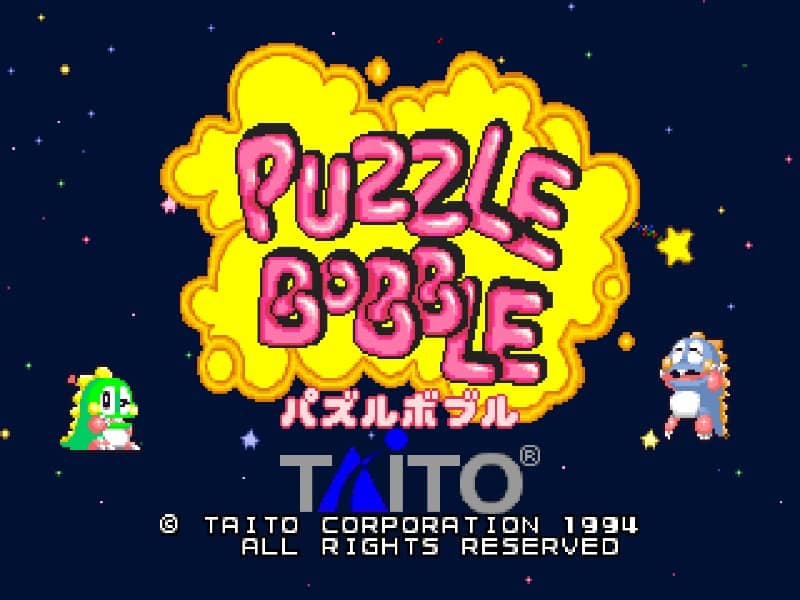
Puzzle Bobble was born in 1994 as an arcade puzzle game by Taito. Its international version is called Bust-A-Move, but they are the same game under different names in different regions. The game was first released in Japan in June 1994, running on Taito's own B System hardware, with the initial working title Bubble Buster.
The inspiration came directly from Taito's 1986 classic arcade game Bubble Bobble. That game was an action title where players controlled two baby dinosaurs, trapping enemies in bubbles. Puzzle Bobble completely changed the gameplay to pure puzzle elimination but retained the characters and theme from Bubble Bobble, giving longtime fans a sense of familiarity.
On December 21, 1994, a Neo Geo version was released, distributed by SNK's MVS arcade system, covering both Japan and North America. This version was nearly identical to the original B System version but supported stereo sound, with slight adjustments to sound effects and text. The Neo Geo release helped the game appear in more arcades and laid the groundwork for its later success.
Puzzle Bobble performed impressively in the arcade market. In Japan, Game Machine magazine listed the Neo Geo version as the second most popular arcade game in February 1995. That same year, it became the second highest-grossing arcade PCB software in Japan, just behind Virtua Fighter 2. In North America, RePlay magazine also reported it as the fourth most popular arcade game in February 1995.
The game's success was not only reflected in arcade rankings but also led to numerous home console ports. From the Super Nintendo to the 3DO, and later Windows, Game Gear, and other platforms, Puzzle Bobble appeared on nearly every major gaming system of the time. Each port introduced the game to more players and expanded its influence.
Development
Puzzle Bobble was developed internally by Taito, with the initial project name Bubble Buster. The name itself indicates a direct lineage to Bubble Bobble. The development team deliberately kept the cute dinosaur characters from Bubble Bobble but shifted the genre from action-adventure to puzzle elimination, a bold change that was uncommon at the time.
The design philosophy was clear: use simple match-three rules combined with physics and chain reactions to create gameplay that is easy to learn but hard to master. The team put considerable effort into balancing, such as the random generation rules for bubble colors and the speed of the ceiling descent, which were repeatedly adjusted to ensure players felt challenged but not so frustrated that they gave up.
The arcade version was initially developed on Taito B System hardware, which had limited capabilities but was sufficient to render colorful bubbles and smooth animations. When porting to Neo Geo, the team leveraged the new hardware's advantages, adding stereo sound and optimizing sound effects and text translation. These improvements, though minor, made the Neo Geo version a better experience.
The home console ports were handled by different teams, resulting in subtle differences between versions. For example, the Super Nintendo version was released in 1995, with the 3DO version following closely. These versions retained the core gameplay but made adjustments for each platform, such as optimizing controls for gamepads and adapting the screen aspect ratio.
The development of Puzzle Bobble was not without challenges, but the team always adhered to a core philosophy: let players enjoy the fun of thinking in a relaxed and pleasant atmosphere. This philosophy carried through the entire series and explains why the game, despite its simplicity, is so addictive. The team's attention to detail ultimately made this a classic.
Reception and legacy
Puzzle Bobble received widespread acclaim upon release. Many media outlets praised it as an 'addictive' puzzle game, especially the two-player mode, which became a popular choice at social gatherings. However, some critics noted that the single-player levels felt similar and lacked depth, but this did not diminish its standing among players.
The game's influence is first seen in the numerous clones it spawned. Snood in 1996 is the most famous example, nearly copying the gameplay of Puzzle Bobble with a different theme. Others include Team 17's Worms Blast, Empire Interactive's Spin Jam, and mobile titles like Bubble Witch Saga and Bubble Shooter, all heavily inspired by Puzzle Bobble.
Puzzle Bobble also inspired the free software community, leading to open-source clones like Frozen Bubble. This game gained popularity on Linux and other platforms, allowing more people to experience similar bubble-popping fun. Although these clones are not official, their existence proves the success and universality of Puzzle Bobble's game design.
In professional evaluations, Puzzle Bobble holds a place. In 2007, Edge magazine ranked it 73rd in its list of the 100 best video games. IGN also placed the Super Nintendo version 54th in its 'Top 100 SNES Games'. These honors further solidify its status as a classic puzzle game.
Entering the 21st century, the Puzzle Bobble series remains active. In 2021, to celebrate the 35th anniversary of Bubble Bobble, Taito released a VR version, Puzzle Bobble VR: Vacation Odyssey, which later came to PlayStation platforms. In 2023, Puzzle Bobble Everybubble! was released on Nintendo Switch, including a crossover mode with Space Invaders. These new titles let old fans revisit the classic while attracting a new generation of players.