Gameplay and design
Rich Man 3's game boards are set in three locations: Taipei, Taiwan, and Mainland China, each with its own map layout and event spaces. In single-player mode, you must clear all three boards in sequence to see the ending; in multiplayer, you can freely choose any board, with up to six players. If fewer than four human players join, the computer fills in the remaining slots, ensuring lively matches. This design gives solo players a clear goal while letting groups jump into the action quickly.
This installment introduced the point ticket system, a new currency used to purchase cards and items. Point tickets can be obtained by exchanging money, landing on point ticket spaces, or winning mini-games. Cards can no longer be bought directly with cash; they must be acquired with point tickets, adding a layer of resource management strategy. As for items, players can use point tickets at the shop to buy timed bombs, missiles, robot dolls, remote-controlled dice, roadblocks, cars, motorcycles, and landmines. Each item serves a different purpose, either hindering opponents or speeding up your own movement, making battles more dynamic.
The calendar system is a series first: the in-game start date uses your computer's clock, and on Sundays and public holidays, banks and the stock exchange are closed, while Saturdays operate normally. This means you must keep track of the date and plan when to trade stocks or take out loans, adding a temporal dimension to strategy. Stock trading now happens simply by passing the stock market, and dividends are introduced for the first time—the more shares you hold, the more dividends you receive. This encourages long-term investment rather than just buying low and selling high.
Companies are a new type of map tile. You can buy reserved shares at the underwriting price, but if a company is already run by someone, you must pay income tax. The player holding the most shares in a company becomes its chairman, and other players landing on that company must pay money as income, making companies key economic hubs on the board. Additionally, the Taiwan and Mainland China boards feature leaseable land: you can pay a rental fee to gain development rights and then build hotels, office buildings, or amusement parks, each yielding different returns, offering more flexible land use.
The god system builds on the previous game, adding angels and demons, and for the first time, the original four gods come in two sizes: large gods always grant their effect, while small gods do so randomly, with possession lasting seven days. This installment also introduces four new troublemakers: police officers, thugs, vicious dogs, and beggars, who can negatively affect players, such as fining them or stealing money. These random events keep the game full of surprises, requiring constant adaptation and ensuring each playthrough feels unique.
Background and release
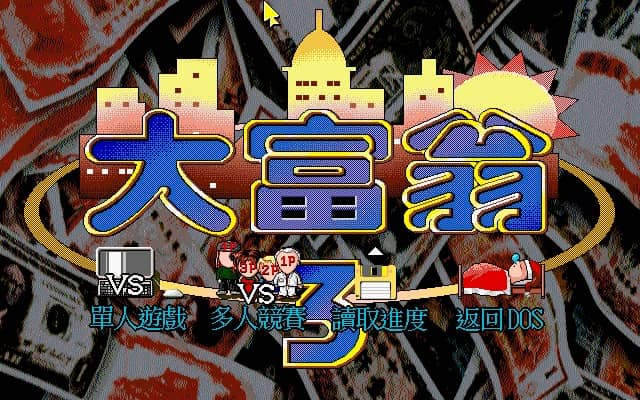
Rich Man 3 was developed and published by Softstar Entertainment in 1996, with the development team being the Crazy Creators, and it ran on DOS. At the time, personal computers were becoming more common, and DOS was still the dominant platform, with many classic games emerging during this period. After releasing the previous installment, Rich Man 2, Softstar had accumulated extensive experience in board game development. Building on that foundation, this game boldly introduced several new systems, aiming to forge a new path for the series.
The game's music was entirely reused from the previous game, Rich Man 2, totaling five tracks. This wasn't uncommon at the time, as sequels often had tight development schedules, and reusing music saved costs while giving returning players a sense of familiarity. However, this meant the game offered little new in terms of audio, but it had minimal impact on the overall experience, as players' attention was mainly on strategic gameplay.
This installment retained three characters from the previous game—Sun Xiao-Mei, Madame Chien, and A-Tu—and added nine new ones, bringing the total to twelve, each with unique dialogue and expressions. The character designs were diverse, ranging from cute little girls to shrewd ladies, each with their own style, allowing players to choose a character that suited them. These characters would appear in later installments, becoming iconic figures in the series.
The board designs covered Taipei, Taiwan, and Mainland China, reflecting the geographical awareness of Taiwanese players at the time. The Taipei board featured city streets, the Taiwan board included various scenic spots, and the Mainland China board had special facilities like train stations and airports. This design let players experience different regional flavors and added variety to the maps.
Rich Man 3 was released during Softstar's golden era, when the company produced several beloved titles, such as The Legend of Sword and Fairy. Against this backdrop, the game garnered significant attention and carried players' expectations for domestic games. Although the music was reused, the system innovations made this installment a significant entry in the series.
Development
The development team for Rich Man 3 was the Crazy Creators, a group at Softstar known for their creativity and execution, responsible for several major titles. During development, the team decided to retain the core fun of the previous game while introducing more strategic elements, shifting the game from a simple dice-rolling luck fest to a more thoughtful contest. This direction set the tone for the series' future evolution.
Character design was a key focus. The team kept three characters from the previous game and added nine new ones, totaling twelve. Each character had unique dialogue and expressions, making their personalities more distinct. These characters weren't just game pieces; they became objects of player attachment, such as A-Tu's simple honesty and Madame Chien's shrewdness, leaving lasting impressions.
In terms of system design, the team introduced point tickets, items, the calendar, companies, and land leasing for the first time. These innovations weren't developed overnight but went through multiple rounds of testing and adjustment. For example, the point ticket system changed how cards and items were obtained, forcing players to choose between cash and point tickets, adding depth to decision-making. The calendar system gave in-game time real meaning, requiring players to plan their actions.
The stock system's improvement was also a development focus. This installment introduced dividends for the first time, so stocks weren't just about buying low and selling high; they could also yield regular income. This encouraged long-term holding and vying for chairmanship to gain additional income. The addition of companies made economic activities on the board more complex, increasing player interaction.
During development, the team also paid attention to game balance. For instance, the design of large and small gods—large gods always activate, small gods activate randomly—provided both predictability and randomness. The troublemakers added challenge without overly disrupting the game flow. These fine-tuned details earned the game a reputation for good balance among players.
Reception and legacy
After its release, Rich Man 3 received positive feedback from many players, with some considering it the best-balanced installment in the series. This praise stems from the interplay of various systems, such as the dual currency of point tickets and cash, investment strategies in stocks and companies, and random events from gods and troublemakers, ensuring each game develops differently without any single strategy dominating.
The game earned two awards in Softstar's internal award records, though the specific award names were not disclosed. This recognition from within the company highlighted the game's quality and innovation, especially in the competitive domestic game market of the time.
Rich Man 3 was a crucial turning point for the series, shifting from a casual orientation to a strategic one, and its original features were retained in later installments. Systems like point tickets, items, and companies were carried forward and expanded in Rich Man 4 and beyond, demonstrating the lasting influence of its design philosophy.
The character designs also impacted the series, with several of the twelve characters continuing to appear in later games, becoming franchise icons. Characters like Sun Xiao-Mei, Madame Chien, and A-Tu remain classic figures in the Rich Man series, beloved by players.
Overall, Rich Man 3 holds an important place in the series' history. It not only bridged the past and future but also became a classic in many players' hearts due to its balanced design and rich content. Even years later, players still look back on this game fondly, a testament to its enduring appeal.