
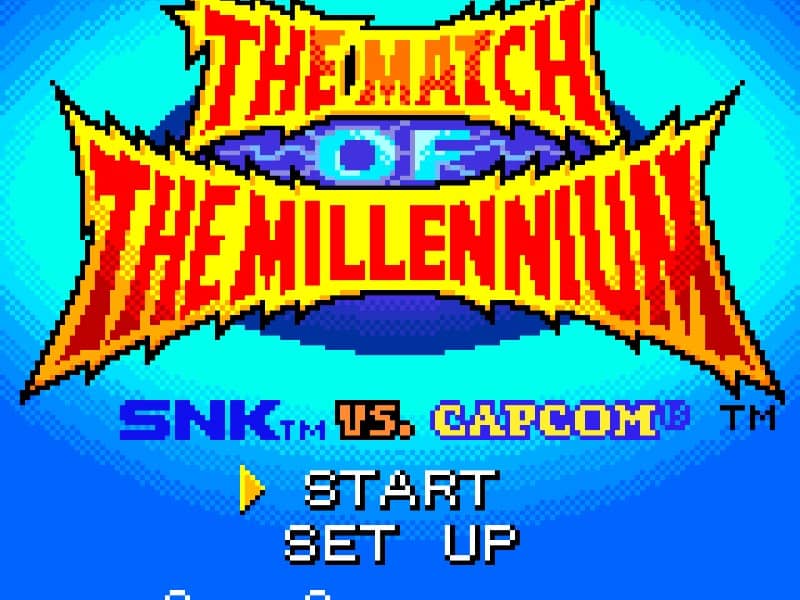
Gameplay and design
The core gameplay of Match The Millennium revolves around three battle modes: two-on-two team battles, three-on-three sequential matches, and one-on-one singles. The two-on-two mode, similar to the Marvel vs. Capcom series, allows players to switch between two characters at will and fight cooperatively. The three-on-three mode, closer to the relay-style format of The King of Fighters, has characters enter the fight in order. The one-on-one mode returns to traditional one-on-one fighting. This design lets players experience both Capcom-style flashy combos and SNK-style strategic switching, catering to fans of both companies.
The energy gauge system also reflects the fusion concept, offering three styles: a Capcom-style average gauge, an SNK-style counting gauge, and a neutral gauge similar to the Advanced mode in The King of Fighters '97 and '98. The average gauge fills automatically over time, favoring aggressive play; the counting gauge builds through hits taken or dealt, rewarding precise strikes; and the neutral gauge sits between the two, emphasizing timing. Players can choose the style that suits their play, a level of freedom rarely seen in handheld fighting games at the time.
Each character has a corresponding rival, and a special battle is forced between the fourth and fifth stages. For example, Kyo Kusanagi faces Iori Yagami, and Ryu faces Ken. These matchups not only recreate the original rivalries but also add narrative tension to the game. The final two boss battles are also unpredictable: players must first defeat the team of Geese and Bison, then face either Orochi Iori or Evil Ryu, depending on the chosen character's faction and whether the rival was defeated. Only by clearing the final stage can players see the character's unique ending; otherwise, a bad ending triggers, encouraging repeated play.
The Olympic mode is a highlight, featuring several themed mini-games, such as shooting down the final boss of Metal Slug 2, the Mars People, or helping Arthur from Ghosts 'n Goblins jump over pits to retrieve treasure. These mini-games not only test skills but also pay homage to classic SNK and Capcom titles, bringing a smile to veteran players. Scores from the mini-games convert into Versus points, which players can use to unlock special attacks for each character or, via a link cable, other hidden content, adding to the game's replay value.
The game features 26 characters from SNK and Capcom, most of whom are playable, but Jubei, Arthur, Marco, and Fio appear only in the Olympic mini-games as cameos. Additionally, characters like Billy Kane and Vega appear as non-player characters, enriching the game's world. This arrangement ensures balance in the fighting portion while expanding the roster through mini-games, offering players more fun within the limited cartridge capacity.
Background and release
SNK vs CAPCOM Match The Millennium was released on November 30, 1999, for the Neo Geo Pocket Color. This game was the first official collaboration between SNK and Capcom, marking a shift from rivalry to partnership between the two fighting game giants. Before this, both companies had flagship series like The King of Fighters and Street Fighter, but they had never officially crossed over their characters, so the announcement caused a huge stir at the time.
As the inaugural title in the SNK vs. Capcom series, this game laid the foundation for future collaborations. The series later spawned multiple titles, including the card game SNK vs. Capcom: Card Fighters' Clash and the 2003 arcade fighter SVC Chaos, but this game, as the starting point, holds irreplaceable milestone significance. It proved that two distinct fighting systems could merge and provided a template for later crossover fighting games.
Upon release, the game drew attention from Japanese media, with Famitsu magazine giving it a score of 30/40. While not top-tier, this was respectable given the NGPC's limitations. IGN, on January 5, 2000, gave it a perfect 10/10, praising its feel and depth of content. These reviews helped build the game's reputation among players, making it one of the most acclaimed titles on the NGPC.
On February 17, 2021, the game was ported to the Nintendo Switch as part of Neo Geo Pocket Color Selection Vol. 1. This port introduced local multiplayer and TV mode for the first time, allowing players to enjoy the classic on a big screen. On September 30 of the same year, the game also came to Windows, further expanding its audience. These ports let a new generation experience this over-20-year-old title and extended its longevity.
In Japan, the game sold 75,000 copies, becoming the best-selling game on the Neo Geo Pocket (and Color) platform. While this number pales in comparison to mainstream console games, it was a remarkable achievement in the NGPC's niche market. It demonstrated the appeal of crossover collaborations and added significant weight to SNK's handheld strategy.
Development
The game's origin traces back to a meeting between two industry heavyweights: former SNK director Takashi Nishiyama and Capcom development head Yoshiki Okamoto. Nishiyama had worked on the original Street Fighter, while Okamoto was a Capcom veteran, and the two were close friends. During a meeting, they conceived the idea of having characters from both companies compete on the same stage and decided to push the plan forward. They each persuaded SNK president Eikichi Kawasaki and Capcom president Kenzo Tsujimoto, ultimately bringing about this historic collaboration.
Art director Toyohisa Tanabe later revealed that one of the motivations for developing the game was to help the struggling Neo Geo Pocket Color platform. At the time, the NGPC's market performance was poor, and SNK needed strong titles to boost sales, so they negotiated with several companies, eventually reaching an agreement with Capcom. This blend of commercial consideration and creative passion made the game not just a fan-oriented crossover but also a mission to revitalize the platform.
The development team's biggest challenge was achieving smooth fighting gameplay on the NGPC's limited hardware. The NGPC had a low-resolution screen and few buttons, but the team carefully tuned character animations and hitboxes to ensure the game felt right. To fit 26 characters and multiple modes, developers had to be economical with cartridge space, even designing some characters to appear only in mini-games to save room. This trade-off showcased the developers' pragmatism and ingenuity.
The game's easter eggs and crossover details also reflected the team's care. For instance, the Olympic mode mini-games were directly inspired by classics like Metal Slug and Ghosts 'n Goblins, serving as tributes to the originals and showcasing SNK and Capcom's rich game libraries. Additionally, the rival pairings were not arbitrary but based on original storylines and fan knowledge, such as the fated duel between Kyo Kusanagi and Iori Yagami, a detail that resonated with veteran players.
The development process was not without friction, as the two companies' design philosophies differed. SNK excelled in team-based combat and energy management, while Capcom focused on combos and pacing; balancing these elements became a focal point of team discussions. Ultimately, the three battle modes and three energy gauge styles cleverly resolved the conflict, preserving each company's strengths while creating new gameplay. This fusion approach was later adopted by other crossover games.
Reception and legacy
Match The Millennium received widespread acclaim from media and players upon release. Famitsu gave it a 30/40, praising its rich content and solid feel; IGN gave it a perfect 10/10, calling it one of the best fighting games on the NGPC. These reviews not only affirmed the game's quality but also elevated the NGPC's overall image, helping it carve a niche in the handheld market.
Commercially, the game sold 75,000 copies in Japan, making it the best-selling game on the NGPC. This was a notable achievement for a handheld fighting game and proved the commercial potential of crossovers. It showed SNK the value of IP collaboration and laid the market groundwork for subsequent SNK vs. Capcom titles.
In terms of awards, the game was nominated for the 9th GamePro Readers' Choice Award for "Best Handheld Game of the Year," but ultimately lost to Pokémon Pikachu. Although it didn't win, being nominated alongside a phenomenon like Pokémon spoke to the game's standing among players. The nomination also reflected Western players' recognition of this Japanese fighting game.
Over time, the game's influence has not waned. In 2023, Time Extension listed it among the best NGPC games, reaffirming its historical value. For many players, this game is not just a childhood memory but also a testament to the golden era of SNK and Capcom collaboration. It proved that even with limited hardware, thoughtful design can create unforgettable gaming experiences.
The game's success also spurred the development of the SNK vs. Capcom series, with later card games and arcade fighters inheriting its character roster and crossover spirit. More importantly, it set a benchmark for future fighting game crossovers, such as the Capcom vs. SNK series, which was heavily influenced by it. In short, this small handheld game left a significant mark on fighting game history.





