
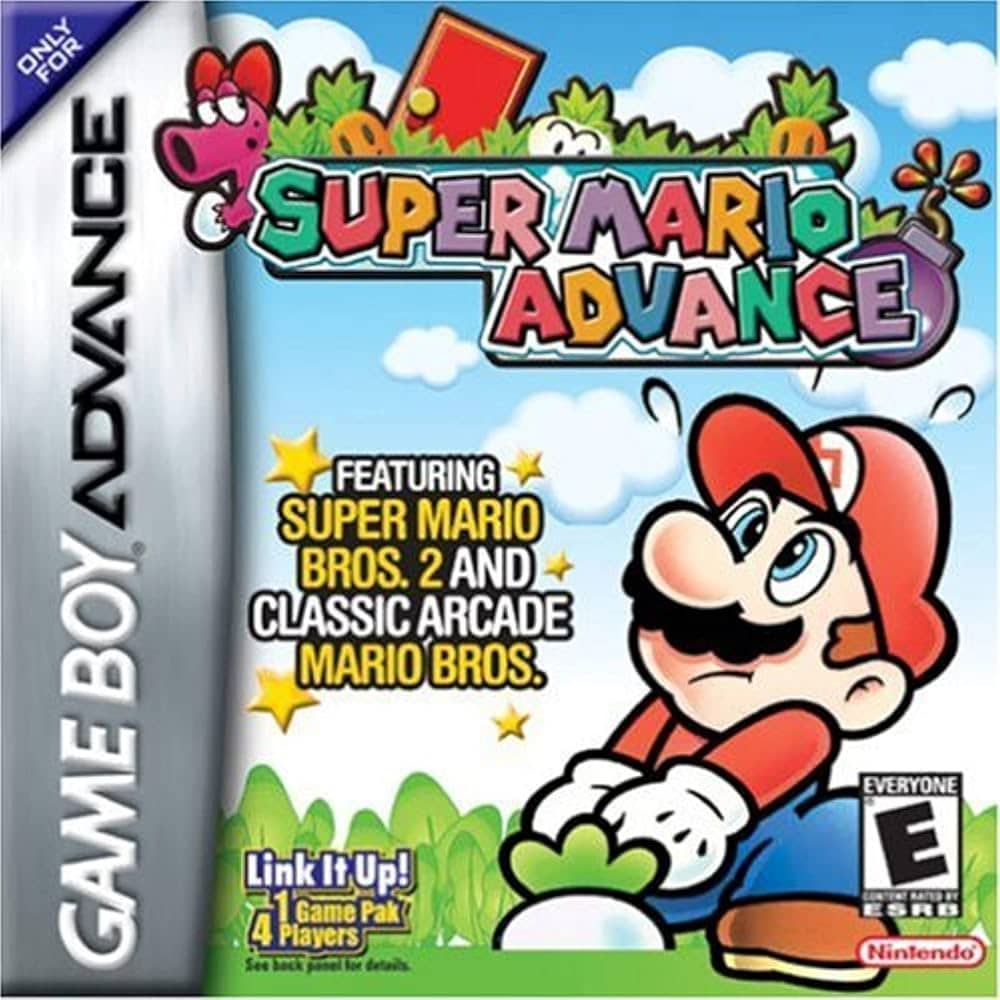
Gameplay and design
The core gameplay of Super Mario Advance continues the distinctive design of the Western version of Super Mario Bros. 2. Unlike the traditional stomping of enemies in the series, players must crouch to grab enemies or objects and then hurl them with force. This mechanic makes both combat and puzzle-solving strategic, as players have to figure out how to use turnips, bombs, or enemies to open paths rather than simply charging ahead.
The game offers four playable characters, each with distinct traits. Mario's stats and jumps are well-balanced, making him ideal for beginners; Luigi jumps higher and farther but has slippery traction; Princess Peach can float briefly, greatly easing platforming sections; and Toad runs fast but has weaker jumps and throws. These differences encourage players to replay with different characters, experiencing entirely different pacing through the levels.
As a remake, this version adds new features while preserving the essence of the original. The most prominent addition is the Ace Coins collectible, with five hidden in each level; collecting them all rewards an extra life, adding another layer of goal to the already exploration-filled stages. Additionally, the game includes voice acting, with Mario and Luigi's "wahoo" and Peach's cries bringing the characters to life.
Visual presentation is another highlight. The game achieves scaling and rotation effects on the GBA, such as smooth zooming when entering pipes or defeating bosses, which was impressive for handheld hardware at the time. Although the GBA screen resolution is lower than the NES, the development team adjusted level layouts and camera angles to ensure players could see the full picture on the handheld without feeling disoriented.
Beyond the main levels, the game includes a remake of the arcade version of Mario Bros. This mode supports up to four players simultaneously, where players cooperate or compete on familiar pipe platforms to clear waves of enemies. This mode enriches the game's content and provides fun for social gatherings, becoming a major selling point that distinguishes this version from other ports.
Background and release
Super Mario Advance was first released in Japan on March 21, 2001, as one of the Game Boy Advance's launch titles. At the time, the GBA was just debuting, and Nintendo needed a title that could showcase the new hardware's capabilities, with the Mario series being an obvious choice. The game's release not only gave the GBA a strong start but also allowed veteran players to revisit a classic on the go, while new players experienced this unique Mario version for the first time.
Players in North America and Europe did not have to wait long. The game launched in North America on June 11, 2001, and in Europe on June 22, nearly coinciding with the GBA's release in those regions. This global simultaneous release strategy quickly made Super Mario Advance a hallmark title of the GBA's early days, with many players picking up the cartridge as their first purchase with the console.
In China, the game was officially released under the iQue brand in 2004, becoming one of the few Mario games to receive an official Simplified Chinese localization. Although many domestic players at the time relied on grey-market imports and flash carts, the iQue release gave legitimate players a chance to own a copy. In 2006, the game was re-released in the United States under the Player's Choice label, a designation typically reserved for high-selling titles, reflecting its market performance.
With the advent of digital distribution, the game has been re-released multiple times. In 2014, it appeared on the Wii U's Virtual Console service, allowing players to enjoy it on TV; on May 26, 2023, it joined two other Advance series titles on the Switch's Nintendo Classics service. Each re-release has given new generations of players the opportunity to experience this classic, proving its enduring appeal.
From its initial launch to re-releases, from handheld to home console, the release history of Super Mario Advance spans over two decades. It is not only an important early GBA title but also a microcosm of Nintendo's strategy for porting classic games. Through continuous re-releases, Nintendo keeps these old games alive, and this title is a successful example of that approach.
Development
Development of this game began following the success of Super Mario Bros. Deluxe. That Game Boy Color port sold 2.8 million units, showing Nintendo the immense potential of classic remakes. Consequently, the team decided to remake Super Mario Bros. 2 again for the GBA, positioning it as a launch title for the new console. This decision was both safe and bold, as the original already had a large fan base.
Although this is a remake, the development team did not simply copy the original. They programmed from scratch, and while the visuals were based on the Super Nintendo version from Super Mario All-Stars, all graphics were redrawn to suit the GBA's hardware. Since the GBA lacked a backlight, making the screen hard to see in low light, the team specifically brightened all graphics to ensure comfortable play outdoors.
The change in screen size also posed challenges for level design. The GBA's resolution was lower than the NES, so a direct port might have prevented players from seeing distant enemies or platforms. To address this, the team adjusted level layouts to bring key elements closer together and used scaling effects to compensate for the reduced field of view. These adjustments were not mere cropping but were made to keep the game smooth and fun on the handheld.
The inclusion of the Mario Bros. mode was actually an accident. This remake was originally a separate project that was later merged with the main game. Designer Takashi Tezuka considered adding more complex new elements but worried that four-player chaos would get out of hand, so he opted for a simpler design. This decision preserved the arcade mode's fast-paced fun and avoided the confusion of overcomplication.
During development, the team also paid special attention to audio. They brought in Charles Martinet to voice Mario and Luigi, and Jen Taylor to voice Princess Peach and Toad. These voice clips made the characters more lively and became a hallmark of the series. Although some players had mixed reactions to the voice editing, there is no denying that this was a breakthrough in audio for GBA games.
Reception and legacy
Super Mario Advance received generally positive reviews upon release. On Metacritic, it holds a score of 84 based on 19 reviews, indicating "generally favorable" reception. IGN's Marc Nix praised the scaling and rotation effects and audio quality but wished for more music; GameSpot and Nintendo Life appreciated the improved graphics and music, though they had mixed feelings about the voice clips.
Commercially, the game was a huge success. In Japan, it sold approximately 159,000 units in its first week, and by July 2001, Famitsu reported Japanese sales of 592,897 units. In 2008, the game received ELSPA's "Gold" sales award, indicating at least 200,000 units sold in the UK. As of 2021, global sales are estimated at 5.57 million units, making it the sixth best-selling game on the GBA, an impressive feat for a remake.
However, the game was not without criticism. Some players and media noted that, compared to Super Mario Bros. Deluxe, this version lacked additional hidden content, with little surprise beyond Ace Coins and Yoshi challenges. This comparison reflected player expectations for remakes—they hoped for not just graphical upgrades but also new gameplay elements. Nevertheless, these criticisms did not tarnish the game's overall reputation.
The success of this game directly spawned the subsequent Advance series. Nintendo released Super Mario Advance 2: Super Mario World, Super Mario Advance 3: Yoshi's Island, and Super Mario Advance 4: Super Mario Bros. 3, all ports of classic Mario games that followed the same model. This series allowed GBA players to experience multiple classic titles on the go.
More importantly, the success of this game prompted Nintendo to develop new titles for the Nintendo DS. The market performance of these ports made Nintendo realize that there was still strong demand for 2D Mario, ultimately leading to the creation of New Super Mario Bros. (2006). That new game blended classic gameplay with modern design and became a bestseller on the DS. In many ways, Super Mario Advance was not just a successful remake but also the starting point for the revival of 2D Mario.





