
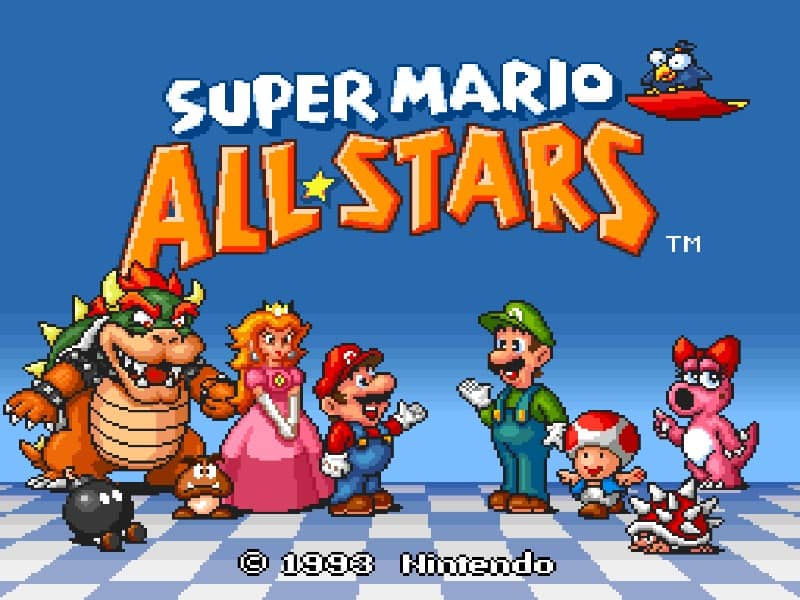
Gameplay and design
At its core, Super Mario All-Stars takes four distinct Mario games from the Famicom and reimagines them with the power of the 16-bit console. The collection includes Super Mario Bros., the series' foundation, which established the basic run, jump, and stomp gameplay; Super Mario Bros.: The Lost Levels, the Japanese sequel known for its brutal difficulty and new enemies like Poison Mushrooms; Super Mario Bros. 2, which takes a completely different approach with its pick-up-and-throw mechanics and puzzle-like levels; and Super Mario Bros. 3, which builds on everything with a world map, power-ups, and flight. These four games are so different in style that playing them back-to-back lets you experience the evolution of the Mario series in one sitting.
Since this is a 16-bit remake, the visuals and audio are a major focus. The development team used Super Mario World's visual style as a baseline, redrawing all characters and environments with brighter colors and more detail, and adding parallax scrolling effects that weren't in the Famicom originals, giving the backgrounds a greater sense of depth. The music was also rearranged, using the SNES's sound chip to produce richer melodies. But this isn't just a simple reskin; the team preserved the original feel while tweaking some physics and fixing glitches to make the controls smoother. For veteran players, this blend of familiar and fresh is exactly what makes the collection so appealing.
The save feature is one of the most thoughtful additions. In the Famicom era, turning off the console meant starting from scratch, but All-Stars gives each game four save slots, letting you save anytime and resume from an unlocked world or level. This greatly lowers the barrier to finishing the games, especially for a tough title like The Lost Levels, where you can now retry without having to start over every time. For players who couldn't spend hours in front of the TV back then, saving made completing these games a real possibility.
The difficulty adjustments also show the developers' care. The Lost Levels was notoriously hard on the Famicom, with Poison Mushrooms and traps that caught you off guard. In the collection, the team slightly eased the difficulty: Poison Mushrooms got a more distinct color scheme so they're easier to spot, and they added more 1-Up Mushrooms and checkpoints. These changes don't ruin the original challenge; they just make it more accessible to a wider audience. For those seeking the ultimate test, the core of the original is still there, just with a friendlier entry point.
Beyond the four main games, the collection hides a few little extras. For example, in Super Mario Bros. 3, you can enter a two-player bonus game based on the original Mario Bros., a nice surprise for longtime fans. Overall, the gameplay content is solid, offering both nostalgic revisits and new touches, so whether you're a newcomer or a veteran, there's something to enjoy. It doesn't just port the old games to the SNES; it reexamines these classics through a 16-bit lens, giving them new life.
Background and release
Super Mario All-Stars came out at a time when the Super Nintendo was establishing itself in the market. By 1993, the SNES already had a killer app in Super Mario World, but Nintendo wasn't resting on its laurels. They realized that many players might have missed the Famicom era or wanted to revisit those classics, so they decided to bundle and remake four Famicom Mario games. This idea was unusual for the time, as compilations were usually simple ports, but Nintendo put significant effort into a full remake, showing how much they cared about the project.
The game launched first in Japan on July 14, 1993, under the title Super Mario Collection. The North American version followed on August 11, and the European version on December 16. The content was essentially the same across regions, but the covers and titles differed slightly. North America got the name Super Mario All-Stars, while Europe kept the Japanese title. Such regional differences were common back then, but the quality was consistent, and the collection quickly won over players worldwide.
In December 1994, Nintendo released a reissue called Super Mario All-Stars + Super Mario World, which added the SNES's Super Mario World to the original four games. This version let players enjoy five Mario games on one cartridge and also updated Luigi's sprite in Super Mario World so he wasn't just a palette swap of Mario. This reissue further boosted the collection's value and gave more players a chance to experience these classics.
Fast forward to 2010, to mark the 25th anniversary of Super Mario Bros., Nintendo released a 25th Anniversary Edition of Super Mario All-Stars on the Wii. This wasn't a remake; it simply included the original SNES ROM, along with a history booklet and a soundtrack CD. While there was nothing new in terms of content, it was full of nostalgia and still sold 2.24 million copies. Critics had mixed feelings, with some calling it a lazy port, but for collectors, it was a treasured keepsake.
In 2020, as part of the Mario 35th anniversary celebrations, Nintendo brought Super Mario All-Stars to the Switch as part of the Nintendo Classics service. This release also used the original ROM, but it allowed a new generation to experience the classic collection on the latest platform. From 1993 to 2020, the game has seen multiple reissues, each carrying the memories of Mario for players of different eras. It's more than just a game; it's a piece of Nintendo's history.
Development
Development of Super Mario All-Stars began after Super Mario Kart was finished. At that time, Nintendo's Entertainment Analysis and Development division had a gap in its schedule, and Shigeru Miyamoto proposed creating a 'value pack' that included all the Super Mario games. His idea was simple: let players enjoy all the classic Mario titles on one cartridge, especially those that hadn't been released overseas. The team responded enthusiastically, and the project got underway. For the developers, it was both a chance to look back at the series' history and a technical challenge.
Miyamoto was particularly keen on letting overseas players experience The Lost Levels, which had never been released in the West due to its high difficulty. In the collection, the team adjusted the difficulty to make it more approachable while preserving the original's challenge. Miyamoto believed this game was an important part of the Mario series and shouldn't be forgotten. His insistence brought The Lost Levels out of Japan for the first time, allowing players worldwide to enjoy this legendary title.
The team put a lot of effort into the graphical updates. Using Super Mario World's design as a base, they redrew all characters and environments, and added a black outline to Mario to make him stand out against the colorful backgrounds. Designer Naoki Mori felt a bit intimidated when he took on the task, as he had only been with Nintendo for three years and was now responsible for updating the company's flagship series. He worried he might not meet expectations, but in the end, he and the rest of the team succeeded in refreshing the visuals while keeping the original feel.
During the remake, a key issue was how to improve the technology without breaking the original gameplay. They decided to keep some useful glitches, like the infinite lives trick, but limited the number of extra lives you could gain to maintain balance. This attention to detail shows the team's respect for the player experience. They weren't just copying the originals; they took the time to understand each game's design philosophy and then presented it with 16-bit technology.
The team also paid special attention to the music and sound effects. They rearranged all the tracks, using the SNES's sound chip to produce richer melodies while preserving the essence of the original tunes. These pieces later became classics in their own right, remembered by countless players. The development process was challenging, but the team's passion and focus ultimately produced a work that would be hailed as a model for remakes.
Reception and legacy
Super Mario All-Stars received widespread critical acclaim upon release. Reviewers praised its beautiful 16-bit graphics and music, saying it perfectly recreated the classics, and they also appreciated improvements like the save feature. However, some criticized it for lacking innovation, seeing it as just a simple upgrade of old games. Regardless, the collection was a commercial success, selling over 10.55 million copies by 2015, with 2.12 million in Japan alone, making it one of the best-selling Super Mario games.
In a 2005 retrospective, Famitsu called Super Mario All-Stars a model for video game remakes. This praise wasn't exaggerated, as it set a standard at the time: a remake isn't just about better graphics and sound, but about fully optimizing the gameplay experience. It proved that classic games could be revitalized with modern technology, not just as nostalgia trips. This philosophy influenced many later remakes, including the Super Mario Advance series.
When the Super Mario Advance series launched on the Game Boy Advance, it used the graphics and audio elements from the All-Stars versions. This shows just how high the quality of All-Stars' remakes was, so much so that later titles used it as a reference. It's not only a favorite among players but also a template for developers. Without All-Stars' success, later Mario remakes might not have been as well received.
The 25th Anniversary Edition in 2010, despite mixed reviews, still sold well, proving the game's enduring popularity. Even a simple ROM port was enough to get players to open their wallets. And the 2020 re-release on Switch gave a new generation the chance to experience this classic. It has spanned multiple generations and remained relevant, which is a success in itself.
Super Mario All-Stars' impact goes beyond the game itself; it changed how people viewed game compilations. Before it, compilations were often seen as cheap products, but it showed they could be made with care. It made players realize that classic games deserve to be taken seriously and savored. For Nintendo, this collection was not just a commercial win but a tribute to its own history. It reminds us that the Mario series is great because of its deep roots and constant innovation.





