
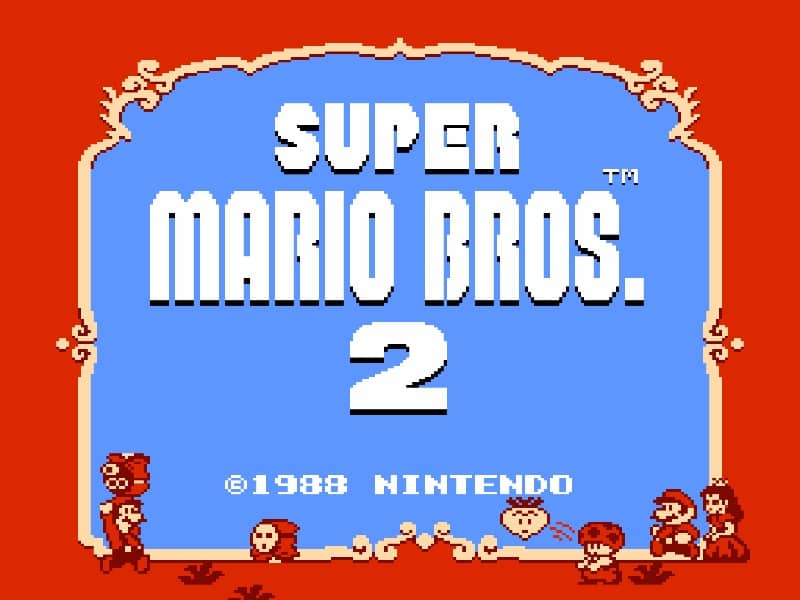
Gameplay and design
The core gameplay of Super Mario Bros. 2 is 2D side-scrolling platforming, but it makes bold changes compared to the original. The most obvious is that before starting a level, players can choose from Mario, Luigi, Toad, or Princess Peach, each with distinct abilities. Mario is well-rounded and ideal for beginners; Luigi jumps highest but is slower; Toad runs fastest but has the lowest jump; Peach can float briefly but is weaker in speed and strength. This design lets players pick a character based on level demands and personal preference, encouraging replayability.
The game's signature mechanic is throwing. Instead of stomping enemies like in the original, players must crouch to pick up enemies or items like vegetables and rocks, then hurl them at targets. This shift changes combat from simple jumping to a strategic offense-defense dynamic. Enemy types were adjusted accordingly: for example, Shy Guys turn to avoid being picked up, while Bob-ombs explode, so players must think carefully about how to grab and throw. This mechanic later became a series staple, appearing in games like Super Mario 3D World.
Another notable feature is the absence of a time limit. The original had countdown timers that pressured players to hurry, but this game removes that stress, allowing leisurely exploration. Level design supports this with both horizontal and vertical scrolling, making environments more layered. This encourages players to search for hidden passages and items, and the pacing is more relaxed, appealing to a wide range of skill levels.
Magic potions are key items in levels. Using one creates a door that leads to a sub-space—a hidden area with inverted colors. Here, players can collect coins and mushrooms that increase their health bar, which is crucial for progression. Sub-spaces often contain shortcuts or bonus rewards, but potions are limited, so deciding when to use them becomes an interesting strategic choice. Additionally, special items like cherries and pumpkins trigger unexpected effects, such as making enemies disappear or revealing hidden blocks, adding to the fun of exploration.
The game features 7 worlds and 20 levels, each with distinct themes like desert, snow, and forest. Levels are filled with puzzles and contraptions, such as pushing blocks or using lifts. Boss battles are also distinctive, with different enemies at the end of each world, culminating in the frog tyrant Wart. Overall, the gameplay emphasizes exploration and puzzle-solving over pure action, which was uncommon for platformers at the time and paved the way for the series' future evolution.
Background and release
To understand the origins of Super Mario Bros. 2 (US), we must go back to 1986, when Nintendo released the Japanese Super Mario Bros. 2, later known as The Lost Levels. That game was notoriously difficult, with trap-filled levels that frustrated even hardcore players. When Nintendo of America received it, they feared North American players would give up in frustration, so they decided not to localize it directly. Instead, they requested a friendlier sequel better suited to the North American market. This decision indirectly led to the creation of this game.
Meanwhile, in 1987, Nintendo released a Famicom Disk System game in Japan called Yume Kōjō: Doki Doki Panic. This was an advertising game for Fuji Television's '87 Dream Factory event, featuring an original protagonist rather than Mario. The game was prototyped by Kensuke Tanabe, with design input from Shigeru Miyamoto, and programming by SRD. It used vertical scrolling and two-player cooperative gameplay, but its style was completely different from the Mario series. Nintendo of America saw potential in this game and decided to adapt it into a Mario title.
The adaptation was thorough. The development team replaced all characters and themes from Doki Doki Panic with Mario series characters and elements, such as making Mario, Luigi, Toad, and Peach the protagonists and redesigning enemies. The difficulty was significantly adjusted, and level layouts and item systems were optimized to fit the Mario style. The game was eventually released as Super Mario Bros. 2 in North America on October 9, 1988, and in Europe and Australia on April 28, 1989.
Interestingly, Japanese players didn't get this game until September 14, 1992, when it was released as Super Mario USA. This was because the Japanese Super Mario Bros. 2 already existed, so Nintendo used a different title to avoid confusion. Since then, the game has been re-released multiple times, including the 1993 remake in Super Mario All-Stars, the 2001 GBA version Super Mario Advance, and later Virtual Console and Nintendo Switch Online versions.
The release timeline also reflects Nintendo's strategies in different markets. In North America, it was positioned as a true sequel, while in Japan it was treated as a spin-off. This difference influenced how players perceived the game. Today, players often refer to it as 'US Mario 2' or 'Super Mario USA' to distinguish it from the Japanese version. This naming confusion highlights the game's unique place in the series.
Development
The development of Super Mario Bros. 2 (US) began with a seemingly accidental opportunity. After Nintendo of America rejected the Japanese Super Mario Bros. 2, they urgently needed a replacement. At the time, Doki Doki Panic was already complete, with a prototype by Kensuke Tanabe and design by Shigeru Miyamoto. The game originally emphasized vertical scrolling and two-player cooperation, but Nintendo of America believed it was better suited for the North American market, so they decided to adapt it into a Mario game. This decision was approved by Miyamoto, who personally participated in character replacement and level adjustments.
During the adaptation, the biggest challenge was blending Doki Doki Panic's gameplay with the Mario series' traditions. The throwing mechanic was retained, but enemies and items were redesigned to fit Mario's world. For example, original enemies were replaced with Shy Guys, Bob-ombs, and other characters that later became series regulars. The difficulty was also greatly reduced, the time limit was removed, and new elements like sub-spaces were added to make it more accessible. These changes were not just a simple reskin but a rethinking of the core mechanics.
One interesting detail is that this game first gave Mario and Luigi noticeably different heights, with Luigi being taller and thinner and having a unique jump animation. This design later became a series standard, influencing all subsequent games. Additionally, the music was composed by Koji Kondo, who retained some sound effects and musical elements from Doki Doki Panic but rearranged them to fit Mario's style. These details show the team's care during the adaptation.
Nintendo of America had considerable autonomy in the development of this game. They not only decided the direction but also participated in specific level design. This localization strategy was uncommon at the time, but it proved highly successful. The game was a huge hit in North America, remaining the best-selling game for 14 consecutive months, selling 3.5 million copies in the US by early 1990, and 7.46 million copies worldwide, making it the fourth best-selling NES game. This success influenced Nintendo's subsequent localization strategies.
It's worth noting that the character selection mechanic also originated from Doki Doki Panic's two-player design. The original allowed two players to play simultaneously, but the adaptation made it a single-player game, though it retained the character selection feature. The ability differences among the four characters were not arbitrary but carefully balanced to ensure each offered a unique play experience. This design was later inherited by games like Super Mario 3D World, becoming a hallmark of the series.
Reception and legacy
Super Mario Bros. 2 (US) was a commercial success, becoming one of the best-selling non-bundled NES games. By early 1990, it had sold 7.46 million copies worldwide, a remarkable figure for a platformer at the time. Critical reception was also positive: Nintendo Power ranked it eighth on their list of best NES games, and GamesRadar placed it sixth. These accolades not only affirmed the game's quality but also recognized its unique place in the series.
The game's influence on the series is profound. It was the first to make Princess Peach and Toad playable, breaking the tradition of male-only protagonists in Mario games. The throwing mechanic also became a series staple, continuing in games like Super Mario 3D World. Additionally, many characters introduced here, such as Birdo, Pokey, Bob-omb, and Shy Guy, later became recurring figures in the Mario franchise, enriching its cast.
The game's music and setting also left a mark. The 1989 animated series The Super Mario Bros. Super Show! was based on this game's characters, setting, and music, further expanding its reach. Elements like the dream world Subcon and the frog tyrant Wart, though rarely appearing in later games, added a unique fantasy flavor to the series. This stylistic difference made the game stand out within the franchise.
The game's re-release history also demonstrates its enduring appeal. In 1993, it was included in the Super Mario All-Stars remake for the SNES; in 2001, it was remade as Super Mario Advance for the GBA, a launch title. Additionally, it was released in chapters as BS Super Mario USA Power Challenge on the Satellaview. These re-releases allowed new generations of players to experience this classic.
Among players, the game's status is somewhat nuanced. On one hand, it is beloved for its unique gameplay and character selection; on the other, it sparks discussion due to its differences from the Japanese Super Mario Bros. 2. Regardless, it is an indispensable part of the Mario series, and its innovative design injected new vitality into the franchise. As many critics have noted, the game's success proved Nintendo's boldness in game design and set an example for future platformers.





