Gameplay and design
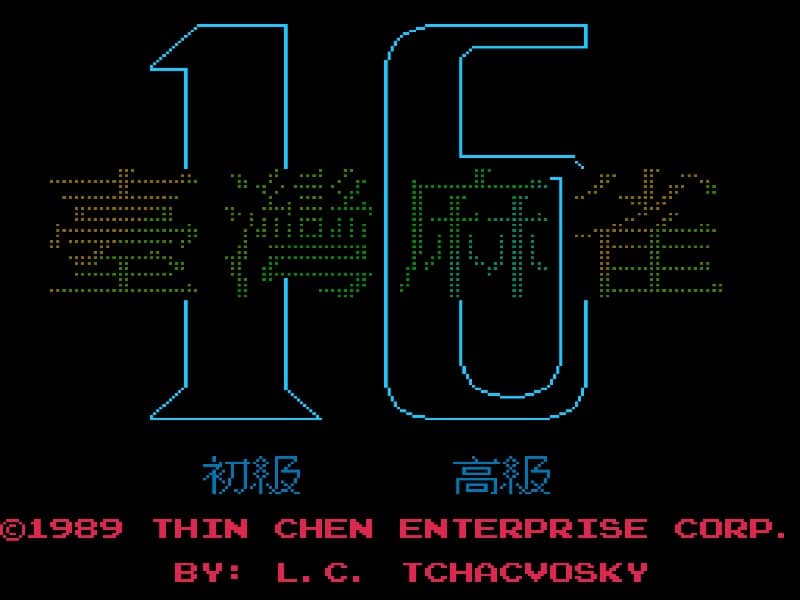
Taiwan 16 Tile Mahjong is a mahjong game built around drawing and discarding tiles, with its core rules taken from Taiwanese 16-tile mahjong. Unlike Japanese and Hong Kong mahjong, which usually use a 13-tile hand, Taiwanese mahjong gives each player more concealed tiles, so the hand a player has to manage is larger. That rules difference directly shapes the pace and strategy of play, and it is the fundamental way this version stands apart from mahjong styles from other regions.
It is worth stressing that this is not a mahjong tile-matching game. Some puzzle games on the market use mahjong tile designs, with play based on flipping tiles to find pairs or clearing matching faces, which is nothing like the draw, discard, meld and win logic of four-player mahjong. Taiwan 16 Tile Mahjong belongs to the latter category: players face a full mahjong match, not a tile-matching challenge.
The game runs on Famicom-compatible hardware, with controls built around the controller. Because source material is limited, details such as the exact button layout, the strength of the opponent AI, whether scoring hands are calculated, and whether there are special modes have not been confirmed. What is certain is that it brought the framework of Taiwanese 16-tile mahjong to a home console, letting players play mahjong matches in front of a television—a regionally distinctive choice in the unlicensed game market of the time.
Background and release
Taiwan 16 Tile Mahjong is an unlicensed Famicom game from Taiwan. Unlicensed here means it was not released through Nintendo's official Famicom licensing program, making it one of the unlicensed cartridge products common in the market at the time. Such products circulated in Taiwan and elsewhere, usually made and brought to market by local developers, and they differed from officially licensed Nintendo games in distribution channels and legal status.
According to records of unlicensed Famicom cartridges, this title is associated with the number SA-001. Its developer and publisher are listed as Thin Chen Enterprise, a company also known by the name Sachen. Sachen was one of the more representative firms in Taiwan's early game industry, and the SA-001 number helps confirm this game's identity among the many unlicensed products.
As for the release year, a date of 1990 was once suggested, but that date has not been consistently supported and has since been removed from public metadata. The exact release year therefore remains unknown. Likewise, no reliable sales figures, media review scores or specific release date have been found. Without solid evidence, these details have to be left blank rather than filled in with speculation.
It is also important to distinguish a game with a similar name. There is another Mega Drive game also called Taiwan Mahjong, and it is not the same product as the unlicensed Famicom game described here. When consulting sources, the two games' companies, gameplay and release information should not be conflated. The surviving catalog evidence is fairly strong for confirming the manufacturer and product identity, but it offers little help on the precise release year.
Development
Based on verifiable material, the game was made by Thin Chen Enterprise, or Sachen. The company's identity is clearly recorded in unlicensed Famicom cartridge catalogs, with the product number SA-001. That number is an important clue for confirming the product's identity, tying the game to a specific manufacturer and product entry rather than leaving its attribution to be inferred from the title alone. As for the specific members of the development team, the production period, the budget and the decisions made during development, no public material is available to verify them, so they cannot be described here. The release year is likewise not consistently supported; the 1990 date that once appeared has been removed from public metadata, so it can only remain unknown.
On the rules side, the game had to adapt Taiwanese 16-tile mahjong to Famicom-compatible hardware. Taiwanese mahjong uses a larger concealed hand than 13-tile mahjong, which means the game has to handle more tile information in both display and controls. That rules-level port was the core production challenge, but the sources do not provide the specific implementation, code structure or technical limitations, so none of that can be invented. What is confirmed is that it is a draw-and-discard mahjong game, not a matching game played with mahjong tile designs; that distinction bears on the direction of the rules adaptation and shows that the makers had to deal with the flow of a full match rather than simple tile matching.
As for release, it is known to be an unlicensed product that did not go through Nintendo's official licensing program. But the reasons for going unlicensed, how the cartridges were produced and the distribution channels are likewise not explained in the sources. It should be stressed that the game was originally released as a Famicom-compatible cartridge, not as an HTML5 or browser game. If it can be played in a browser today, that comes from later emulation or porting and is a separate matter from the original platform, and the two should not be conflated. In addition, there is another Mega Drive game also called Taiwan Mahjong, which is not the same product as this one; the two should not be mixed together when discussing release and production information.
Reception and legacy
Because reliable sales data, media review scores and player reception records are lacking, it is impossible to make a quantitative judgment about Taiwan 16 Tile Mahjong's market performance or reputation. No awards, chart rankings or specific review quotations have been found. Under these circumstances, any assessment can only stay at the level of the game's identity and its representativeness of a rules set, and must not invent commercial results or industry influence.
In terms of preservation value, the game is a concrete sample from the period of unlicensed console production in Taiwan. It was made by a local company like Sachen, took as its subject the 16-tile mahjong popular in Taiwan, and left a numbered record in unlicensed Famicom catalogs. These facts make it a verifiable case for studying Taiwan's game industry and regional rules adaptations at the time, though its actual historical standing still needs more material to assess.
In terms of rules, it clearly adopts the draw-and-discard play of Taiwanese 16-tile mahjong rather than mahjong tile matching. That helps distinguish it from other puzzle games that use mahjong tiles as elements. As for whether it influenced later Taiwanese mahjong games, the sources contain no record of this, so no causal conclusion can be drawn. Its significance lies more in documenting an early attempt to bring a regional rules set to a home console.