Gameplay and design
The core gameplay of Tetris is simple yet deep: seven different block shapes fall from the top of the screen, and players must rotate and move them to fit neatly at the bottom, clearing lines when they fill up. The game offers two main modes: A-Type mode, where the goal is to score as many points as possible, and B-Type mode, which requires clearing 25 lines against a preset wall of obstacles. These modes cater to different play styles, with the former appealing to those seeking a high-score challenge and the latter emphasizing strategic planning.
The speed mechanic is one of the game's most captivating features. In A-Type mode, every 10 lines cleared raises the level, and the blocks fall faster. At level 29, the speed maxes out at one cell per frame, nearly too fast to react. This speed limit is known as the 'kill screen' because the developers never expected anyone to pass it, but modern players have proven it can be overcome with special techniques.
The scoring system is also intricate. Clearing one line earns 100 points, two lines 300, three lines 500, and a four-line clear (a 'Tetris') nets 800 points, all multiplied by the current level. As a result, skilled players aim for Tetrises rather than clearing one or two lines at a time, adding a layer of strategic thinking to the frantic action.
When the game ends, an animation plays showing a rocket launch, with the rocket flying farther based on the player's score, eventually revealing St. Basil's Cathedral ascending into the sky. This design both rewards player achievement and adds a touch of humor. Notably, the game has no true 'ending'; what players call 'beating' the game is actually a community term for triggering a crash, a story with its own interesting backstory.
The game also contains hidden details, such as an unfinished two-player versus mode in the code, possibly intended to promote the Game Link Cable, but it was never completed. Additionally, the random number generator uses a 16-bit linear feedback shift register, causing the seven block types to appear slightly unevenly. While a technical flaw, it adds an element of unpredictability to the game.
Background and release
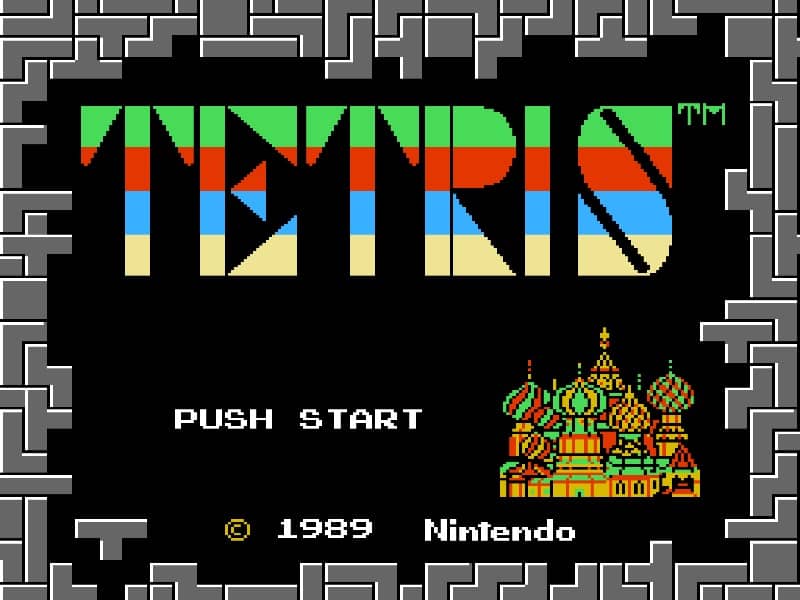
Tetris traces its origins to 1984, when Soviet programmer Alexey Pajitnov designed this simple puzzle game during his spare time at the Moscow Academy of Sciences. In 1985, he completed the first playable version, which quickly spread across the Soviet Union. However, this original differs from the NES version released by Nintendo in 1989, which was redeveloped under license, optimized for home consoles, and featured new modes and music.
The Nintendo version's creation was marked by a fierce legal battle. Atari Games also saw Tetris's potential and sought the home console rights. However, Nintendo negotiated with Soviet authorities to secure exclusive home console rights, leading to Atari's version being recalled shortly after release due to licensing issues. This dispute not only determined the fate of both versions but also profoundly influenced copyright awareness in the gaming industry.
During the 1989 Christmas season, Nintendo launched a massive marketing campaign with the slogan 'You've been Tetris-ized!', which quickly became a catchphrase. The game's cover tagline, 'From Russia with fun!', cleverly referenced Ian Fleming's novel 'From Russia with Love', highlighting the game's origins while adding a cultural touch. This marketing strategy generated high anticipation before the game's release.
The game's sales were impressive. In the first six months, it sold 1.5 million copies, generating $52 million in revenue. By 2004, cumulative sales exceeded 8 million copies, making it one of the best-selling games on the NES. In 1991, it was also bundled with some European NES consoles, further expanding its reach.
Despite its commercial success, not all players considered the Nintendo version the best. IGN noted that 'almost everyone' thought the Nintendo version was inferior to Atari's, which boasted better graphics and gameplay but was unfortunately recalled due to legal problems. Computer Entertainer magazine also suggested that only those who hadn't played the Atari version should try the Nintendo one. Such reviews reflected the differing opinions players held about the two versions.
Development
During the development of the Nintendo version, Pajitnov himself was not directly involved, but he received credit for the concept design. This reflected Nintendo's respect for the original creator, even though the actual development was carried out by Nintendo's team. The development team preserved the core gameplay of the original while optimizing it for the NES hardware and adding new elements to make it more suitable for home console players.
The game's color palette was chosen by Howard Phillips, an employee at Nintendo of America who later worked on localizing other games. His color choices made the game's visuals more vibrant and improved block distinction, helping players make quick decisions during fast falls. Though seemingly minor, this detail significantly impacted the gaming experience.
The game used a 16-bit linear feedback shift register to generate pseudo-random numbers, a simple and efficient algorithm, but it caused a slight bias in the distribution of the seven block types. For instance, some blocks appeared slightly more frequently. While hard to notice in normal play, this became a topic of study for hardcore players, who even used the bias to optimize their strategies.
The code also contains an unfinished two-player versus mode, possibly designed to promote the Game Link Cable, but it was cut due to time constraints or other reasons. This incomplete feature left traces in the game files, later discovered by players through data mining, sparking speculation about the development process.
The game's music features arrangements of Russian classical pieces, including Tchaikovsky's 'Nutcracker' and Bizet's 'Carmen'. These tunes not only fit the game's Russian theme but also added a touch of elegance to the intense gameplay. The music choice was widely praised by players and became a hallmark of the game.
Reception and legacy
Tetris's revival in the esports arena is one of its most remarkable legacies. Since 2010, the NES version has been a featured game at the annual Classic Tetris World Championship (CTWC), attracting top players from around the world. The tournament not only lets veterans relive the classic but also introduces new generations to the game's depth and competitiveness.
In 2018, Joseph Saelee won the world championship using a technique called 'hypertapping', which involves rapidly vibrating fingers to achieve extremely high button-press rates, thereby breaking the speed barrier. His victory popularized the technique and inspired more players to explore new methods. In 2020, Chris Martinez developed the 'rolling' technique, which allowed players to pass level 29 and set new records, further proving the game's potential.
On December 21, 2023, 13-year-old Willis Gibson became the first player to trigger the game's crash, considered 'beating' the game. This event caused a stir in the player community, as level 29 was widely believed to be an insurmountable barrier. Gibson's achievement not only showcased the limits of human reaction and skill but also redefined the meaning of 'completing' a game that has no designed ending.
The game's influence on subsequent titles is profound. For example, modern works like 'Tetris Effect: Connected' build on the core gameplay while adding immersive visual and auditory experiences, but their roots lie in the 1989 NES version. Additionally, the game has appeared in numerous documentaries and films, such as the 'Tetris' documentary, further cementing its place in popular culture.
The game also holds a place in academic research. A 2018 study showed that when the preview window was turned off, experts' average scores plummeted from 465,371 to 6,457, highlighting the importance of the preview feature to player performance. A 2023 study found that novices blink less while playing Tetris, while experienced players blink at near-normal rates, reflecting the game's impact on cognitive load. These studies not only reveal the game's psychological effects but also demonstrate its unique value as a research tool.