Gameplay and design
The core gameplay of Age of Empires 2: The Age of Kings builds on the framework of its predecessor: players gather four resources—food, wood, gold, and stone—to construct towns, train armies, and advance through the ages. The game divides history into four ages—Dark, Feudal, Castle, and Imperial—each unlocking new buildings, units, and technologies, allowing players to grow from a humble village into a vast empire. This parallel design of resources and ages tests both economic management and strategic planning of the military tech tree.
The game offers 13 playable civilizations, each with unique units, technologies, and team bonuses, such as the Byzantine Cataphract or the Mongol fast cavalry archers. These differences give each civilization a distinct playstyle, while architecture comes in four styles—Western European, Central European, Middle Eastern, and East Asian—so you can tell at a glance which civilization an opponent belongs to. Units speak in their civilization's native language, a detail that adds immersion.
The campaign mode is a highlight, featuring five campaigns based on real history: William Wallace, Joan of Arc, Saladin, Genghis Khan, and Barbarossa. Each campaign consists of a series of missions with diverse objectives, from escort and defense to large-scale sieges. These missions not only test your skills but also weave in historical context, such as Wallace's rebellion and Joan's relief of Orléans, letting players experience the drama of the Middle Ages.
Multiplayer supports up to eight players over LAN or the internet, making it one of the most popular online modes of its time. The game also introduced two practical new features: the idle villager button and the town bell. The former quickly finds idle villagers to keep resource gathering efficient; the latter lets villagers retreat to the town center and automatically rings the alarm during enemy raids. These simple additions greatly improved convenience and became staples in later RTS games.
Military units are clearly categorized into five types—infantry, archers, cavalry, siege weapons, and ships—each with a rock-paper-scissors relationship. Players must adapt their army composition based on the opponent's units, such as using spearmen to counter cavalry or catapults against dense infantry formations. This balance makes combat strategic rather than a mere numbers game, a key reason the game has retained its appeal.
Background and release
Age of Empires 2: The Age of Kings is set in the Middle Ages, roughly from 500 to 1500 AD, covering vast regions of Europe, Asia, and the Middle East. The game's four-age progression lets players experience everything from barbarian invasions in the Dark Age to the gunpowder revolution in the Imperial Age, a simulation of historical progress that was highly compelling at the time. The wonder buildings players construct correspond to real landmarks, such as cathedrals and pyramids, adding a sense of historical authenticity.
The campaigns are not pure fiction but based on real historical figures and events. For example, the Genghis Khan campaign tells of the rise of the Mongol Empire, while the Saladin campaign revolves around the Muslim leader during the Crusades. Mission designs aim to reflect history, such as Genghis Khan conquering cities in Central Asia or Saladin facing Crusader attacks. This blend of history and gameplay lets players learn something about history while having fun.
After release, the game quickly became a staple of esports, appearing as a competition title at the World Cyber Games (WCG) for three consecutive years. In the early 2000s, RTS games dominated esports, and Age of Empires 2 attracted many professional players and spectators thanks to its balance and spectator appeal. Its multiplayer mode demanded not only quick reflexes but also strategic depth, which helped it hold its own on the esports stage.
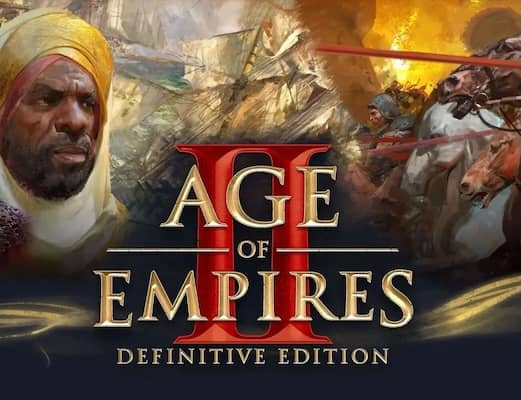
The success of Age of Empires 2 also spurred the development of later RTS games. Many subsequent titles, such as Empire Earth and Cossacks, borrowed its age progression and resource management mechanics. The game itself continued to evolve through expansions and remasters: the 2000 expansion The Conquerors added new civilizations and technologies, while the 2013 HD Edition and the 2019 Definitive Edition let veteran players revisit the classic on new platforms.
Released during the golden age of RTS, the game helped define the genre's standards alongside titles like StarCraft. Rather than pursuing sci-fi or fantasy, it rooted itself in real history, a unique positioning that made it stand out among RTS games. Even today, players remain active in the community with matches and mods, a testament to its enduring legacy.
Development
The development of Age of Empires 2 was handled by Ensemble Studios, initially planned for one year but ultimately taking two. To fill the gap, the studio released the expansion Rise of Rome for the previous game in 1998 as a transitional title. This delay was not a bad thing; the team used the extra time to polish the game, especially addressing the pathfinding issues and AI flaws that players had criticized in the predecessor.
The development team redesigned the engine's movement system, allowing units to navigate complex terrain more intelligently, reducing instances of getting stuck or taking detours. They also developed a stronger AI system, making computer opponents more reasonable in resource management and tactical use. These improvements made the game smoother and reflected Ensemble Studios' attention to player feedback.
The game introduced a trigger system, a scripting tool used for the campaign editor and single-player campaigns. Through triggers, designers could set events, conditions, and effects to create complex mission logic, such as triggering an ambush when the player reaches a certain location. This system was not entirely new, but the game refined it and integrated it into the editor, allowing players to create their own campaigns, greatly expanding replayability.
The music was directed by Stephen Rippy, who later became the music producer for the Age of Empires series. The soundtrack blends medieval European, Middle Eastern, and East Asian musical elements, varying by civilization and scenario to create a rich historical atmosphere. Development also faced technical issues, such as delayed patches and compatibility problems with the DirectPlay API, but the team overcame these to ensure the game ran stably.
Before the official release, a playable demo was released on October 16, 1999, but prior to that, several incomplete versions had already leaked online. Despite this, the final version's quality was widely recognized. Over two years, the team invested considerable effort, from engine improvements to content creation, ultimately crafting a work that respected history while being entertaining, laying the foundation for its later success.
Reception and legacy
Age of Empires 2: The Age of Kings received widespread acclaim upon release, earning a 92% positive score on Metacritic based on 21 reviews. Critics praised its deep gameplay, rich historical content, and excellent multiplayer. Commercially, it was a huge success, selling 2 million copies within three months and becoming the best-selling game in seven countries, one of the best-selling titles of 1999.
The game won numerous awards, including GameSpot's 1999 Strategy Game of the Year and several honors at the AIAS (Academy of Interactive Arts & Sciences) awards. These accolades not only affirmed the game's quality but also solidified Ensemble Studios' position in the RTS genre. For many players, this game was their introduction to historical-themed gaming.
The game left a lasting impact on subsequent RTS titles; for example, Star Wars: Galactic Battlegrounds used its engine, demonstrating the technology's scalability. Its design principles, such as age progression, resource management, and unit counters, were adopted by many later games. In IGN's 2005 list of the best games of all time, it ranked 53rd, and in 2007 it placed 10th in PC gaming, showing its enduring classic status.
The game's vitality has not waned over time. The 2000 expansion The Conquerors added five new civilizations and unique technologies, further enriching the content. The 2013 HD Edition, developed by Hidden Path Entertainment, supported Steam Workshop, allowing players to share custom mods. The 2019 Definitive Edition, developed by teams including Forgotten Empires, offered 4K graphics and all previous content, attracting a new generation of players.
During the COVID-19 pandemic in 2020, the game's popularity surged again, with many veteran players returning and the community continuously producing new content. The game also became an esports title, boosting RTS esports. Today, Age of Empires 2 is still regarded as a classic of the RTS genre; its success lies not only in its quality at the time but also in its ability to bring joy to players over two decades later.