Gameplay and design
The core gameplay of COMMANDOS: Behind Enemy Lines revolves around stealth and strategic planning rather than frontal gunfights. The six commandos under the player's control are quite fragile in combat, so they must rely on stealthy movement and careful planning to complete missions. The game emphasizes observation, thought, and patience; every action can affect the overall situation, creating a cycle of tension and accomplishment for the player.
Each of the six commandos has distinct abilities, forming the foundation of the game's strategic depth. The Green Beret excels in close combat, silently eliminating enemies; the Sniper has long-range precision shooting; the Marine is skilled in underwater demolition; the Sapper can set and defuse explosives; and the Driver handles vehicles. The Spy is a key character, able to wear enemy uniforms to infiltrate camps, but if discovered, he falls into danger. Players must choose the right mix of commandos based on mission objectives, leveraging their specialties.
The enemy vision system is the game's most central mechanic. Each enemy's field of view is shown as a green cone, divided into near and far zones, which players can monitor in real time. Enemies become alert to suspicious signs like footprints, corpses, or gunfire, and will investigate. Once an alarm is raised, enemies become more active, and barracks may send reinforcements. This dynamic reaction system forces players to carefully plan routes before acting and be ready to adapt to unexpected situations.
The game includes twenty missions with diverse objectives, such as destroying military installations, assassinating enemy officers, and rescuing captured Allied soldiers. The mission maps are intricately designed, with enemy placements and patrol routes carefully arranged, requiring players to try repeatedly to find the best approach. This high difficulty may not be friendly to newcomers, but it is part of the game's charm, making every success deeply satisfying.
The game uses mouse-click controls with a simple, intuitive interface, but it is easy to learn yet hard to master. Players must manage multiple commandos simultaneously, coordinating their actions, which tests multitasking skills. The game also offers save and load functions, encouraging players to adjust strategies after failure; this trial-and-error process is itself part of the fun.
Background and release
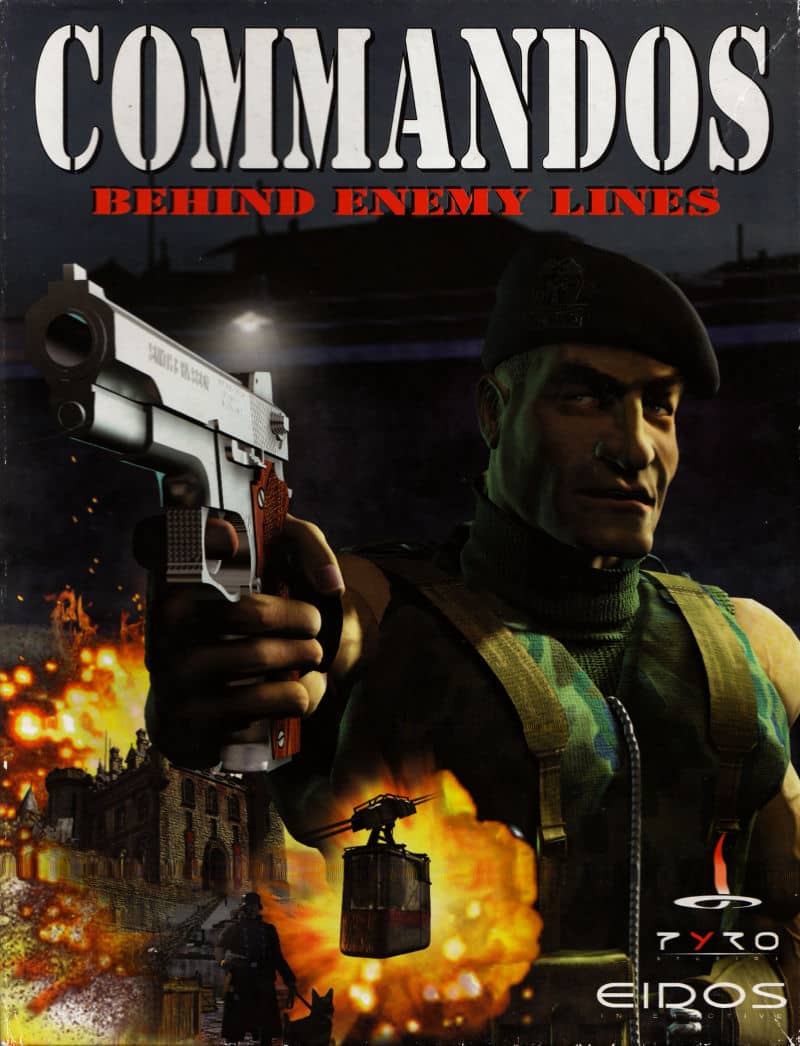
COMMANDOS: Behind Enemy Lines was developed by Pyro Studios in Madrid, Spain, and published by Eidos Interactive, released in 1998. It was the studio's first title and the beginning of the COMMANDOS series. Set during World War II, the game has players command a squad of six Allied commandos on high-risk missions behind enemy lines in North Africa and Europe.
The game's story is not a linear narrative but unfolds through a series of independent missions, each with clear military objectives like destroying bridges, assassinating generals, or rescuing prisoners of war. This mission-based structure allows players to choose the order of operations flexibly and enhances replay value. Although the game lacks a complex plot, it successfully creates the tension of behind-the-lines operations through mission briefings and battlefield atmosphere.
At release, the game was not heavily promoted; Pyro Studios initially targeted sales of only 15,000 units. However, thanks to its unique gameplay and strong word-of-mouth, it quickly spread among players. In Germany, it topped the computer game sales chart for 16 consecutive weeks, and in the UK, it held the number one spot for 15 weeks, becoming a phenomenon.
By November 1998, global sales had reached 600,000 units, and by year's end, they climbed to 706,000. This was remarkable for a small Spanish studio's debut. The game's success brought great prestige to Pyro Studios and proved that European game developers could compete internationally.
The commercial success was also reflected in awards. In 1999, it received a "Gold" award at the Milia festival, recognizing revenues exceeding 16 million euros in the EU. In Germany, it earned a "Gold" award (for at least 100,000 units sold) and later a "Platinum" award (200,000 units). These honors further cemented its status as a classic.
Development
The development of COMMANDOS: Behind Enemy Lines began with an observation by Pyro Studios founder Gonzalo Suarez: at the time, tactical action games were scarce, and he decided to create something different. This idea evolved into a game emphasizing stealth and strategy rather than the fast-paced shooters popular then. The development team was initially small, but they had high standards for quality.
Development took about 18 months, with the final 12 months of full-time work in the Madrid studio, with a team of around 18 people. The project's source code comprised about 250,000 lines, primarily written in C++ and assembly language. For a small team, this was a daunting task, but the members' passion and dedication helped them overcome many challenges.
On the technical side, the game used a custom graphics engine rather than the standard tile-based systems of the time. This choice allowed for more detailed visuals but brought a major challenge: maps could not be created with existing tools and had to be handcrafted. This meant each map required meticulous design and placement by the developers, a huge workload, but it ensured the maps' uniqueness and playability.
The development budget was around one million dollars, a moderate sum for the era. Despite limited funds, the team invested heavily in graphics and sound. The music, composed by David García-Morales, added tension and period flavor, enhancing the WWII atmosphere.
During development, the team carefully tuned the difficulty to balance challenge and playability. They designed a complex enemy AI system, including vision, hearing, and investigation behaviors, making enemies seem realistic and intelligent. This attention to detail led to post-release reviews praising the game's "beautiful graphics, difficult and challenging gameplay," establishing its hardcore stealth-tactics tone.
Reception and legacy
COMMANDOS: Behind Enemy Lines received widespread acclaim upon release, with GameRankings giving it a "positive" review, and Next Generation magazine praising its graphics and challenging gameplay. Players and media generally agreed that the game successfully blended stealth, strategy, and action, creating a new gaming experience.
The game's commercial success exceeded the developers' expectations. Designer Gonzalo Suarez attributed it to word-of-mouth, as there was little promotion and an initial sales target of only 15,000 units. However, its long-term popularity in Germany and the UK, along with growing global sales, proved its strong appeal. By July 1999, combined sales of the game and its expansion pack reached 1.3 million units worldwide, and by May 2000, they exceeded 1.5 million.
In Spain, the game holds special significance. In 2001, GameSpot Spain called it the best-selling game in Spanish history. It showcased the talent of Spanish developers and laid the groundwork for the rise of the Spanish game industry. Many Spanish developers have said this game inspired them to enter the field.
The game's success spawned an entire series. In 1999, the expansion pack COMMANDOS: Beyond the Call of Duty was released, adding eight new missions. Subsequently, the series saw COMMANDOS 2, COMMANDOS 3, and COMMANDOS: Strike Force, with a prequel, COMMANDOS: Origins, set for 2025. These titles continued the core gameplay while introducing new elements, keeping the series alive.
More importantly, the game left a lasting impact on subsequent stealth tactics games. It inspired titles like Desperados and Shadow Tactics, which borrowed its enemy vision, squad coordination, and mission planning mechanics. In essence, COMMANDOS: Behind Enemy Lines is not just a classic game but a foundational work of the stealth tactics genre, and its design principles are still studied and emulated by many developers today.