Gameplay and design
The core of Dr. Mario is color matching. Players control Dr. Mario, who faces a bottle filled with viruses and must toss two-colored capsules to eliminate them. Capsules fall from the top of the bottle, and players can move them left or right and rotate them to align with same-colored viruses in a horizontal or vertical line of four, which then disappears. The goal is to clear all viruses, but if capsules pile up to the top, the game ends. This gameplay shares similarities with Tetris but emphasizes color pairing and strategic planning.
The game offers a wealth of customization options. Before starting, players can choose the starting level (0-20), the falling speed, and the music. Higher levels mean more viruses and faster capsule descent, increasing the challenge. Scoring is based on the number and speed of virus eliminations, with bonus points for consecutive clears or chain reactions. These features allow players to adjust the difficulty to their skill level, making it accessible for beginners while still offering a challenge for experts.
A standout feature is the two-player versus mode. Each player clears viruses in their own bottle, and when they eliminate multiple viruses or trigger a chain, extra capsules are dropped into the opponent's bottle, adding pressure. This competitive mechanic transforms the game from a solo puzzle into an intense showdown, letting friends compete against each other and greatly enhancing replayability and social fun.
There are subtle differences between the Famicom and Game Boy versions. The Game Boy version has a smaller playfield due to the smaller screen, and the intermission animations differ. Additionally, in the Game Boy version, achieving a chain of four or more plays the invincibility theme from Super Mario Bros., a delightful easter egg for veteran players. These differences give each version its own character, allowing players to choose based on their platform preference.
The music, composed by Hirokazu Tanaka, is light and lively, perfectly complementing the medical theme. The music changes when viruses are eliminated, adding to the game's rhythm. Overall, Dr. Mario, with its simple rules, deep strategy, and distinctive theme, became a classic puzzle game that is easy to pick up but hard to master, and its design philosophy has had a lasting influence on later games in the genre.
Background and release
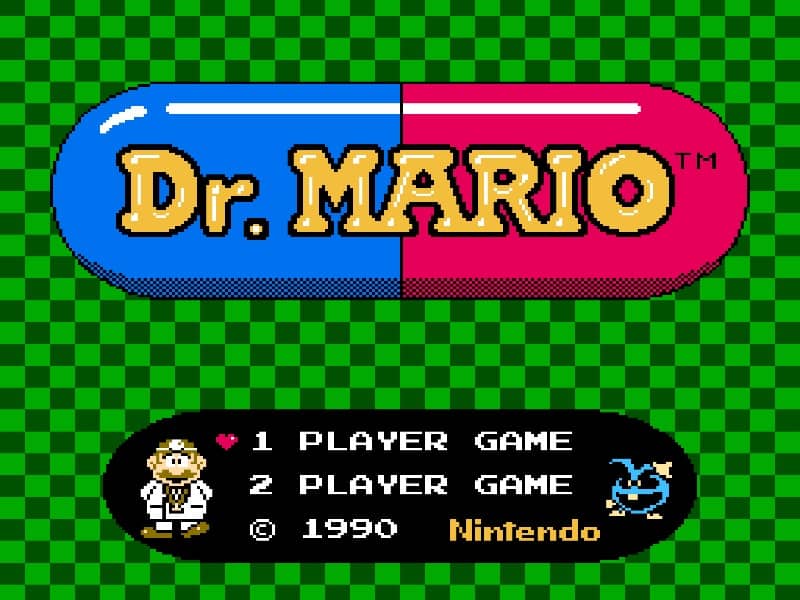
Dr. Mario was released for the Famicom in Japan on July 27, 1990, followed by the Game Boy version in October of the same year, and the North American version on June 27, 1991. As a spin-off in the Mario series, the game features Mario in a new role, trading his usual plumber attire for a white lab coat as a doctor. This concept was quite novel at the time, showing a different side of the character and expanding the series' thematic range.
At the time of its release, the puzzle game craze was in full swing, with Tetris taking the world by storm. Nintendo capitalized on this by releasing Dr. Mario, which quickly attracted a large audience thanks to Mario's popularity and its unique gameplay. The game was a commercial success, selling over ten million copies worldwide, with 5.34 million on Game Boy and 4.85 million on Famicom. In North America, it sold 2.5 million copies within six weeks, making it one of the best-selling games of its time.
Beyond the Famicom and Game Boy, the game was ported to arcade systems like the VS. System and PlayChoice-10, with the VS. version released in August 1990. These arcade versions allowed players to enjoy Dr. Mario in arcades, further expanding its reach. In 1994, the Famicom version was bundled with Tetris for the Super Famicom as Tetris & Dr. Mario, combining two classic puzzle games into one package, offering players more options.
In 1997, this Super Famicom version was distributed as Dr. Mario BS Version via Satellaview, Nintendo's satellite broadcast service for the Super Famicom, allowing players to download the game. This version added some new content while keeping the core gameplay intact. The game was re-released multiple times, including as part of the Classic NES Series on Game Boy Advance in 2004, and bundled with Puzzle League as Dr. Mario & Puzzle League in 2005.
In the digital era, the Famicom version was released on the Wii U Virtual Console in 2014 and became one of the launch titles for Nintendo Classics in 2018. The Game Boy version was released on the 3DS Virtual Console in 2011 and 2012, and joined Nintendo Classics on March 12, 2024. These re-releases have allowed a new generation of players to easily experience this classic, ensuring its enduring legacy.
Development
Dr. Mario was developed by Nintendo's Research & Development 1, with Gunpei Yokoi as producer, Takahiro Harada as programmer, and Hirokazu Tanaka as composer. Yokoi, a legendary figure at Nintendo who led the development of hardware like the Game Boy, emphasized simple and fun design, which is evident in Dr. Mario. Harada handled the programming, ensuring smooth gameplay, while Tanaka created the memorable soundtrack that added to the game's appeal.
The game's development was likely inspired by the popularity of Tetris, but Nintendo innovated by introducing color matching and virus elimination. The team integrated Mario into a medical theme, designing elements like capsules and viruses, which made the game stand out among puzzle games. Yokoi once expressed his desire to create a game that was easy to pick up but offered deep challenges, a philosophy that guided the development process.
The music, composed by Hirokazu Tanaka, who later became a renowned Nintendo composer, features upbeat electronic tunes that are simple yet catchy, perfectly matching the game's pace. One of the classic tracks was later remixed in the Super Smash Bros. series, becoming one of the iconic pieces of Mario music. Tanaka's soundtrack was also ranked seventh on IGN's list of the best 8-bit soundtracks, highlighting its quality.
During development, the team meticulously adjusted the game's balance, including parameters like capsule falling speed and virus count, to ensure players of all skill levels could find an appropriate challenge. The addition of the two-player versus mode was a deliberate effort to enhance interactivity. These details reflect Nintendo's commitment to quality, and they contributed to Dr. Mario's positive reception upon release.
It's worth noting that the team did not anticipate the game's enormous success, but thanks to Nintendo's brand and the game's inherent fun, it quickly became a classic. The core gameplay was carried forward in subsequent titles, with new elements added, but the essence of the original Dr. Mario has always been preserved, serving as the foundation of the series.
Reception and legacy
Dr. Mario received generally positive reviews upon release, though some parents criticized its 'drug' theme. Critics generally found it similar to Tetris but fun, and praised the two-player mode. Four reviewers from Famicom Tsūshin gave positive feedback, noting that the game found its own identity while borrowing from Tetris. The Game Boy version was well received by Joystick and Zero magazines, with the latter describing it as 'easy to learn but hard to master,' which is ideal for a puzzle game.
However, not all reviews were positive. ACE magazine criticized the graphics as bland and repetitive, and called it a 'rip-off' of Tetris. This criticism reflected the intense competition in the puzzle game market at the time, but many players and critics felt that Dr. Mario innovated on the formula rather than simply copying it. Allgame praised the Famicom version, saying it stood out among the flood of puzzle games, with a smooth learning curve, lively graphics, and memorable music.
The game's commercial success is undeniable, with global sales exceeding ten million copies, making it a classic puzzle game on the Famicom and Game Boy. Dr. Mario has also appeared on various best-of lists. Nintendo Power ranked it 134th on its list of the best games for Nintendo systems, IGN placed it 51st on its list of the best NES games, and GamesRadar ranked it 13th. These rankings attest to the game's standing among players and critics.
The game spawned several sequels and spin-offs, including Dr. Mario 64 for the Nintendo 64 and Dr. Mario Online Rx for WiiWare. These titles retained the core gameplay while adding new modes and elements, keeping the series alive. Additionally, the game was adapted into a microgame in the WarioWare series and a 'Virus Buster' mode in Brain Age 2, introducing the classic gameplay to even more players.
The music and characters of Dr. Mario have also left a lasting impression. The game's music has been remixed in the Super Smash Bros. series, and Dr. Mario appears as an unlockable character, becoming part of Nintendo's all-star roster. Despite Henk Rogers, founder of The Tetris Company, criticizing the game in 2018 as a 'poor imitation of Tetris,' there is no denying that Dr. Mario, with its unique theme and gameplay, has left a significant mark on gaming history.