Gameplay and design
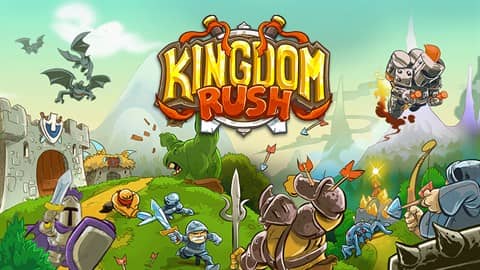
The core gameplay of Kingdom Rush revolves around building defensive towers along a predetermined path to stop enemies from reaching the end. Players command the king's general, Denas, and fend off waves of enemies in each level. Every enemy defeated earns gold, which can be used to purchase new towers or upgrade existing ones. The game offers four basic tower types: archers, mages, artillery, and barracks, each with unique attack styles and roles. Players must strategically combine them based on enemy types and terrain.
Each tower can be upgraded three times, and at the highest level, players choose between two special upgrades, creating branching paths. For example, archer towers can become Rangers or Snipers, while mage towers can become Arcane Wizards or Necromancers. This design allows players to adapt their strategy to the situation in each playthrough, adding replay value. Once a branch is chosen, it cannot be changed, so planning ahead is essential.
In addition to towers, players have a hero unit that can move freely, attack, and use unique abilities. Heroes provide extra firepower and can draw enemy fire, making them a crucial tactical element. Players also have two active skills: a meteor spell that damages an area and a reinforcement skill that summons two soldiers to assist. These skills have cooldowns, requiring careful timing in critical moments.
After completing a level, players earn stars based on performance, which can be used for permanent upgrades between levels, such as increasing tower starting levels, boosting gold income, or enhancing hero abilities. This progression system gives players a sense of improvement when replaying and encourages trying different strategies. The game features a variety of enemies, from common orcs to flying units, armored soldiers, and bosses, each with different weaknesses that require targeted tower placement.
The game includes multiple levels across different map regions, each with unique scenery and enemy compositions. Level design emphasizes pacing, starting with weaker enemies and gradually increasing difficulty while introducing new enemy types. Boss battles are the climax of each level, requiring players to utilize all resources. The game also offers multiple difficulty modes to cater to players of different skill levels. Overall, the depth and strategic nature of the gameplay are its core appeal.
Background and release
Kingdom Rush was initially released as a free Flash game on browser platforms on July 28, 2011, published by Armor Games. It quickly gained popularity, becoming a hit on Kongregate within days and attracting a large player base. The success of the Flash version laid the groundwork for future ports and expansions, bringing commercial success to Ironhide Studio.
After the Flash version's success, Ironhide made a deal with Armor Games to port the game to mobile devices. The iOS version was released on December 19, 2011, with programming by studio member Pablo Realini, taking four months to complete. The Android version followed on May 17, 2013, and the PC version (Windows and macOS) on January 6, 2014. These versions retained the core gameplay while optimizing for touch and mouse controls.
The game received continuous content updates after release. In March 2013, the "Winter Storm" update added a hard mode and two new levels. In October of the same year, the "Burning Torment" campaign introduced two new heroes, five enemy types, and a boss battle. In December, a free level called "Fungal Forest" was released. In January 2015, an expansion with four levels was added to the iOS version. These updates enriched the game and kept players engaged.
The success of Kingdom Rush also spawned sequels. The sequel Kingdom Rush: Frontiers was released on June 6, 2013, and received similar acclaim. The prequel Kingdom Rush: Origins came out on November 20, 2014, telling the story before the original. The fourth installment, Kingdom Rush: Vengeance, was released on November 22, 2018, where players take on the role of the villain Vez'nan. These games evolved the gameplay while maintaining the core mechanics.
Beyond the main sequels, Ironhide also released spin-offs. On June 11, 2021, the turn-based strategy game Legends of Kingdom Rush was launched. On July 25, 2024, the fifth installment, Kingdom Rush 5: Alliance, was released, set after Vengeance and Legends. On October 9, 2025, the multiplayer PvP spin-off Kingdom Rush: Battle was released globally. These titles expanded the series' universe and gameplay types, but the original remains the cornerstone of the series.
Development
Ironhide Game Studio was founded in Uruguay in 2010 by Álvaro Azofra, Pablo Realini, and Gonzalo Sande. All three founders were passionate about games and saw an opportunity in the tower defense genre, deciding to create their own title. The studio started with just six people, and despite the small team, everyone wore multiple hats, handling programming, art, and design almost entirely on their own.
The development of Kingdom Rush took six months. The inspiration came from popular tower defense games at the time and classic games the team played in their youth. The medieval fantasy theme was influenced by popular media and Dungeons & Dragons, as they wanted to create a world of magic and swordplay. The characters and enemies were designed with a sense of humor, which became a hallmark of Ironhide's later works.
During development, the team faced several challenges. Without external feedback, they had to rely on their own judgment to balance gameplay and mechanics. More difficult was the fact that funds and savings were running out, putting immense pressure on the team. Despite this, they persevered and completed the game, releasing it with almost no money left. This all-or-nothing determination ultimately paid off with the game's massive success.
The game was initially released as a free Flash game in partnership with publisher Armor Games. Armor Games handled distribution and promotion, while Ironhide focused on development. The Flash version was a huge success on Kongregate, attracting many players and generating revenue for the team. Subsequently, they made a deal with Armor Games to port the game to mobile, with the iOS version programmed by Realini over four months.
The mobile version was not a simple port; it was optimized for touch controls and included new content, such as additional levels and heroes. These changes made the mobile experience more polished and attracted more players. The experience Ironhide gained during development laid a solid foundation for future projects. They grew from a small team to a representative of Uruguay's game industry, but always maintained their independent development spirit.
Reception and legacy
Kingdom Rush received widespread acclaim from critics and players upon release. Metacritic shows the iOS version received "generally favorable reviews," with critics praising its graphics and tower upgrade system, considering it a standout in the tower defense genre. The game also earned high ratings on Kongregate, becoming one of the platform's most popular games. Many players were drawn to its beautiful visuals, strategic depth, and humor.
The game's difficulty also drew attention, but it was considered balanced and not frustrating. Critics noted that the game struck a good balance between challenge and accessibility, so even failure didn't feel discouraging but rather motivated players to try new strategies. This design made the game suitable for both casual players and hardcore tower defense enthusiasts, broadening its audience.
The success of Kingdom Rush had a lasting impact on Uruguay's game industry. It proved that a small team could produce a world-class game, inspiring local developers. Ironhide Studio became a benchmark in Uruguay's game industry, with subsequent releases further cementing its status. The game's success also attracted more investment and attention, fostering the growth of Uruguay's game ecosystem.
The sequels and spin-offs continued the original's success. Kingdom Rush: Frontiers and Origins both received favorable reviews, and the fourth installment, Vengeance, was also well-received. Spin-offs like Legends of Kingdom Rush and Kingdom Rush: Battle explored different gameplay genres. Together, these titles built a vast series, but the original is still regarded as a classic by players.
In the tower defense genre, Kingdom Rush holds an important place. It didn't invent the genre, but through its innovative tower upgrade branches, hero system, and skill design, it set a new standard. Many later tower defense games have drawn inspiration from its design. The game's influence persists to this day, with a Nintendo Switch release in 2020 and an Xbox release in 2023, allowing a new generation of players to experience this classic.