Gameplay and design
The core gameplay of Kirby's Dream Course is isometric mini-golf. Players control a round Kirby, who must be rolled toward the target hole by adjusting the power, angle, and spin of each shot, navigating through pinball-like three-dimensional courses. Each hole is filled with slopes, walls, chasms, and various traps, requiring players to calculate ricochets like in billiards to sink the ball in as few strokes as possible. This design gives the game both the strategy of golf and the immediate feedback of an action game.
In single-player mode, players must hit enemies on the course within a limited number of strokes. Each enemy hit yields a star, and the last enemy transforms into the hole. This setup turns the traditional putt into a 'hit enemies to collect stars' challenge, giving every shot a purpose. Enemies are not static; some move or attack, adding unpredictability. Players must weigh whether to go straight for enemies or use the terrain to reposition, making each hole a small puzzle.
The copy ability system is a standout feature. After hitting an enemy, Kirby can inhale its ability, gaining special skills like Tornado, Spark, or UFO. These abilities help clear obstacles and allow Kirby to move faster or along unusual trajectories, reducing stroke counts. For example, Tornado lets Kirby fly over chasms, Spark can break bricks, and UFO grants brief flight. Using abilities wisely can lead to surprising 'hole-in-ones,' which is part of the game's addictive appeal.
The game includes eight single-player courses, each with eight holes, with increasing difficulty. Completing courses earns medals, which can be used to unlock extra features like new game modes or hidden elements. This reward system encourages replay to achieve lower scores. Each course has a distinct theme, from lush grass to fiery volcanoes, with imaginative level design that keeps players engaged.
Multiplayer is another highlight. Two players take turns hitting the ball on the same course, competing to collect all stars and reach the hole first. The second player controls a yellow Kirby named Keeby, who later became a classic multiplayer color in the series. In multiplayer, players not only compete on skill but can also deliberately hit the ball into the opponent's path to interfere, adding a playful sabotage mechanic that makes matches lively and fun for parties.
Background and release
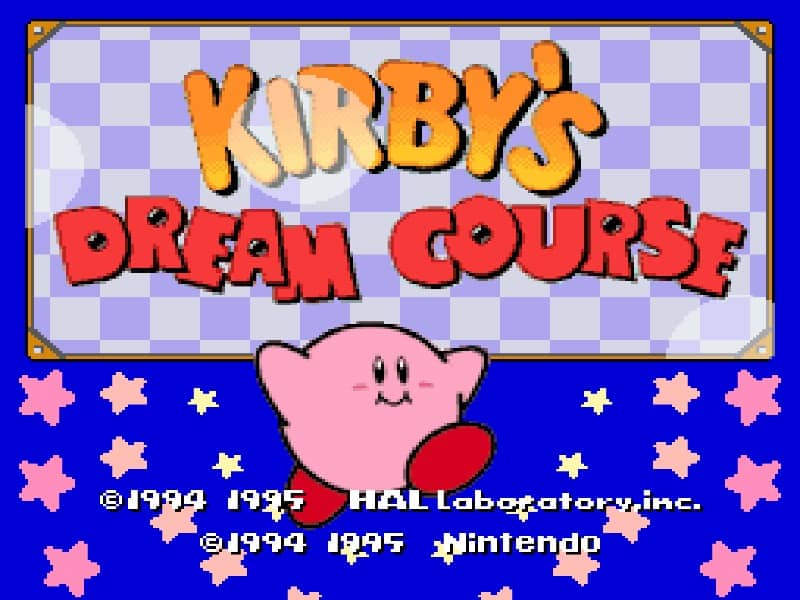
Kirby's Dream Course was released in Japan on September 21, 1994, under the name Kirby Bowl, and in North America on February 1, 1995, as Kirby's Dream Course, with a European release later that year. As the first Kirby game on the Super Nintendo, it broke from the platform-action formula, boldly adopting a golf-style action-puzzle design. This surprised many players at the time, but the innovation helped it stand out among sports games.
The story is simple: King Dedede has stolen the stars from the night sky, plunging the world into darkness. Kirby embarks on a golf-course-like adventure to reclaim the stars. Though the narrative is light, it provides a fitting motivation—each hole represents Kirby chasing down a star. The story lacks complexity, but combined with Kirby's cute appearance and cheerful music, it creates a fairy-tale atmosphere that brings a smile even during challenges.
Over the years, the game has been re-released multiple times. In 2007, it appeared on the Wii Virtual Console, allowing new players to experience it on a modern console. In 2013, it was released on the Wii U Virtual Console in Japan. Additionally, it was included in the Super NES Classic Edition mini-console in 2017, cementing its status as one of Nintendo's officially selected classics and proving its importance in the series.
Notably, the game is listed on the official Kirby series history page as a 1994 title, described as 'Kirby Bowl,' and the page indicates support for Switch Online, meaning players can play it on the Nintendo Switch via subscription. This ongoing official support has kept the game active across generations, reflecting Nintendo's appreciation for classic titles.
From the original SFC cartridge to Virtual Console and Switch Online, the game's distribution has evolved, but the core gameplay remains unchanged. This cross-platform strategy not only lets old players relive memories but also introduces new generations to this unique golf game. In many ways, the release history of Kirby's Dream Course is a microcosm of Nintendo's legacy of classic game preservation.
Development
The development of Kirby's Dream Course was quite winding. The game was initially designed by HAL Laboratory as a standalone game called Special Tee Shot, with no connection to Kirby. At the time, HAL wanted to create an action-puzzle game based on golf and had already developed the basic gameplay framework. However, during development, the Kirby series achieved great success on the Game Boy, and Nintendo and HAL realized that applying the golf gameplay to Kirby might be more popular, so the project was repositioned.
Special Tee Shot was previewed in magazines in 1992 and even appeared on console packaging, but the project was shelved. It wasn't until the success of the Kirby series convinced the team to repurpose it as a Kirby title. This transformation was not a simple reskin; it integrated Kirby's copy abilities, enemy designs, and other elements into the golf gameplay, turning the game from a standard sports title into an action-puzzle game full of Kirby charm. Without the success of the Kirby series, this unique game might never have existed.
The yellow Kirby, Keeby, originated from an amusing misunderstanding. It is said that Shigeru Miyamoto mistakenly thought Kirby was yellow, so the team designed the second player as a yellow Kirby, naming him 'Keeby,' a combination of the Japanese words for 'yellow' (kīro) and 'Kirby' (Kābī). This seemingly accidental choice later became a classic multiplayer color in the Kirby series, appearing in many subsequent games as a second player or special character, making it an iconic element.
The development team consisted of HAL Laboratory and Nintendo EAD, with senior Nintendo producers involved to ensure quality. During development, the team fully utilized the SFC's hardware capabilities to achieve smooth isometric graphics and rich colors. The copy abilities, such as Tornado, Spark, and UFO, were tailored for the golf gameplay, preserving the series' ability traits while adapting to the shot mechanics. This design ingenuity reflects the team's dedication.
In 1995, Nintendo and HAL began developing a Nintendo 64 sequel, Kirby Ball 64 (also known as Kirby Bowl 64), planning to use the N64's analog stick for more precise movement and Gouraud shading for improved visuals. However, the sequel was ultimately canceled and never released. Some concepts were later used in Kirby Air Ride, allowing players to see these ideas continue in another game. Although the sequel never materialized, its legacy did not disappear, a common mix of regret and inheritance in game development.
Reception and legacy
Kirby's Dream Course received positive reviews from media and players upon release. Critics praised its unique design and absurdity, noting it broke sports game conventions. For instance, Scary Larry of GamePro called it as polished and fun as early Kirby games, while Next Generation and Electronic Gaming Monthly also lauded its unique gameplay. However, some reviews pointed out the high difficulty and the learning curve for controls, but this did not prevent it from becoming a beloved title.
In retrospective reviews, the game still enjoys high esteem. Nintendo Life compared it to the classic game Zany Golf, and IGN's Lucas M. Thomas considered its concept incomparable. IGN also ranked it 38th on its list of the 'Top 100 SNES Games,' a testament to its standing among SFC titles. USgamer's Nadia Oxford praised its unconventional level design and comedic presentation, calling it a cute and fun game on the SNES Classic. These reviews highlight the game's special place in players' hearts.
The game's influence on the series is profound. The yellow Kirby, Keeby, became a common element in multiplayer modes, appearing in later titles such as Kirby's Buffet, where the yellow Kirby is named 'Keeby Yellow,' directly referencing this game. This continuity in character design gives old players a sense of familiarity when playing new entries, underscoring the game's pioneering significance.
As the first Kirby game on the SFC, this title proved that Kirby could not only jump and inhale but also play golf. Its success paved the way for future spin-offs, encouraging Nintendo to experiment with non-traditional gameplay. Although the N64 sequel was canceled, the game remains a classic, included in the Super NES Classic Edition and listed as playable on the official history page, a fitting recognition of its historical importance.
In summary, Kirby's Dream Course is a classic proven by time. It may not be the most mainstream Kirby game, but its uniqueness and fun make it stand out among golf games. Whether players first experienced it on the SFC or discovered it through Virtual Console or Switch Online, they can feel the pure joy it offers. Like a star stolen by King Dedede, the game has weathered challenges but continues to shine in the sky of gaming history.